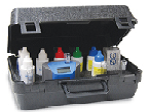
| |
|
Scroll
down to browse through some archived SPA and Hot Tub
questions and answers. Please click the Spa
Problems
Link, on top of every page, to access a complete listing
of Spa and Hot Tub Problem subjects, an alphabetized
Website Table of Contents, Spa and Hot Tub Equipment
Information, About Alan Biographic Material and a Spa
and Hot Tub Glossary. Use
the other links to access additional subject
information. More information about some new and unique
products, for Spas and Hot Tubs, can be found by visiting
The Website Store.
You'll never know what you'll find and that's always
fun. Be better prepared and avoid costly problems!
|
|
 |
Shipping is FREE* . . . within
the Continental U.S.
A $9.99
handling charge will apply
to Continental U.S. Orders,
under $75.00. Orders
outside of the Continental
U.S. may require some
additional charge, based on
quantity and destination.
Most products can be
shipped World-Wide. International
and orders outside of
Continental U.S. - see
comments on the ordering
pages. |
|
 |

Major
Credit Cards and PayPal are accepted. |
|
On-line
shopping since 2002 - Safe and Secure!!! |
|
Managing the use of Biguanide, in spa,
swim-spa or hot tub
water!!! |
|
Biguanide (PHMB) is the generic name of
some of the more popular non-chlorine,
non-bromine chemical sanitizers used in
spas: products such as Baquacil,
Soft-Swim and Revacil. While it is
a popular alternative to traditional
chlorine sanitizers, it does have a host
of shortcomings. Conversion
requires the addition of chlorine or
draining.
Sanitizing
is a must, for proper spa water
management.
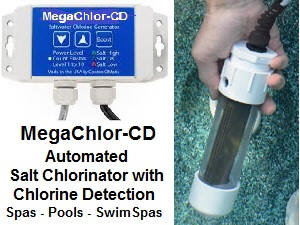
Salt Chlorine generators are a
better way to utilize chlorine, producing
more controllable results. They
eliminate the need to handle, measure or
store chlorine products, while reducing
buildup problems. An
Electronic
PockeTester Kit is a convenient
way to monitor the salt level. |
|
|
|
How to sanitize a spa or swim spa without
chlorine? |
Biguanide
(PHMB) is the generic name of some of the more
popular non-chlorine, non-bromine chemical
sanitizers: products such as Baquacil,
Baqua-Spa, Soft-Swim and Revacil. The main
advantage is that no chlorine or bromine is
required and there is little chemical odor.
However, it does cause foaming, which can
interfere with proper and complete sanitizing.
To truly sanitize a spa or hot tub, all foam
much be eliminated, at least daily. Biguanide is
an effective bactericide and can replace
chlorine or bromine in that function. However,
chlorine or bromine are also oxidizing agents
that can destroy organic contamination:
biguanide cannot destroy organic contamination
and, therefore, concentrated hydrogen peroxide
must be added to the spa or hot tub on a regular
basis. A disadvantage of biguanide is the
development of biguanide-resistant
micro-organisms, after several years of product
usage. This usually takes the form of a pink
slime or water mold and the only recommended
treatment is the application of large amounts of
chlorine and/or non-chlorine shock. This
treatment destroys all of the biguanide present
in the water. Restoration of the biguanide
regimen can risk a return of the problem and,
therefore, a permanent switch to chlorine or an
alternative form of sanitation should be
considered. The trick is in understanding that
recurring water quality issues are a clear
indication, that a switch to an
alternative
spa sanitizer is required, and not be talked into
staying, with what could become an expensive
course. If problems arise, refer to the
Spa Problems
Page, as a source of problem-solving
information, broken down into various
categories. Scroll down the page and click on the linked
keywords,
catch phrases
or images, in the archived answers below, to access additional information, on that topic or product.
Do you know what's in
your water? If you're having problems, with
sanitation or water clarity, testing allows you to better
understand the chemistry and determine the cause of the
problem. Once understood, you can select the best
treatment option. Understanding the nature of the
problem, should be step one. For information about
our full selection of testing options, visit our
Test Equipment Store.
 |
Join our E-Letter Mailing List.
You'll receive 1-3 E-Letters a
month, featuring helpful pool
and spa advice, new product
information and sale
announcements. All we
require is your e-mail address
and you can opt out anytime you
wish.
Your information
will never be shared or sold. |
|
▼
Helpful,
Problem-Solving Information, in a question and
answer format.
▼ |
► Biguanide
Testing Made Easy?
I use biguanide, for the spa, and test
using
test strips. For some reason I find the results hard to
read. Especially pH always appears high, but when I have had
the water tested at the spa dealer it appears to be in the
correct range. Is there another test strip or kit I can use
for the biguanide system that will test pH, TA, Hardness,
Sanitizer? I have had problem with calcium and high pH that
resulted the circulation pump going bad. Thanks for your
assistance
Dave, 1/7/2018
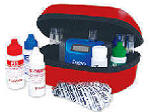
The test strips are convenient, but some people may have
trouble reading the colors. For a better testing option
consider using the
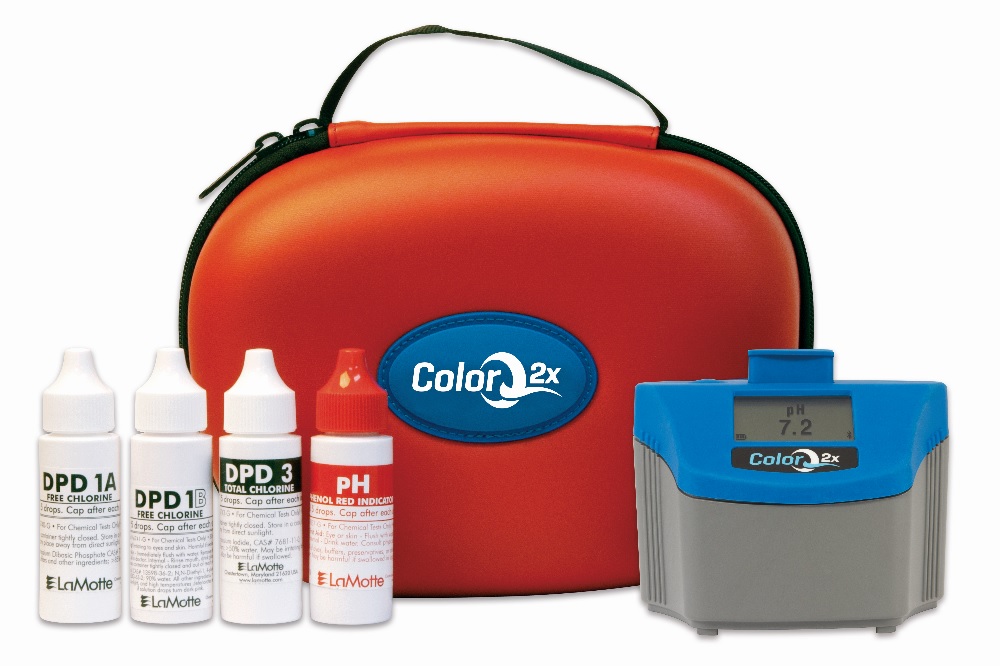
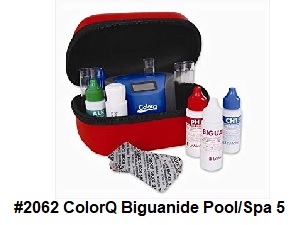
ColorQ
Biguanide Pool/Spa 5 Water Analyzer. It
is hand-held, all-digital and requires no color matching or
look-up charts. It is quite reasonably priced and
easy-to-use. In addition to testing for biguanide, it tests
the pH. total alkalinity, calcium hardness and Biguanide
Shock levels. It's the perfect tester, for those with any
color vision impairment! I hope that this information will
prove helpful.
Sincerely. Alan Schuster, 1/7/2018
► Switching To
Biguanide?
My wife seems to be sensitive to
chlorine. I've tried bromine and that seems to be no better.
Could biguanide make enough of a difference? Please advise.
H. S., 1/23/2017
Biguanide is an alternative to chlorine and bromine. It is
based on a totally different chemistry. Actually, with
biguanide you will not be able to use any chlorine or
bromine - even for shocking purposes. A spa on biguanide can
only use concentrated hydrogen peroxide for shocking
purposes. In your
situation, biguanide is worth
considering. I suggest that the spa
be emptied completely and cleaned
before starting on biguanide or
another alternative spa sanitizer.
There are some other alternatives to
chlorine and bromine to consider:
products such as mineral sanitizers or
ozone generators or a
combination. Look through the archives, on these topics, for
more information. Good luck.
Sincerely. Alan Schuster, 1/23/2017
► Mold In A
Spa?
I have been told that my spa has a
water mold in it. I have been using biguanide with good
results, until recently. How should I handle the problem?
Sam A., Columbia, MD, 9/14/2016

Water mold is caused by a microorganism that has,
unfortunately, become resistant to the biguanide. In order
to treat the problem, I suggest that you drain the spa and
refill with fresh water. Add some quick-dissolving chlorine
or non-chlorine shock and make sure that at least a 1-3 PPM
level of Free Chlorine persists overnight. Add more shock,
as necessary. This will destroy the water mold on the
surfaces and in the lines. Resuming maintenance on biguanide
will require that you once again drain the spa, refill and
start from scratch. Once a biguanide-resistant microorganism
has developed there is no guarantee that it will not return,
even after successful treatment. For this reason, I suggest
that an alternative sanitizer be considered: chlorine,
bromine. salt chlorine generators,
ozone generators,
mineral
sanitizers,
ultraviolet sanitizers or a combination
or products.
Otherwise, you just might get the problem back, in spite of
your best efforts. I hope that I have been helpful. Good
luck.
Sincerely. Alan Schuster, 9/14/2016
► Spa
Sanitizer Sensitivity?
I am having a problem with my hot tub.
I have just switched over to biguanide as my sanitizer, as
my wife has developed a reaction to chlorine and bromine.
I cleaned and fill my tub 5 days ago and have a high pH
reading. I have been adding a granular pH reducer ever few
hours for 3 days and can not get the pH down. I am also
getting a reddish brown scum around the tub. This scum is
very sticky to touch and hard to remove. Can you give me
some help. My tub is located indoors. Is this a factor?
Thank You.
Don G., Ontario, Canada, 8/12/2017
There have been some reports of problems with some brands of
test strips. I suggest that you have the pH verified by a
local spa dealer. There is no reason
that the pH should be unable to be
lowered. The
LaMotte Insta-Test Strips or
ColorQ all-digital testers do
not seem to have any problems
testing the pH in a biguanide
sanitized spa. The reddish deposits
could be iron. Have the source water
tested. If may be necessary to treat
the water. The problem may disappear
if the pH is lowered. The reddish
deposits are very likely to be a
bacterial slime, due to inadequate
sanitation. Check the sanitizer
level. Adding shock may be
necessary. Biguanide is a reasonable
chlorine/bromine alternative for
sensitive people. However, long term
use may cause sanitizer-resistant
microorganisms to develop, requiring
a switch. You might consider using
an ozonator and a mineral sanitizer.
It will be close to chlorine free
sanitizing, but better results
probably require small additions of
chlorine and/or non-chlorine shock. Good luck and I hope that
this information proves helpful.
Sincerely. Alan Schuster, 8/12/2017
► What Is
Biguanide?
What is biguanide sanitizing that you
mentioned? You suggested against it, but I've never heard of
it. I've been using chlorine, but considered switching to
bromine. It sounds like you prefer bromine. I've been adding
a lot of chlorine, much more than the dealer said I should
have to add. I test the water every couple days and need to
add chlorine. A friend has a very old hot tub and adds
chlorine once a week.
Wondering, 3/30/2005
Biguanide is an alternative
sanitizer, based on a chemical other
than chlorine or bromine. It is
based on the polymer
PHMB (polyhexamethylene biguanide) and can be useful for
people with chlorine or bromine sensitivities, but is,
otherwise, not something that I would suggest: cost factor,
tendency to foam and possible development of resistant
microorganisms. I do prefer bromine over traditional types
of chlorine: less odor and less
irritation potential. How much
chlorine a spa will require is more
directly related to how the unit is
being used, than by its size or age.
If you are looking to improve your
spa sanitation and simplify
maintenance, I suggest that you
consider adding a
salt chlorine generator.
It is the better way to do chlorine.
We offer several models and 2 of
them have chlorine detection
technology, which means they only
produce chlorine, when it is
actually needed. In general,
salt chlorine generators avoid some
of the negative properties, of
chlorine usage, and provide better
control and results. I hope that this information proves helpful.
Sincerely. Alan Schuster, 3/30/2005
► Milky White
Spa Water?
OK - I haven't seen this one before. I
just bought a new house with a 300 gallon spa. The
owner drained and refilled the tub just before we moved in.
The water tested OK and looked beautiful. My wife and I
climbed in, turned on the jets and everything was just fine.
Then I turned on the blowers and everything turned milky
white. I have shocked and waited, but no improvement. After
this the water still looks great when only the filter or
jets are running, but as soon as you hit the blowers, it
happens again. Any help is appreciated. Oh yeah - biguanide
chemicals in the water.
Steve C., Jacksonville, FL, 4/12/2009
Two possibilities. The blower lines are coated with a
biofilm (mold, bacteria, etc) and some of it is loosened
when the blower is turned on. The other
possibility involves the biguanide
itself: this material has a tendency
to foam and the blowers may be
creating zillions of micro-bubbles
that cloud the water. To deal with
the biofilm, you will need to shock
with hydrogen peroxide and let the
blowers operate to clean the lines.
So far as the foaming due to the
biguanide is concerned, you may be
able to control it by the addition
of an antifoam. If none of this
works, it is possible that you have
a water mold problem that has become
resistant to the sanitizer. Such
problems are not uncommon with
biguanide. If that is the case, you
will have to switch from biguanide
to another sanitizing method. My
suggestion would be to use an
ozonator and a mineral sanitizer
with bromine or a salt chlorine
generator. I have no doubt, that you
will be happy with either method. I hope that this will
clear things up.
Sincerely. Alan Schuster, 4/13/2009
►
Not Wanting To Continue With
Biguanide?
Dear Alan, I could not find this
question addressed anywhere, so here goes. We bought a spa 6
mo. ago and it arrived with a Biguanide Spa start-up kit.
Our spa has an ozonator and we have used the chemicals with
relative success. However, they are pricey. We heard from a
spa salesperson that simply dropping a bromine tablet into
the filter area once a week. That sounds too simplistic to
me. I know that there are pH levels that need checked and
maintained and also shock treatments that he never
mentioned. What do you recommend I use?
Mary S., Fremont CA, 1/21/2009
What to do? Bromine, Chlorine or Non-Chlorine Shock can
never be used with biguanide. Drain the spa and refill and
don't add anymor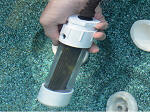 e biguanide. If your ozonator is working
properly, you should be able to get by quite easily with
just adding some bromine. To use bromine, you need to get
rid of the remaining biguanide.
I suggest that you consider adding a
salt chlorine generator, which
is a complete sanitizing system.
It is the better way to
do chlorine. We offer several
models and 2 of them have chlorine
detection technology, which means
they only produce chlorine, when it
is actually needed. You could
start by draining and cleaning the
spa, which is something that should
be done every 3-4 months, in any
event. This way you start off
with a clean slate. An ozonator will allow you to use
less chemicals to maintain a satisfactory bromine level: 2-3
PPM should suffice, as compared to 3-5 ppm without the
ozonator. However, you will still have to maintain the pH,
total alkalinity and calcium hardness. The good news is that
because you are adding fewer chemicals, the water balancing
should be easier. Don't drop the bromine tablet in the
skimmer, as it might add to the possibility of heater
corrosion. Use a floating dispenser. I hope that I have
helped. e biguanide. If your ozonator is working
properly, you should be able to get by quite easily with
just adding some bromine. To use bromine, you need to get
rid of the remaining biguanide.
I suggest that you consider adding a
salt chlorine generator, which
is a complete sanitizing system.
It is the better way to
do chlorine. We offer several
models and 2 of them have chlorine
detection technology, which means
they only produce chlorine, when it
is actually needed. You could
start by draining and cleaning the
spa, which is something that should
be done every 3-4 months, in any
event. This way you start off
with a clean slate. An ozonator will allow you to use
less chemicals to maintain a satisfactory bromine level: 2-3
PPM should suffice, as compared to 3-5 ppm without the
ozonator. However, you will still have to maintain the pH,
total alkalinity and calcium hardness. The good news is that
because you are adding fewer chemicals, the water balancing
should be easier. Don't drop the bromine tablet in the
skimmer, as it might add to the possibility of heater
corrosion. Use a floating dispenser. I hope that I have
helped.
Sincerely. Alan Schuster, 1/21/2009
► Switching
From Biguanide?
I would like to stop using biguanide
and switch to an Ozonator and an Ionizer. I want to use as
few chemicals as possible. Is there anything that I should
do before switching over? Thank you.
The Kelly Family, NJ, 3/22/2011
Spa water has to be replaced on a regular basis, so you
might as well start there. That way you start with a clean
page and avoid the chemical buildups, that may have
previously occurred. Thereafter, the spa water should be
changed on a regular basis depending upon your usage
patterns or at the first signs of a loss of optimum water
quality. In any event, not more than 3-4 months is recommended
without a water change. Enjoy the spa.
Sincerely. Alan Schuster, 3/23/2011
► Cloudy Spa
Water And Water Mold?
Alan, about 3 years ago we bought and
had installed a spa (435 gallons) on our screened in porch.
We first used bromine as a sanitizer, but due to the drying
effect on our skin we switched to biguanide. This was done
about 2 years ago. About 8 months ago we developed a problem
with what we believed to be white water mold. We used a
sodium bromide and thought we had it cleaned up. We also
started using another product on a weekly basis to try to
keep it cleaned up, but it came back. About a week before
Christmas my chemical supplier recommended that the spa be
drained, refilled and a strong chlorine shock be added and
allowed to remain in the spa for 24 hours. This was done. We
were to then drain, clean and refill with fresh water. This
was done. After 48 hours we added the appropriate amounts of
the chemicals used in the biguanide system. The pH was
adjusted to 7.5, TA was @100, calcium hardness was 250, and
sanitizer was at 50. In less than a week the water was
looking very hazy and we could not see the bottom in the
spa. The spa was used once during this time. I again drained
an cleaned the spa. Again, everything was brought up to
specs. This water was clear as a bell on Dec. 31. It was
used Dec. 31 and again on Jan. 1 and the water was
absolutely milky looking on Jan. 2, and has gotten even
worse as of today, Jan.4. I have added shock and clarifier
which made no difference at all. I have no idea what else to
try. I am thinking about going back to bromine. I understand
that the biguanide people have a new bromine system out
there that is not as rough on the skin. Maybe I should give
that a try. Do you have any ideas on this one? Thank you.
Gary J., Chatsworth, GA, 1/3/2008
The water mold and the resultant cloudiness are the result
of the formation of a biguanide-resistant microorganisms.
The cleaning and treating with chlorine are only temporary:
it is resistant to biguanide and will, in all likelihood,
return quickly. I suggest that you permanently switch from
biguanide to another sanitizer. To reduce the chemical
effects of bromine you should add an ozonator, as this will
allow you to maintain proper conditions with much lower
bromine levels. To almost completely eliminate bromine, you could
use an ozonator and with a mineral sanitizer.
A very low level still is suggested, for best results. Another
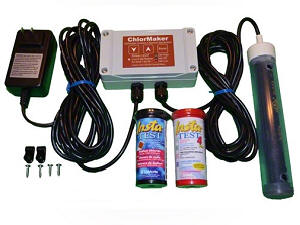
convenient option would be a
salt chlorine generator. In any
event, it is time to move past biguanide. I hope that I have
been helpful.
Sincerely. Alan Schuster, 1/4/2008
► Biguanide
And Ozone?
We recently switched to biguanide and
an ozonator in our spa as my wife has developed a rather
severe sensitivity to the shock used for chlorine and
bromine. The rash problems have disappeared and we are back
to enjoying the hot tub - very timely, as it's been -30 to
-45 here for the past week. However, after about three weeks
of use, the water has taken on a yellowish tint. The water
is crystal clear, but a slight yellowish in color. We've
tested the water for pH, alkalinity, hardness, and sanitizer
level using test strips and liquid kit testers. As well, we
took a sample into the spa dealer for water quality testing.
All readings are normal and within the ranges recommended by
both the spa and biguanide manufacturers. Mineral tests on
the water showed no iron or copper in the water. No one
could definitively identify the source of the problem. When
we reported the sanitizer (biguanide) level of 30-50 to the
spa staff, they recommended that we reduce the amount of
biguanide we are adding to about half of the recommended
dose. We did follow this practice when we were using
chlorine and bromine sanitizers. However, the biguanide
manufacturer does not recommend this procedure. Bottom line,
Alan - can we reduce the amount of biguanide in the hot tub
and will that affect the water color? Any help you can
provide is greatly appreciated. Thanks.
Murray, 2/1/2014
There are a few things that are not clear. While using
biguanide, did you add chlorine or bromine? Ordinarily a
yellow color is indicative of iron. Did you use well water?
Even though the test showed no iron, it is still possible
that iron is present, but that the test is being interfered
with by a chemical present in the water. I suggest that you
have the source water tested for iron. Get back to me with
this information and I'll have more to relay to you. The
yellow color could be indicative of decomposition of the
biguanide.
Sincerely. Alan Schuster, 2/1/2014
To clarify, we used only the products
recommended by the biguanide manufacturer. No chlorine or
bromine, or any other chemicals added. The only thing we
have put in the water (besides ourselves) has been biguanide
sanitizer, shock and waterline control - and only the
recommended amounts at the recommended times. We had had a
slight rise in the pH readings for the first two weeks that
we controlled by adding about 15 g of pH down every 4 or 5
days, but this problem now seems to be under control. We are
using municipal water that has been tested and shows no iron
or copper, alkalinity of 110 ppm, hardness of 100 and pH of
7.3 - with the exception of hardness, all within acceptable
range. When we had the spa water tested by the spa
manufacturer, their computer program came back with "yellow
color caused by yellow or mustard algae" and recommended the
addition of an algaecide. We talked about this possibility
and didn't think it sounded reasonable, as it is the dead of
winter here and nothing is growing. Again, any help you can
offer is greatly appreciated. Thanks again.
Murray, 2/3/2014
You definitely don't have mustard algae. It shows up as a
powdery deposit on the walls and bottom. If the shock that
you are using is anything other than hydrogen peroxide, such
as chlorine or non-chlorine shock, it could account for the
problem. The use of an ozonator and biguanide is not common
and may be part of the cause of the problem. When biguanide
is oxidized, it forms colored decomposition products. This
may or may not be the case. At the very least, the biguanide
will add to the foam level and possibly interfere with the
venturi effect, by which ozone is added to the spa. My
recommendation would be for you to empty and clean the spa
thoroughly, removing as much water as possible. Upon
refilling, I would stop the use of biguanide. Because you
want to avoid chlorine and bromine, I would strongly
recommend that you use a mineral sanitizer, in conjunction
with the ozonator. This will provide complete sanitation,
without chlorine or bromine, on a
regular basis. Occasional shocking with chlorine is
suggested, as is the maintaining of a very low free chlorine
level. You not use non-chlorine shock (MPS), when
required, because I have had anecdotal reports of rashes,
due to excessive usage of the
potassium monopersulfate shock. This
might have been the problem, from
the start. Many biguanide users find themselves forced
to switch after a few years because of the development of
biguanide-resistant microorganisms. I hope that this
information will prove helpful.
Sincerely. Alan Schuster, 2/3/2014
► Bromine
Alternative?
I have an allergy to bromine in our
hot tub and the chemical biguanide has been suggested as an
alternative spa sanitizer. Can you tell me what this
chemical is? Thank you.
S.E.B, 11/17/2017
The active chemical is a polymer called biguanide:
abbreviated PHMB. This material is incompatible with
chlorine or bromine and is a popular alternative to these
sanitizers. While it does function as a spa water sanitizer,
it cannot perform the necessary oxidizing action that is
needed to destroy organic wastes and accumulations. For this
purpose liquid hydrogen peroxide is used. For someone
sensitive to bromine this is a reasonable alternative.
Another viable alternative spa water sanitizing method would
be the use of a
salt chlorine generator, which
is the better way to do chlorine.
Bromine tablets contain a chemical
called dimethyl hydantoin, which is
not present in chlorinated pools or
spas. That being said, the
allergy may have been due to the
dimethyl hydantoin and not to
chlorine or bromine. Unless
you went into a bromine pool or spa,
you would never have encountered
this chemical. I hope that this information proves
helpful.
Sincerely. Alan Schuster, 11/17/2017
► Biguanide
and Ozone?
My spa was supplied with an Ozonator
already installed. I currently use some bromine to act as a
back up. Would it be possible to stop the bromine and start
using biguanide as a back up? I think that my wife is
sensitive to bromine and chlorine. Thank you.
Marc P., 2/3/2008
Yes, you can use biguanide and ozone
based on a leading biguanide
manufacturer's recommendations. I
suggest that you start by draining
and cleaning the spa. That way
you'll get rid of all of the bromide
salts and start off with a clean
slate. You should maintain the
typical level of
biguanide, because the ozone, being produced, quickly leaves
the water. Follow the directions on
the label and test daily, until you get a
handle on how much biguanide you need to add periodically.
Biguanide has a tendency to foam and that could interfere
with the venturi (vacuum siphon tube) effect, by which ozone
is added to the water. There is another possibility that you
might want to consider. Why not use a
Mineral Sanitizer
with your ozonator, instead of biguanide? If sensitivity to chemicals is a
consideration, this makes a lot of practical sense. Browse
through the archives for more on the topic. Good luck and I
hope that I have been helpful.
Sincerely. Alan Schuster, 2/3/2008
|
Visit The Website Stores . . . for
better informed shopping!!! |
|
|
Shipping is FREE* . . . within
the Continental U.S.
A $9.99
handling charge will apply
to Continental U.S. Orders,
under $75.00. Orders
outside of the Continental
U.S. may require some
additional charge, based on
quantity and destination.
Most products can be
shipped World-Wide. International
and orders outside of
Continental U.S. - see
comments on the ordering
pages. |
|
|
Major
Credit Cards and PayPal are accepted. |
|
▲
Return To Top Of Page
▲
Aqualab Systems, LLC does not
make any warranty or
representation, either expressed
or implied, regarding the
accuracy or completeness of the
information provided by this
website; nor does Aqualab
Systems., LLC. assume any
liability of any kind whatsoever
related to, or resulting from,
any use or reliance on this
information. The content of this
website should not be used, if
it is conflict with any
applicable federal, state or
local regulations or guidelines.
© Aqualab Systems, LLC. All
rights reserved
|
|