| |
|
Scroll
down to browse through some archived SPA and Hot Tub
questions and answers. Please click the Spa
Problems
Link, on top of every page, to access a complete listing
of Spa and Hot Tub Problem subjects, an alphabetized
Website Table of Contents, Spa and Hot Tub Equipment
Information, About Alan Biographic Material and a Spa
and Hot Tub Glossary. Use
the other links to access additional subject
information. More information about some new and unique
products, for Spas and Hot Tubs, can be found by visiting
The Website Store.
You'll never know what you'll find and that's always
fun. Be better prepared and avoid costly problems!
|
|
 |
Shipping is FREE* . . . within
the Continental U.S.
A $9.99
handling charge will apply
to Continental U.S. Orders,
under $75.00. Orders
outside of the Continental
U.S. may require some
additional charge, based on
quantity and destination.
Most products can be
shipped World-Wide. International
and orders outside of
Continental U.S. - see
comments on the ordering
pages. |
|
 |

Major
Credit Cards and PayPal are accepted. |
|
On-line
shopping since 2002 - Safe and Secure!!! |
|
Using an Ultraviolet spa or swim-spa
water sterilizer!!! |
|
An
ultraviolet (UV) Sterilizer uses UV rays
to kill virtually everything passing
through the cell. However, it has
no residual effect on water in the spa
or swim-spa.
Although it does reduce algae and
bacterial populations, it must be used
to augment a traditional pool sanitizing
system and cannot be used alone.
Typically, it is used with chlorine,
salt chlorine generators or bromine.
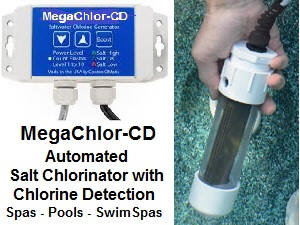
Salt Chlorine generators are a
better way to utilize chlorine, producing
more controllable results. They
eliminate the need to handle, measure or
store chlorine products, while reducing
buildup problems. An
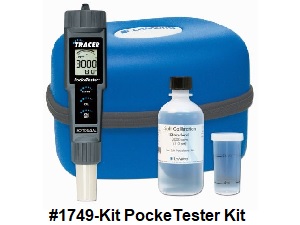
Electronic
PockeTester Kit is a convenient
way to monitor the salt level. |
|
Salt Chlorine Generators - 4
Models |
Testing The Salt Level |
Salt Chlorine Generators - 4
Models |
 |
 |
 |
|
Product and Ordering Information |
Product and Ordering Information |
Product and Ordering Information |
If you have a pool or spa water testing
need, we should have the product.
►
Scroll down to read through some
Question & Answer information.
◄
|
|
A
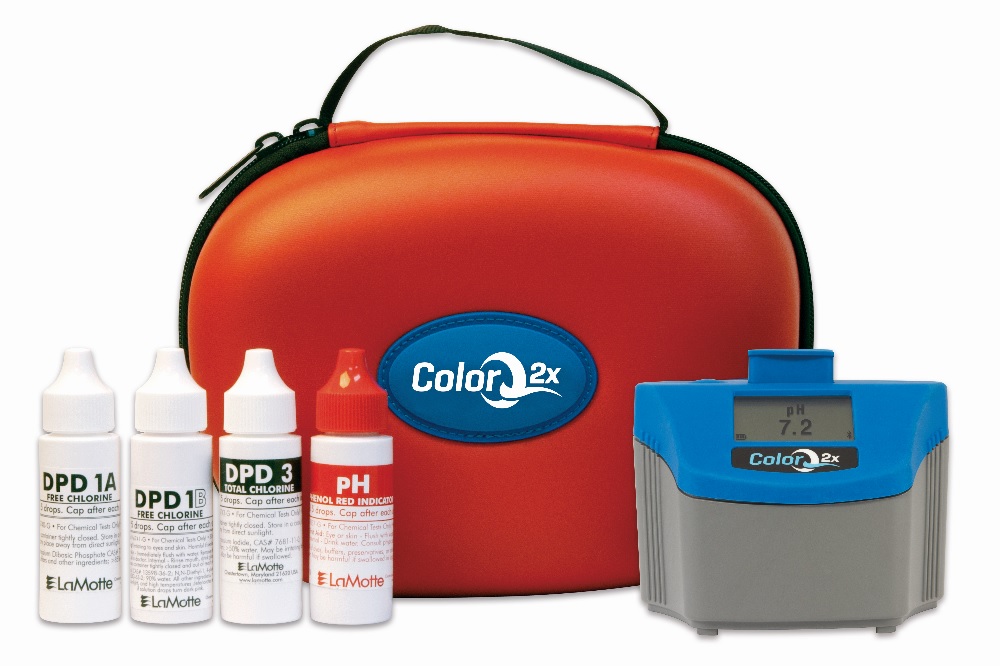
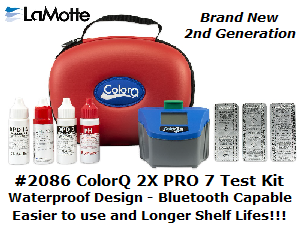
ColorQ 2X is a 2nd generation,
Bluetooth, Waterproof, all-digital tester,
that can
measure all the common test factors. There is a model, for every sanitizing
need.
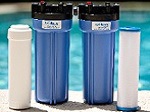
A
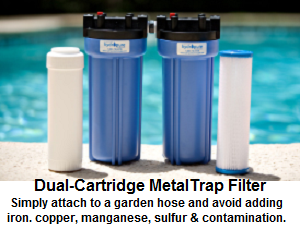
MetalTrap
Dual-Cartridge Filter
can help you avoid common
problems, caused by the presence
of dissolved metal and
sediments. The
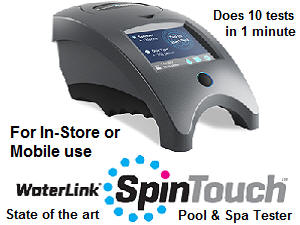
WaterLink SpinTouch Labs
are the ultimate tester, doing
up to 10 different water test
factors, in just 1 minute.
Voted product of the year. |
|
ColorQ All-Digital Water Testers |
Pre-Treatment System removes
metals |
WaterLink SpinTouch Labs |
 |
 |
 |
|
The ColorQ 2X line of all-digital
testers which are Bluetooth and
Waterproof, use a photometer to
test and measure combinations of
up to 11 different pool and spa
water parameters, including Free
and Total Chlorine, Bromine, pH,
Total Alkalinity, Calcium
Hardness, Cyanuric Acid, Iron,
Copper, Biguanide and Biguanide
Shock. Simple and easy to use,
with models for every need,
whether for home or professional
use. Instructions are
diagrammatic and trilingual. The
individual testers use
either liquid or tablet
reagents. Better control
of the water chemistry helps
control all aspects of pool or
spa water quality and
sanitation. |
If your water
source contains dissolved metals, as
well as suspended sediments, the
METALTRAP Dual-Cartridge Filter would be
a better choice. It features
a washable, reusable 5-micron sediment
filter and replaceable MetalTrap Filter cartridges, for greater
economy. The first, washable,
reusable, 5-micron filter cartridge
removes sediments, which might,
otherwise, clog the second MetalTrap
cartridge, intended to remove dissolved
heavy metals. The MetalTrap
Dual-Cartridge Filter is a real
must-have product, when an auto-filler
is being used. Available in three
sizes, that will suit a variety
of pool and spa sizes. |
The WaterLink SpinTouch Lab are
the most advanced testers ever
introduced, in the pool and spa
industry. They are the result of
7 years of R & D. Using a single
3-ml sample of water, you can
perform up to 10 different
tests, in just one minute, with
the press of a button. Tests
include: Free and Total
Chlorine, Bromine, pH, Total
Alkalinity, Calcium Hardness,
Cyanuric Acid, Iron, Copper,
Biguanide, Biguanide Shock,
Borates, Phosphates and Salt.
Four models for In-Store,
Mobile, Commercial or Drinking
water use. Read test results on
the TouchScreen, send them to a
computer, a tablet or to the
Cloud. So Easy!!! So fast!!! So
Precise!!! |
|
Product and Ordering Information |
Product and Ordering Information |
Product and Ordering Information |
If you have a pool or spa water testing
need, we should have the product.
►
Scroll down to read through some
Question & Answer information.
◄
|
|
|
How to use ultraviolet (UV), as part of
alternative spa sanitizing? |
UltraViolet
(UV) light can be used as an alternative
sanitizing method to very effectively destroy
microorganisms in spa or hot tub water. Up to
99.9% of the microorganisms can be destroyed, as
the water passes through the UV unit. This
dramatic reduction, in the microbial
populations, helps to better maintain proper,
sanitary spa water conditions: reducing the
amount of chemical sanitizer needed to maintain
water quality and to keep the underwater
surfaces free of bacteria and slimy deposits.
Typically, an Ultraviolet Sanitizer is plumbed
inline and operates with the filter pump cycle.
Water passing through the cell is efficiently
sanitized, as the ultraviolet light passes
through the microorganism's cell membrane. UV
Sanitizers are capable of killing resistant,
pathogenic microorganisms, such as Giardia and
Cryptosporidium. If problems arise, refer to the
Spa Problems
Page, as a source of problem-solving
information, broken down into various
categories. Scroll down the page and click on the linked
keywords,
catch phrases
or images, in the archived answers below, to access additional information, on that topic or product.
 |
Join our E-Letter Mailing List.
You'll receive 1-3 E-Letters a
month, featuring helpful pool
and spa advice, new product
information and sale
announcements. All we
require is your e-mail address
and you can opt out anytime you
wish.
Your information
will never be shared or sold. |
|
▼
Helpful,
Problem-Solving Information, in a question and
answer format.
▼ |
►
Ultraviolet Alone Is Not Enough?
I have a 400
gallon spa with UV and micro filter. I live in an area with
very hard water, over 390+, I have been using the hard water
to fill the tub. My wife and I use the tub daily. I've been
having trouble keeping my spa chemicals balanced,
specifically high pH, I am constantly adding pH lower, but
the pH always remains on the high side. Also, the water
isn't as clear as I would like it, not real cloudy, but a
dingy look, and at times we get skin irritations. I use
chlorine, 2 table spoons about 3 times per week and shock it
weekly. I also use a stain and scale inhibitor weekly.
I have a water softer on our house that maintains the
hardness at around 20 PPM. Should I be using the soft water
or the hard water to fill the tub, or a mixture of both to
help control pH and water clarity. Thanks.
Ken H.,
10/20/2017
Ultraviolet (UV) Sterilizers
do not kill bacteria, present in the spa. It kills virtually
everything passing through the cell and will reduc e
the population, but has
no effect on anything growing on the walls. That is probably
why the water looks dingy and you get irritations.
Ultraviolet sterilizers must be used with a persistent
sanitizer, such as chlorine. You need to add enough chlorine
to maintain 1-3 PPM. You are probably not adding enough or
adding it often enough. I don't suppose that anyone bothered
to tell you that. UV will allow you to use less chlorine, to
maintain any given level, but you need to maintain an
appropriate level, at all times. Adding a
salt chlorine
generator will allow you to maintain a proper chlorine
level, with a minimum of effort, and eliminate the need to
measure, handle, store or shock, with standard chlorine
products. We offer 5 no-installation required models. Two
are smart enough to only turn themselves on, when chlorine
is actually needed, so you'll never over-chlorinate again.
As concerns the irritation, I suggest consulting a medical
doctor. e
the population, but has
no effect on anything growing on the walls. That is probably
why the water looks dingy and you get irritations.
Ultraviolet sterilizers must be used with a persistent
sanitizer, such as chlorine. You need to add enough chlorine
to maintain 1-3 PPM. You are probably not adding enough or
adding it often enough. I don't suppose that anyone bothered
to tell you that. UV will allow you to use less chlorine, to
maintain any given level, but you need to maintain an
appropriate level, at all times. Adding a
salt chlorine
generator will allow you to maintain a proper chlorine
level, with a minimum of effort, and eliminate the need to
measure, handle, store or shock, with standard chlorine
products. We offer 5 no-installation required models. Two
are smart enough to only turn themselves on, when chlorine
is actually needed, so you'll never over-chlorinate again.
As concerns the irritation, I suggest consulting a medical
doctor.
Yes, by all means use a combination of tap and softened
water. You want a hardness of around 200 PPM. A reading of
390+ could be 800 PPM. To be
sure, mix 1 part of tap water, with 3 parts of store-bought
distilled water. Test and multiply the test result by 4, to
get a more accurate and truer hardness reading. If it turns
out to be 400 PPM, then use an equal mixture of tap and
softened water. Otherwise, adjust the proportions. You do
have the option of using all softened water and adding the
small required amount of calcium hardness booster. I would
opt, for the latter. A
ColorQ 2X
all-digital tester can do all the required tests and
is Bluetooth, so you can use the WaterLink Solutions Home
App. pH is something that needs to be
controlled and is affected, by the chemicals being added.
I hope that this is helpful.
Sincerely. Alan Schuster, 10/20/2017
►
Chlorine Use With Ultraviolet Sanitizers?
Hi Alan, I Just purchased a new SPA with UV and aware that
you don't need as much chlorine when you have UV filtration.
I appreciate that you still need some chlorine when you have
UV but after researching am aware that you don't need as
much. So how do you test for Chlorine, every time I test
after the kids have been in the SPA using test strips the
chlorine level is low and I need to add a couple of table
spoons. To me this seems like there is no benefit to the UV
as I am adding as much chlorine as I would if the UV was not
fitted. Therefore are there different chlorine levels I
should work towards if the UV is in place. Cheers.
Dim D., 10/23/2014
You are correct that you don't
require as much chlorine, but you are missing one important
point. You need to sanitize water and oxidize wastes.
Ultraviolet
Sanitizers do a great job of sanitizing the water, as it returns to
the spa. It has no residual action and cannot kill
microorganisms in the spa or destroy wastes. It will reduce
the overall microbial populations and destroy some seriously
pathogenic microorganisms, that could be resistant to
common sanitizers. Chlorine will act to oxidize wastes and
provide a residual sanitizer. Because you have an
ultraviolet
sanitizer, you will require less chlorine
to maintain any given level of chlorine. I suggest
maintaining 1-3 PPM of free chlorine. The UV provides the
benefit of eliminating the odorous and irritating forms of
chlorine. How much chlorine will be required to maintain 1-3
PPM will depend on how the spa is used, how many people use
it and for how long it is used. UV sanitizing should make it
easier to maintain satisfactory conditions, but you should
still maintain 1-3 PPM of free chlorine. In addition, the
other aspects of spa water chemistry, such as pH, total
alkalinity and calcium hardness, should be optimized, on an
ongoing basis. For a convenient reliable way to test the
water, I suggest a
#2086 ColorQ
2X PRO 7 Digital Water Analyzer. The bottom line is
that UV can be the best defense about sanitizing issues,
when used properly and in conjunction with chlorine.
Instead of using conventional chlorine, you have the option
of using a salt
chlorine generator. The combination of salt chlorination
and UV sanitizing is a highly effective combination. For
more about some affordably-priced, spa model salt chlorine
generators visit the salt chlorine generator store. I
hope that this information will prove helpful.
could be resistant to
common sanitizers. Chlorine will act to oxidize wastes and
provide a residual sanitizer. Because you have an
ultraviolet
sanitizer, you will require less chlorine
to maintain any given level of chlorine. I suggest
maintaining 1-3 PPM of free chlorine. The UV provides the
benefit of eliminating the odorous and irritating forms of
chlorine. How much chlorine will be required to maintain 1-3
PPM will depend on how the spa is used, how many people use
it and for how long it is used. UV sanitizing should make it
easier to maintain satisfactory conditions, but you should
still maintain 1-3 PPM of free chlorine. In addition, the
other aspects of spa water chemistry, such as pH, total
alkalinity and calcium hardness, should be optimized, on an
ongoing basis. For a convenient reliable way to test the
water, I suggest a
#2086 ColorQ
2X PRO 7 Digital Water Analyzer. The bottom line is
that UV can be the best defense about sanitizing issues,
when used properly and in conjunction with chlorine.
Instead of using conventional chlorine, you have the option
of using a salt
chlorine generator. The combination of salt chlorination
and UV sanitizing is a highly effective combination. For
more about some affordably-priced, spa model salt chlorine
generators visit the salt chlorine generator store. I
hope that this information will prove helpful.
Sincerely. Alan Schuster, 10/24/2014
►
Cryptosporidium?
I recently returned to the US from
Central America and found out that I had a cryptosporidium
infection. I had been in our hot tub since our return. I
went online and found out that cryptosporidium is hard to
kill and resistant to chlorine. How do I sanitize my hot
tub? We have been using biguanide. Would a UV unit be a wise
investment, as we do travel often? Thank you.
Joyce B., Albuquerque, NM, 12/2/2013
Ultraviolet (UV) Sanitizers
are one of the most effective ways to eliminate potential
problems caused by protozoa, such as Cryptosporidium or
Giardia. It is certainly one of the worst offenders, all of
which are usually killed by UV. Bacteria are generally
inactivated, by chlorine disinfectant, in properly
maintained swimming pools and spas, in less than an hour at
a minimal concentration. Protozoa, especially
Cryptosporidium, are highly resistant and can survive for up
to 10 days at typical chlorine concentrations in pools or
spas. You can't use UV alone, because it does not oxidi ze,
will not kill microorganisms on the walls and is not
persistent. Most often it is used with chlorine. It kills
virtually everything in the return flow and chlorine
eliminates the wastes and provides persistent continuing
sanitation. If reduced chemical usage is the intent, UV
sanitizing is the place to start! UV treatment will
reduce the microbial populations in the return flow to near
zero, without the use of chemicals. How much chlorine will
be required, will depend upon actual bather usage. More
usage will require more chemicals. In order to assure that
adequate oxidation and sanitation exist at all times, I
suggest that you try and maintain a level of chlorine, at
about 1/2 the normal level. A
salt chlorine generator
is ideal, for this application, as it avoids measuring,
handling and storage of chlorine products. The UV unit will help decrease
microbial populations and reduce the amount of chlorine,
necessary to maintain any given PPM level, by a considerable
amount. Over time, charting the amount of chemicals added,
the bather usage and the chlorine level will provide the
best indication of actual chemical requirements. I
consider biguanide a poor choice to sanitize a spa. It adds
to the foaming and that makes sanitation more difficult, as
the foam harbors microorganisms and the sanitizer level is
usually too low. To truly sanitize a spa, all foam has to be
periodically eliminated. I hope that this information will
be helpful. ze,
will not kill microorganisms on the walls and is not
persistent. Most often it is used with chlorine. It kills
virtually everything in the return flow and chlorine
eliminates the wastes and provides persistent continuing
sanitation. If reduced chemical usage is the intent, UV
sanitizing is the place to start! UV treatment will
reduce the microbial populations in the return flow to near
zero, without the use of chemicals. How much chlorine will
be required, will depend upon actual bather usage. More
usage will require more chemicals. In order to assure that
adequate oxidation and sanitation exist at all times, I
suggest that you try and maintain a level of chlorine, at
about 1/2 the normal level. A
salt chlorine generator
is ideal, for this application, as it avoids measuring,
handling and storage of chlorine products. The UV unit will help decrease
microbial populations and reduce the amount of chlorine,
necessary to maintain any given PPM level, by a considerable
amount. Over time, charting the amount of chemicals added,
the bather usage and the chlorine level will provide the
best indication of actual chemical requirements. I
consider biguanide a poor choice to sanitize a spa. It adds
to the foaming and that makes sanitation more difficult, as
the foam harbors microorganisms and the sanitizer level is
usually too low. To truly sanitize a spa, all foam has to be
periodically eliminated. I hope that this information will
be helpful.
Sincerely. Alan Schuster, 12/2/2013
► The Fewer
The Better?
I realize that you must have some
chemicals present, in order to have sanitary conditions. I
would rather go with a system or product that allows me to
use fewer chemicals. Currently, I am using granular chlorine
and would like to switch because I just don't like the
omnipresent chlorine odor. Helpful advice will be
appreciated.
Bob H., Tampa, FL 2/17/2017
When it comes to spas, I agree that less can be better.
Chemicals tend to build up much quicker in a spa than a pool
because of the volumes involved. Less may be better, but it
has to be enough to do the job! There are several options
that do not include chlorine. An ozonator, combined with a
mineral sanitizer,
salt chlorine generator
or a bromine, will provide effective sanitation and little or no
odor. Alternately, you could use an
UltraViolet Sanitizer
and a lower level of chlorine, to provide complete
sanitation with reduced amounts of chemicals and less odor.
Either way, the amount of chemicals required for sanitizing
purposes will be reduced. The SmarterSpa Model is smart
enough to only produce chlorine, when it is actually needed,
to maintain a proper level. You'll never
over-chlorinate again. The pH, total alkalinity and
calcium hardness will have to be maintained to maintain
bather comfort, as with any sanitizer. I hope that you'll find
the information helpful.
Sincerely. Alan Schuster, 2/17/2017
► Oxidizer
And Sanitizer Levels?
I AM A POOL AND SPA SERVICE /
MAINTENANCE CO. I AM PUTTING AN 800 GALLON SPA IN AND
DECIDED TO PURCHASE A UV UNIT. I WAS THINKING OF USING
HYDROGEN PEROXIDE WITH THIS, BUT DON'T KNOW WHAT LEVEL TO
KEEP THE HYDROGEN. PEROXIDE AT. DO YOU KNOW? IF YOU HAVE ANY
IDEAS ON THE UV AND WHAT ELSE I SHOULD USE, PLEASE ADVISE.
EXAMPLE: UV AND NON CHLORINE SHOCK 1 TIME PER WEEK, UV AND
0.5 CHLORINE ALL TIMES. LET ME KNOW WHAT YOU THINK. THANK
YOU.
ERIK, 12/20/2010
Ultraviolet (UV) sanitizing will reduce the microbial
populations in the return flow to near zero, without the use
of chemicals. However, it cannot oxidize wastes or totally
eliminate the microbial population in the spa water or
prevent the growth of biofilm on the underwater surfaces.
You are correct in recognizing that products such as
hydrogen peroxide, chlorine or non-chlorine shock must be
used. How much will be required will depend upon actual spa
usage. More usage will require more chemicals. In order to
assure that adequate oxidation and sanitation exist at all
times, I suggest that you try and maintain a 0.5-2 PPM level
of free chlorine. The UV will help destroy irritating and
odorous chloramines. Hydrogen peroxide alone may not
adequately sanitize the spa proper. Chlorine will provide
the necessary oxidation and sanitizing residual. The UV unit
will help decrease microbial populations and reduce the
amount of chlorine necessary to maintain any given PPM
level. Over time, charting the amount of chemicals added,
the bather usage and the chlorine level will provide the
best indication of actual chemical requirements. Inasmuch as
you will be using hydrogen peroxide and, perhaps, some
chlorine, why not accomplish the same effect, by adding a
salt chlorine
generator. It works well with UV Sterilizers, to
reduce the required amount of chlorine. I hope that
I have been helpful.
Sincerely. Alan Schuster, 12/20/2010
I was told UV breaks down chlorine and
bromine. What should I use with my UV system for my spa? The
amount it breaks down is small, compared to the amount that
it saves by its effective sanitizing. Thank you.
Erik, 12/23/2010
UV sterilizers have minimal effect on the chlorine and
bromine, because of the choice of wavelengths. In addition,
it will only have an effect on the water that is passing
through the cell. It will still be possible to maintain a
chlorine level in the spa. After the unit is shut off, this
chlorine residual will be able to provide continuing
sanitation. The UV should make it easier to maintain a free
chlorine level because the UV will destroy chloramines
(irritating and odorous) and will reduce the microbial
populations that would, otherwise, consume chlorine. The maintaining of about 1 ppm of free
chlorine will help assure proper sanitation and water
quality. I hope that this information proves helpful.
Sincerely. Alan Schuster, 12/23/2010
► UV And
Ozone?
Thanks for your help. I just purchased
a new hot tub and it is coming with both a UV
Sanitizer attached to the 24 hour low-speed pump and an
Ozonator. Both of these units will be running 24 hours a day
along with the circulation system. .With two separate units
running, do I still need to use Bromine or Chlorine in my
tub? I know both the UV and Ozone do different things within
the hot tub. We are sensitive to chemicals and are trying to
use little to no chemicals, if possible. I purchased a
Magnetizer from your website, that will be attached to the
tub with the UV light and Ozone system running 24 hours a
day. If I need to use Chlorine or Bromine, what is the
smallest PPM, I can get away with?
Chris G., 12/7/2008
You are wise to ask this question.
UV Sanitizing is great,
but it does nothing to what is growing in the spa. However,
it kills nearly everything in the return flow, including
some of the worst microorganisms. Ozone Generators will
oxidize and destroy wastes, but might not positively assure
sanitizing. It is not long lasting, but running it 24/7 will
help. Adding some chlorine will provide a persistent
sanitizer. I would try to maintain 0.5-1.5 PPM. If the
equipment is operating properly, it will take very little
chlorine to maintain this level and there should be little
or no chlorine odor. A little sodium dichlor is probably all
you require. If all it takes is a small amount of chlorine,
it is confirmation, that proper conditions are being
maintained. A salt
chlorine generator can also be used and works really
well with ultraviolet sterilizers. Enjoy the hot tub and I hope that I have been
helpful.
Sincerely. Alan Schuster, 12/7/2008
► Where Does
the Chlorine Go?
We are new spa owners and use chlorine
as the sanitizer. I don't understand why a spa, with
chlorine and pH levels where should be, changes so much when
you get out. The chlorine levels, especially, are much
lower. Is this typical of spa operation? We are new
owners, but I didn't realize that you should add chemicals
after, or before, each use. Guess we have a few more
things to learn.
Wanda P, Florida, 9/15/2009
The typical Florida pool has about 60 times more water than
your spa. The spa is at a much higher temperature and
this will produce more bather wastes. This result is that
the typical spa places more demands on its sanitizing
system, than a typical pool. Sanitizer levels can be
depleted very quickly. It just seems like the prudent thing,
to test the spa water and add more chlorine before and after
each use, as might be required. If the spa is equipped
with an ozonator or
Ultraviolet
(UV) Sanitizing unit, less chlorine will
be used. Ozone and UV units have significant, controllable
effects on the sanitation, while chlorine effectiveness
rises and falls with its concentration. These alternative
methods of sanitizing spas are more flexible and provide a
higher degree of effectiveness, wit the addition of a backup
system. Much of the chlorine or Ozone is used to destroy
organic wastes and byproducts, that cannot be removed by
standard spa filters. I hope that I have addressed
your question.
Sincerely. Alan Schuster, 9/15/2009
► Baptistery
Sanitizing?
My name is Jessica, I work at a
Church. We have a 500 gallon spa (we use as a baptistery),
and are trying to find out what the best type of sanitizer
to use for it would be, the baptistery is mostly used 3-5
times a week for a few minutes at a time. With the type of
finishing that we have chlorine is absolutely prohibited. I
don't know much of anything about ultraviolet lights or the
Ozone. If you could help me figure out what would be the
best thing to use that would be great. Thank you for your
time.
Jessica R., 2/27/2006
Ultraviolet sanitizing works without chemicals to control
microorganisms, but needs to be used with an oxidizer to
eliminates wastes and organics. The combination on a UV
Sanitizer and bromine or hydrogen peroxide
should work well and impart very little chemical sensation
or odor. Adding a mineral sanitizer will add a sanitizer
backup. Ozone Generators should be suitable, given there is
adequate ventilation, within the church facility. I hope
that this information will prove helpful.
Sincerely. Alan Schuster, 2/28/2006
► Floatation
Chamber Sanitizing?
I have a floatation chamber, using a very high concentration
of Epsom Salts (about 280 kgs/500 litres water). Due to the
extremely high concentration of salt, water is 99% sterile,
and in order to achieve 100% an additional
sanitizer/oxidizer is required. Which would your recommend.
Ozonator? UV? Brominator? Keeping in mind the high salt
concentration, could be any damage to the system? Because of
the salt content, will corrosion be an issue?
Mike T., 9/9/2018
Ultraviolet (UV) Sanitizers will sanitize the water without
chemicals and in an enclosed space, that is very important.
Bromine will sanitize the water and oxidize the wastes, but
odors might present a problem in the enclosed tank. If an
Ozonator is used, ozone gas will accumulate in the enclosed
air space and might required a venting procedure. While UV
will sanitize the water very effectively, something must be
added to oxidize the accumulating waste products. Hydrogen
peroxide can be used for this purpose and would not create
an odor problem. So far as corrosion is concerned, you need
to make sure that dissimilar metals are not in close
proximity, to one another. I hope that I have been
helpful. Enjoy the experience!
Sincerely. Alan Schuster, 9/9/2018
► Effect On
Bromine?
If the Sun's ultraviolet has a
negative effect on bromine, what effect do UV sanitizers
have on the bromine level? Is there a difference with
chlorine? I would like to reduce the use of bromine used in
my spa, by adding a UV sanitizer. Please shed some light on
this. Thank you.
Martin H., 7/23/2005
Sunlight is UltraViolet-A (UV-A) and this wavelength does
destroy chlorine and bromine. All
residential
UltraViolet
Sterilizers use the UltraViolet-C (UV-C) wavelength, which is
different than Sunlight. To help minimize the effect of the
UV on bromine or chlorine, it is necessary to install all
chemical feeders downstream of the UV sanitizing unit. A
small amount of chlorine or bromine will be destroyed by
UV-C. In the process those irritating and odorous
chloramines will be destroyed. However, the reduction in the
bromine or chlorine usage is still far greater than the 2-5%
lost due to the UV-C. Install the chemical feeder last in
line. I hope this information is helpful.
Sincerely. Alan Schuster, 7/23/2005
► How Is A UV
Sanitizer Used?
We moved into our new home and found
out the spa has a UV Sanitizer. When I tell people around
here about it, no one knows anything about them. Having one
of these should mean I can use lower chlorine levels, but
how do I know when the water is safe, the tests strips show
you how much to keep your levels at for a normal spa, not
for one with this UV device.
Eric B., 7/26/2006
Your UV (ultraviolet) Sanitizer does not register on any
test strip. What it does is sanitize the water, as it
returns to the spa. It cannot sanitize the spa surfaces or
oxidize wastes and contamination. To do this you should use
chlorine. With a UV sanitizer in place, you will require
less chlorine to maintain proper conditions and consume less
chlorine in the process. In addition, the UV will destroy
the irritating and odorous chloramines. Just test the water
for free chlorine, as would be the case if only chlorine was
being used. In addition, the pH, total alkalinity and
calcium hardness need to be maintained. I hope that I have
helped explain the use of the UV device.
Sincerely. Alan Schuster, 7/26/2006
|
Visit The Website Stores . . . for
better informed shopping!!! |
|
|
Shipping is FREE* . . . within
the Continental U.S.
A $9.99
handling charge will apply
to Continental U.S. Orders,
under $75.00. Orders
outside of the Continental
U.S. may require some
additional charge, based on
quantity and destination.
Most products can be
shipped World-Wide. International
and orders outside of
Continental U.S. - see
comments on the ordering
pages. |
|
|
Major
Credit Cards and PayPal are accepted. |
|
▲
Return To Top Of Page
▲
|
|