|
 |
Shipping is FREE* . . . within
the Continental U.S.
A $9.99
handling charge will apply
to Continental U.S. Orders,
under $75.00. Orders
outside of the Continental
U.S. may require some
additional charge, based on
quantity and destination.
Most products can be
shipped World-Wide. International
and orders outside of
Continental U.S. - see
comments on the ordering
pages. |
|
 |

Major
Credit Cards and PayPal are accepted. |
|
On-line
shopping since 2002 - Safe and Secure!!! |
|
Managing the sanitizer level, of pool
water!!! |
|
Sanitizing
is a must, for proper pool water
management.
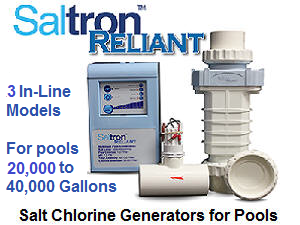
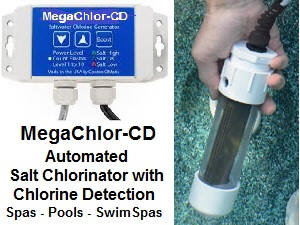
Salt Chlorine generators are a
better way to utilize chlorine, producing
more controllable results. They
eliminate the need to handle, measure or
store chlorine products, while reducing
buildup problems. An
Electronic
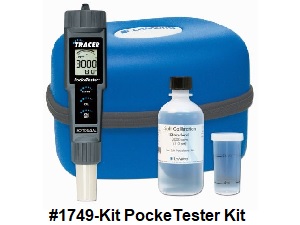
PockeTester Kit is a convenient
way to monitor the salt level. |
|
Salt Chlorine Generators - 3 models |
Testing The Salt Level |
Salt Chlorine Generator - No
Installation |
 |
 |
 |
|
Product and Ordering Information |
Product and Ordering Information |
Product and Ordering Information |
For more
information on maintaining and adjusting
water chemistry go to: Calculating
Chemical Additions
► ► ►
Scroll down to
read through some Question and Answer
information.
◄ ◄ ◄
|
|
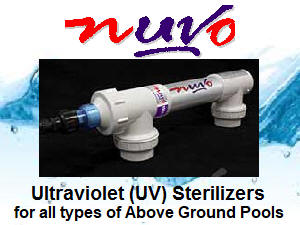
An
Ultraviolet Pool Sterilizer
kills 99.9% of the
microorganisms, passing through
the cell. It can kill
sanitizer-resistant pathogens
and is typically used with
chlorine or bromine.
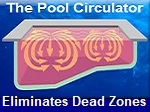
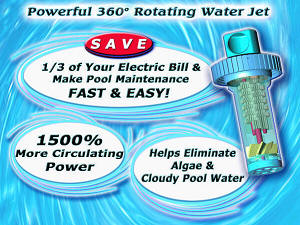
The
Circulator will
dramatically improve water
circulation and eliminate the
"dead zones" that promote algae
growth.
Better circulation helps
sanitizers work more
effectively. The
Precision UV model is an
Ultraviolet Sterilizer,
for all types of pools, up to
40,000 gallons. Kills
microbes that normal levels of
chlorine may not. Even
better when used together. |
|
Above-Ground UV Sterilizer |
Circulation Boosting Return Jet
Fittings |
Ultraviolet Sterilizer, for all types of
pools |
 |
 |
 |
|
Product and Ordering Information |
Product and Ordering Information |
Product and Ordering Information |
If you have a pool or spa water
testing need, we should have the
product.
►
Scroll down to read through some
Question & Answer information.
◄ |
|
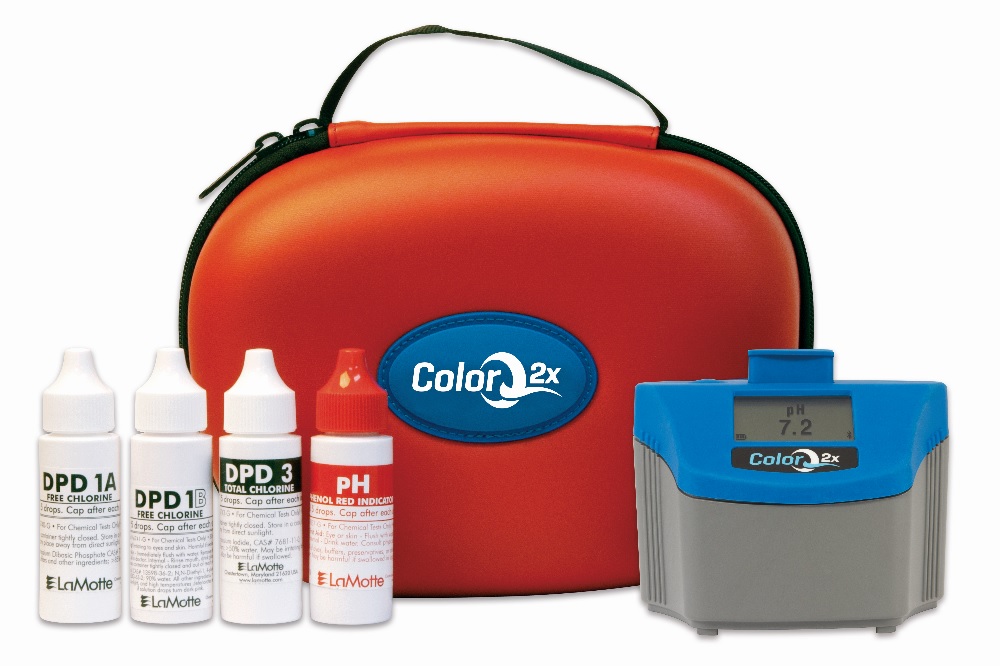
A
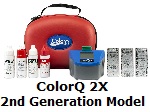
ColorQ 2X is a 2nd generation,
Bluetooth, Waterproof, all-digital tester,
that can
measure all the common test factors. There is a model, for every sanitizing
need.
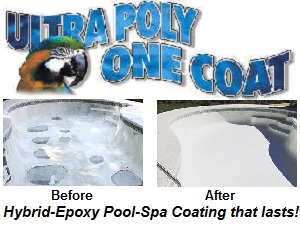
Refinishing your gunite or
fiberglass Pool or Spa, with
Ultra Poly One Coat, can
be a money-saving do-it-yoiurself
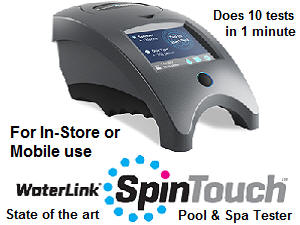
project. The
WaterLink SpinTouch Labs
are the ultimate tester, doing
up to 10 different water test
factors, in just 1 minute. |
|
ColorQ All-Digital Water Testers |
Hybrid-Epoxy Coating, for
pools and spas |
WaterLink SpinTouch Labs |
 |
 |
 |
|
Product and Ordering Information |
Product and Ordering Information |
Product and Ordering Information |
If you have a pool or spa water
testing need, we should have the
product.
►
Scroll down to read through some
Question & Answer information.
◄
|
|
|
How to
choose an Alternative Pool Water Sanitizer? |
The phrase
"Alternative Pool Sanitizer" usually refers to
something other than conventional forms of
chlorine: the most popular sanitizing product.
Alternative Pool Sanitizers include:
salt
chlorine generators,
ionizers/mineralizers, mineral sanitizers, ozone generators, hydrogen peroxide,
ultraviolet sterilizers,
biguanide (Trades names
such as Baquacil, Soft-Swim and Revacil) and
bromine. Some alternatives perform best by being
used in combination, while others can be stand
alone. Some alternatives are other chemicals and
others are generating or releasing devices. The
quest for simple and effective pool sanitizing
is ongoing. The goal is better sanitizing, more
convenience, less chemical sensations and
safety. What is right for any pool or swim spa will depend
on how it is used, by whom it is used, bather
demand, the importance of convenience and cost
considerations. No matter which sanitizer is
used, it is a good practice to shock the pool or
swim spa, at
least periodically, after periods of heavy usage
and at distinct signs of a loss of water
quality. This will help to rid the water of
organic buildups and prevent the development of
resistant microorganisms. The use,
of two totally different sanitizers, is almost
always better and more consistent, than the use
of a single product or method. If problems arise,
refer to the
Pool Problems Page, as a source of
problem-solving information, broken down into
various categories. Scroll down the page
and click on the linked
keywords,
catch phrases
or images, in the archived answers below, to access additional information, on that topic or product.
 |
Join our E-Letter Mailing List.
You'll receive 1-3 E-Letters a
month, featuring helpful pool
and spa advice, new product
information and sale
announcements. All we
require is your e-mail address
and you can opt out anytime you
wish.
Your information
will never be shared or sold. |
|
▼
Helpful,
Problem-Solving Information, in a question and
answer format.
▼ |
►
Chlorine Alternatives, Peroxide and
DE Filters?
I'm looking
into alternative solutions to
traditional chlorine pool treatment,
due to household members adverse
effects of the chlorine. I have been
looking into possibly using ~32%
hydrogen peroxide in combination
with UV light as the new treatment
source. I have been able to find a
few articles on line which say
people have converted their pool,
but I'm unable to an specifics on
exactly how to do the conversion,
and how well it actually works after
being converted. Couple questions I
have, which I was hoping you may be
able to help with. Since the
pools is already treated which the
traditional chlorine, does the pool
need to be drained and re-filled
with fresh water before treating
with hydrogen peroxide? I have seen
some articles which say you can just
shock the pool with peroxide
treatment, and the peroxide will
remove the chlorine. I have also
read that this reaction may cause a
hydrochloric acid to result, is that
true? If this is the case, will the
hydrochloric acid break down, or
stay in the pool, and how would it
be treated? I have seen that
hydrogen peroxide and DE filter
should not be used together, since
the peroxide breaks down the DE
component? Any idea how long this
breakdown takes to occur? If I would
continue to use the DE filter could
it just be cleaned more often and DE
just re-added and have the filter
work correctly? Or will doing this
cause the filter to plug and ruin?
Using UV light is suppose to speed
up the reaction of peroxide breaking
down. So if a UV light is used in
conjunction with peroxide, any idea
how often peroxide will need to be
re-added to obtain the recommended
50-100 ppm concentration in about
~30,000 gal pool. Thanks.
Tyler M.,
3/7/2020
Most likely, it is the irritating
forms of chlorine, that are causing
the problems. An
Ultraviolet Sterilizer will
destroy these combined chlorines,
as water passes through the cell.
Hydrogen will provide the required
oxidizing action, needed to destroy
organic wastes. UV works best with a low level of
chlorine, which provides both
oxidizing and persistent sanitizing.
Peroxide is not recognized as a pool
sanitizer, but will provide
oxidation. There are articles
referring to problems with peroxide
and DE, although the concentration,
at which problems become
overwhelming is not well defined.
based on what I have seen. Instead
of peroxide, why not use an ozonator
and UV? With a variable speed pump,
you'll be able to run 24/7, and
still lower the electrical costs. UV
has not effect on algae in the pool
and ozone is very short lived. With UV, Ozone and a
Mineralizer and running 24/7, you
should only need a very low level of
chlorine - under 1 PPM. And it
should take very little to maintain
the level, because of the ozone.
Both UV and ozone will destroy the
irritating forms of chlorine,
leaving only the active sanitizing
form. Improving circulation, by
adding The Circulator replacement
return jet fittings, will eliminate
the algae-prone dead zones and allow
the ozone to reach more of the pool.
low level of
chlorine, which provides both
oxidizing and persistent sanitizing.
Peroxide is not recognized as a pool
sanitizer, but will provide
oxidation. There are articles
referring to problems with peroxide
and DE, although the concentration,
at which problems become
overwhelming is not well defined.
based on what I have seen. Instead
of peroxide, why not use an ozonator
and UV? With a variable speed pump,
you'll be able to run 24/7, and
still lower the electrical costs. UV
has not effect on algae in the pool
and ozone is very short lived. With UV, Ozone and a
Mineralizer and running 24/7, you
should only need a very low level of
chlorine - under 1 PPM. And it
should take very little to maintain
the level, because of the ozone.
Both UV and ozone will destroy the
irritating forms of chlorine,
leaving only the active sanitizing
form. Improving circulation, by
adding The Circulator replacement
return jet fittings, will eliminate
the algae-prone dead zones and allow
the ozone to reach more of the pool.
UV Sterilizers and Ozone Generators
will still need to be used for
chlorine. However, both will enable
you be decrease chlorine usage.
Ozone quickly leaves the water, so
chlorine is needed to make sure that
oxidizer/sanitizer reaches the
entire pool. UV only acts as water
passes through the cell, but kills
virtually everything, including the
worst offenders. To sanitize in the
four corners of the pool, chlorine
be used, but at reduced usage rates.
Poor circulation can make algae
growth more likely. You might
consider adding THE CIRCULATOR. The
easy to install device will
eliminate the dead spots that can
promote algae growth. Helps to
better distribute heat and
chemicals.
Sincerely. Alan Schuster,
3/7/2018
►
A Hydrogen Peroxide Fish Tale?
Alan, In the beginning of this year
I transitioned to a 27% Hydrogen
Peroxide system, for several months
it was perfect. Then slowly a light
brown stain started forming on the
bottom and sides. It does not scrub
off at all. I might add I had
let the previous chlorine deplete to
0. In addition a slight fish odor
started. A neighbor child said he
smelled Lobster! I searched the
internet high and low with no result
at all and also asked my local pool
supply, they never heard of such a
thing. So I made the decision to
switch back to chlorine. Again I let
the H2O2
deplete. I also had a phosphate
issue, so they said, which I just
used a Phosphate remover. At this
point the water tests good. its
clear and no algae. I believe
I may purchase a Salt unit soon, but
in the mean time I have an unsightly
stain on the Vinyl liner. At
some point, something I added
removed some of it. So now its a
patchwork. The only additions I've
used are powdered shock, liquid
shock and non foaming algaecide. I
can tell by rundown on the angled
walls that something did remove it,
just don't know what. Your thoughts
and help would be greatly
appreciated.
Ed O, 8/11/2017
Peroxide is not recognized, as a
pool sanitizer, in the US. Your
result and olfactory descriptions
are consistent with inadequate
sanitation. Switching to chlorine
was the wise thing to do. Getting a
salt chlorine generator would be
even wiser. A salt chlorine
generator! It is chlorine without
all the negatives. No chlorine odor, no
handling, storage or buying chlorine
and much better water quality.
You'll have to buy some salt -
common, non-iodized food grade or
water softener grade - inexpensive!
Thereafter, you need to add more
salt only to replace that lost
through pump out, splash out,
backwashing or overflow. With a salt
chlorine generator, all you need to
do is add an initial dose to
stabilizer to bring the level up to
40-60 PPM. Thereafter, more
stabilizer is needed only to replace
that lost through pump outs,
backwashing and splash out. The
overall water chemistry should be
maintained in the usual manner.
Because salt chlorinators destroy
chloramines so effectively, you will
find the swimming conditions more
pleasant and easier to maintain.
Proper salt level is important. Too
little and not enough chlorine will
be produced. Too much could shorten
the life of the salt cell.
PockeTesters are the easy way to
test the salt level. The
stains are not explained, by
anything you added. Possibly adding
acid made a difference. Test with
some pH reducer and see what
happens. Possibly, time and a
optimum free chlorine level will
solve the problem. In case it is a
metals stain, try rubbing some
vitamin C tablets on a stained area.
If that works get back to me, for a
whole pool solution. I hope
that this information will be
helpful.
negatives. No chlorine odor, no
handling, storage or buying chlorine
and much better water quality.
You'll have to buy some salt -
common, non-iodized food grade or
water softener grade - inexpensive!
Thereafter, you need to add more
salt only to replace that lost
through pump out, splash out,
backwashing or overflow. With a salt
chlorine generator, all you need to
do is add an initial dose to
stabilizer to bring the level up to
40-60 PPM. Thereafter, more
stabilizer is needed only to replace
that lost through pump outs,
backwashing and splash out. The
overall water chemistry should be
maintained in the usual manner.
Because salt chlorinators destroy
chloramines so effectively, you will
find the swimming conditions more
pleasant and easier to maintain.
Proper salt level is important. Too
little and not enough chlorine will
be produced. Too much could shorten
the life of the salt cell.
PockeTesters are the easy way to
test the salt level. The
stains are not explained, by
anything you added. Possibly adding
acid made a difference. Test with
some pH reducer and see what
happens. Possibly, time and a
optimum free chlorine level will
solve the problem. In case it is a
metals stain, try rubbing some
vitamin C tablets on a stained area.
If that works get back to me, for a
whole pool solution. I hope
that this information will be
helpful.
Sincerely. Alan Schuster,
8/11/2017
► Wanting To
Minimize Chlorine Usage?
My in ground new pool runs on a
mineralizer together with a ozonator. I know I have to use
every, once a while a chlorine tablet to keep the proper
balance. I am located in Dallas, TX. Some guy told me we
have to shock the pool and add conditioner, to keep the
chlorine in the pool. The whole reason I installed the
system. is to not use or at least minimum amount of
chlorine. Do I need a conditioner and chlorine? Thx for your
help.
Dieter, Dallas, TX, 10/27/2020
The reason a low level of chlorine is recommended is that
ozone does not remain, in the water for very long, once the
pump is turn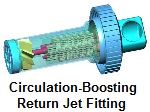 ed off. Having a mineralizer helps make keeping
a low chlorine level more feasible. So long as you are using
chlorine, you should add chlorine stabilizer/conditioner.
Otherwise, the Sun's ultraviolet rays will quickly deplete
the chlorine and your usage will go up. I suggest you try
for 1 PPM of free chlorine. Because of the ozonator, there
should be no chlorine smell or sensation. Instead of
thinking no chlorine - think low chlorine and you'll have
far fewer problems. Adding The Circulator will dramatically
improve circulation and will help eliminate dead zones,
where algae starts to grow. In addition, it will help ozone
stay in the water longer, because of the spiraling return
flow it creates. Once a month or so, when you may not plan
on using the pool, it would be a good time to shock. This
will help prevent the development of sanitizer resistant
microorganisms. Test the water regularly and you should be
good to go. I hope that this information help make the
season more enjoyable.
ed off. Having a mineralizer helps make keeping
a low chlorine level more feasible. So long as you are using
chlorine, you should add chlorine stabilizer/conditioner.
Otherwise, the Sun's ultraviolet rays will quickly deplete
the chlorine and your usage will go up. I suggest you try
for 1 PPM of free chlorine. Because of the ozonator, there
should be no chlorine smell or sensation. Instead of
thinking no chlorine - think low chlorine and you'll have
far fewer problems. Adding The Circulator will dramatically
improve circulation and will help eliminate dead zones,
where algae starts to grow. In addition, it will help ozone
stay in the water longer, because of the spiraling return
flow it creates. Once a month or so, when you may not plan
on using the pool, it would be a good time to shock. This
will help prevent the development of sanitizer resistant
microorganisms. Test the water regularly and you should be
good to go. I hope that this information help make the
season more enjoyable.
Sincerely. Alan Schuster, 10/27/2020
► Would Like
To Be Chlorine-Free?
My son has an extreme sensitivity to
chlorine and/or the byproducts associated with its use in
pools. He breaks out, whenever he goes into any chlorine
pool. We would like to have an inground pool installed, but
not without being able to avoid using chlorine. Can you
offer suggestions?
Henry K., Temecula, CA, 10/31/2013
The simple answer would be to use biguanide, as it is
incompatible with chlorine. However, the product does have
its share of baggage. Most users encounter problems with
resistant microorganisms, after periods, as short as one
season. Try as they might, the only practical solution, at
that point, is to permanently switch to another sanitizer.
It also impedes proper filtration and causes foaming. It is
not the long term solution that you are seeking.
Chlorine acts as a disinfectant, sanitizer and oxidizer of
organic wastes and byproducts. Many products or devices
claim to perform "chlorine-free", but may not be acting with
the sanction and approval of the U.S. Environmental
Protection Agency. This agency regulates the text that
appears on a registered product's label. However, it's easy to take
liberties, with sales materials. Bromine will meets these
goals and, while closely related to chlorine chemically, in
terms of being another member of the halogen family of
elements, it has been found to be less irritating.
Ordinarily 3-5 PPM of bromine are required. With some
additional treatment products, you can get optimum results
with a much lower 1-2 PPM level.
As a first step, I would add a
UltraViolet
Sterilizer. It kills virtually every microorganism,
including the worst offenders, as pool water passes through
the cell and returns to the pool. It will reduce the
microbial population of the pool, but will not sanitize the
water, in the pool, completely, nor will it eliminate algae,
that might be growing on underwater surfaces or oxidize
organic wastes and byproducts. Still, it accomplishes much
and adds no chemicals, but needs some help to do the
complete job. An Ozone Generator will
help destroy many microorganisms, organic wastes and
byproducts, without adding chemicals. Ozone is a form of
oxygen, that is a powerful oxidizer, but is short lived. The
ozone might only remain in the water for twenty minutes,
after the unit is shut off. Adding
The Circulator, to each
return will help it reach the far
corners of the pool, as good
circulation is very important in
achieving your goal. Operating the
ozone generator, for periods spaced
throughout the day, would be of
great help. Operating with a 2-speed
pump on low 24/7, is something to
consider. At this point, you have
greatly reduced microbial
populations and controlled organic
wastes, without adding chemicals.
What is missing is something to act
as a persistent sanitizer. It is normally used with chlorine or
bromine and will help reduce the need for the higher 3-5 PPM
level of bromine. Because the ozonator is doing much of the
oxidation, the amount of bromine required, to maintain any
given level, will be greatly reduced.
At this point, you have a low level of bromine and the only
other chemical being added is silver ions. When the pool is
filled, adjust the pH, total alkalinity and calcium
hardness, as required. As mankind has learned,
microorganisms are highly adaptable. On a monthly basis or
after periods of heavy bather usage, to help prevent the
formation of resistant microorganisms and to assure peak
performance of this triad approach to a reduced halogen
pool, I would add enough potassium monopersulfate shock
(non-chlorine) to boost the bromine level to 3-5 PPM. You
want 3-5 PPM present, for at least a few hours. I suggest
this last step, as assurance against developing a sanitizer
resistant microorganism. It may not be needed, but better
safe than sorry. However, if you ever feel slimy deposits on
the underwater surface, it should be taken as a sign that
something may not be performing properly or that this
periodic bromine treatment needs to be done. A
high-efficiency filter can further assure optimum water
quality, while remaining a low halogen pool. I hope that
this information will prove helpful.
Sincerely. Alan Schuster, 10/31/2013
► Won't Do
Without One?
I live in Houston. We are starting the
process of getting quotes to build a
new pool. My sister in Chicago has a
pool ionizer. I have never seen
anything as easy as this. Every
season they put a few bags of salt
in the pool when they and the
ionizer makes its own chlorine. They
rarely have to add anything. Is it
possible to have this system in the
hot humid weather that we have here
in Houston? I do not want a pool
that does not have an ionizer. Can
you help me in finding a pool company in our area that will
install this system with maintenance service?
Becky A., 3/6/2011
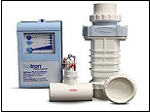
Not a problem! The product that you are referring to as an
"ionizer" is more correctly described as a
salt chlorine
generator. That's why some salt is added yearly: in
order to replenish the salt content, after the pool water
level has been restored in the springtime. An ionizer is
something different: it uses copper and silver ions, in
conjunction with shock treatments, to maintain proper water
quality. An ionizer does not make chlorine! A salt chlorine
generator system can produce all of your pool's chlorine
requirements, with a minimum of other chemicals. It is like
having a chlorine manufacturing plant. Chlorine output is
controlled by a setting on a dial and is making adding pool
chlorine the old fashioned way obsolete. It works in the
humidity of Florida and the Arizona desert. Good luck with the pool.
Sincerely. Alan Schuster, 3/7/2011
► Salt
Chlorinators And Mineral Sanitizers?
Your website is a great source of
information that I found while doing research on alternate
pool sanitizer solutions. Thank you for your time in
providing this service. I hope this isn't a repeat, but I
didn't find the specific info on the mineral sanitizers, and
specifically not any comparison between the two in terms of
effectiveness, cost and ease of use. I would very much like
to know your thoughts on the relative merits of the mineral
sanitizers and salt water chlorine generators.
Gene G., Madison, AL, 7/7/2009
A salt chlorine
generator is a complete pool sanitizing system.
About all you'll need on a regular basis is some acid to
lower
the pH. It is like maintaining a chlorine pool without
the headaches or the handling of chlorine. It is highly
automated and controllable. Need more chlorine - just dial
it up. A mineral sanitizer adds metallic ions to
control algae and bacteria. You will still have to add
chlorine or non-chlorine shock on a regular basis, to
perform the necessary oxidizing function. In either case,
the water chemistry must be maintained. A salt chlorinator
will cost more initially. While I don't have specific
figures, I suspect that over the life of the unit, the cost
will be very competitive and possibly lower depending upon
individual circumstances. Some salt cells are rated to last
5 years or more, depending upon the location.
Mineral
Sanitizers use cartridges and have life expectancies of
about 6 months, by comparison. You can use both products
together. That will allow you to maintain a lower level of
free chlorine and that will make control of the pH easier
and extend the life of the salt cell. I hope that the
information proves to be helpful.
Sincerely. Alan Schuster, 7/7/2009
► What is
Ionization-Oxidation?
A friend has a pool that uses
something called Ionization-Oxidation. He seemed very happy
with it and I must admit there was no heavy chlorine smell.
It sounded too good to be true, but I didn't want to press
him on the details. Can you fill in the blanks?
Jerry N., Darien, GA, 6/23/2018
Ionization-Oxidation is a hybrid method for purifying water.
The technology was actually used in the space program to
purify water on many manned space missions. In the better
units, electrodes release controllable amounts of copper and
zinc ions, to act as sanitizers. In addition, other
electrodes produce forms of active oxygen to destroy organic
matter, algae and waste products. The Ionization-Oxidation
unit is operated for a preset time and carries the
sanitizing load, with a minimal chemical presence.
Frequently, it is touted as 100% chlorine free. In the real
world, better and more consistent results are gotten, by
also maintaining a very low level of chlorine. It requires
very little chlorine and there should be little or no sense
of this being a chlorine pool. However, the oxygenation
leaves the water quickly, after
turning off the unit, and many
users make the mistake of increasing
the copper level. When the
copper level goes above 0.3 PPM or
the pH too far above 7.2, copper
staining becomes a possibility. The chlorine just helps
bridge the gap between the shutting off of the unit and its
restart the next day. If you are interested in a pool that
uses a minimum of chemicals, you might consider a
salt chlorine generator.
It is the better way to do chlorine
and avoids the buildup of unwanted
byproducts and does not contribute
to the possibility of copper
staining.
I hope that this information proves to be helpful.
Sincerely. Alan Schuster, 6/24/2018
► Perplexed
About Biguanide?
I have been using biguanide for
several years and been happy with the results. It may cost
more, but I like the feel and the lack of chlorine odors.
The problem is that on two occasions the pool has developed
a water mold. I had to add chemicals and chlorine shock and,
in effect, had to start all over. The dealer says it could
happen again. Short of switching to something else, can you
suggest something? Thanks.
Paul B., Lake Worth, FL, 9/4/2010
You could try adding an
Ultraviolet Sanitizing unit. It will
depress the microbial populations and help prevent a
possible recurrence. If the problem does recur, you really
should permanently switch from biguanide. In that case, you
could change to chlorine or bromine and the UV unit will
allow you to maintain satisfactory sanitizer levels with
fewer chemicals. It's your call. Good luck with your
decision.
Sincerely. Alan Schuster, 9/5/2010
► Why Aren't
Ozonators More Popular?
Ozonators sound like a good idea. So
why are they not very popular? Is it good for a lazy pool
owner?
John W., 6/24/2017
They may not be as popular as chlorine, but their popularity
is increasing in all types of residential and commercial
pools. The use of ozone generators has been widespread in
spas for many years. Ozonators are not complete stand alone
pool sanitizers. A backup system, usually chlorine or
bromine must be used. A salt chlorine generator can be used
in conjunction with an ozonator and will provide additional
benefits.
Ionizers can also be used
in conjunction with ozone and chlorine, to provide backup
sanitizing and reduce the chlorine usage. In addition, all
of the important water chemistry parameters must be
maintained, as in a chlorine-maintained pool. Yes, it is
convenient. Yes, it will reduce the overall requirements for
sanitizer and will simplify chemical balancing. Yes, it is
good for "lazy" pool owners. There are other choices that
might be worthy of your consideration.
Salt chlorine
generators can completely eliminate the need for any
chlorine and there is no need for a backup. Still the water
chemistry must be maintained. But isn't that what pool
service companies are for? I hope that I have been of
assistance.
Sincerely. Alan Schuster, 6/24/2017
► An Ionizer
vs. A Salt Chlorinator?
I'm building a new concrete 26X42 pool
and I'm having a little difficulty deciding on the purifier
to use. One of my concerns is to eliminate as much as
possible any chemicals used (i.e. I hate the smell and feel
of chlorine). So I've looked at several chlorine generators
and Copper/Silver Ionizers. Some vendors swear by the
generators because you don't have to handle chlorine. But,
they can't answer my concern that the Chlorine content of
the pool is probably no different (i.e. regular
Chlorinators). On the other hand, Ionizers claim to use
little or no Chlorine. What can you tell me about the
relative strengths, beyond trivialities, between generators
and Ionizers? Any recommendations are appreciated.
Mike S., 8/22/2006
With an ionizer you will still have to add chlorine, bromine
or non-chlorine shock on a regular basis. Otherwise, organic
bypr oducts will buildup to problem levels. The use of
chlorine or bromine will act as a backup sanitizer and help
assure better water quality. The ionization unit
will reduce the use of
chemical sanitizing products - how
much less will depend on your
particular usage pattern. The
overall pool chemistry must still be
maintained, as with any pool.
Your concern about chlorine should
be eliminated, if you add a
salt chlorine generator. Under
normal conditions, it is chloramines
that prove odorous and irritating.
With a salt chlorination system, all
the water passing through the cell
will be free of odorous and
irritating chloramines and there
should be much less of a sensation
of chlorine being in the pool. It is the chloramines
- not the chlorine that are smelled. There are no chlorine
containers to handle or store! As with any chlorine pool,
you will have to maintain all of the other water chemistry
parameters. Test the salt level, periodically to assure that
the amount is within the proper range. Good luck with your
decision. I hope that I have been helpful.
oducts will buildup to problem levels. The use of
chlorine or bromine will act as a backup sanitizer and help
assure better water quality. The ionization unit
will reduce the use of
chemical sanitizing products - how
much less will depend on your
particular usage pattern. The
overall pool chemistry must still be
maintained, as with any pool.
Your concern about chlorine should
be eliminated, if you add a
salt chlorine generator. Under
normal conditions, it is chloramines
that prove odorous and irritating.
With a salt chlorination system, all
the water passing through the cell
will be free of odorous and
irritating chloramines and there
should be much less of a sensation
of chlorine being in the pool. It is the chloramines
- not the chlorine that are smelled. There are no chlorine
containers to handle or store! As with any chlorine pool,
you will have to maintain all of the other water chemistry
parameters. Test the salt level, periodically to assure that
the amount is within the proper range. Good luck with your
decision. I hope that I have been helpful.
Sincerely. Alan Schuster, 5/13/2006
► Ionizer
Needed Chlorine To Maintain Water Quality?
I purchased this powered ionizer, for
above ground pools and I think it is time for me to replace
the cartridge in this ionizer. I am debating buying another
cartridge, because the replacement price is going to
be around $150. Can you please share your opinion and/or
suggestions about this product or any others similar to it?
What is your personal experience or advice regarding these
ionizers? Being a new above ground pool owner, I am not
able to determine if this product is worth re-investing my
money again every 2 or 3 yrs. Please advise & Thanks for all
your help.
Debbie R, Dallas, TX, 10/25/2009
When sanitizing products, such as
algaecides or chlorine, are
registered by the US Environmental
Protection Agency, they receive an
EPA Reg. Number. In addition, the
agency limits the types of claims
that can be made. For some
unfathomable reason the EPA does not register all devices
and they seem free to make claims, that may not be
supported. I agree that this product can help sanitize
water. But water can be sanitary and look unappealing.
Wastes must be oxidized, with the use of chlorine, bromine,
ozone, potassium monopersulfate or hydrogen peroxide. WHAT
ARE YOU ADDING TO OXIDIZE BATHER WASTES? THIS PRODUCT WILL
NOT DO ANYTHING TO ELIMINATE URINE! Ionizers
usually suggest the use of chlorine or bromine, at lower
levels, to destroy the wastes. In my opinion, stand alone
ionizers fail to provide proper water quality and add to the
risks of staining. In many cases, the dealer tells the pool
owner that no chlorine is needed. Just add a gallon of
laundry bleach weekly. Guess what! Most laundry bleach is
chemically identical to liquid pool chlorine, only at about
1/4 - 1/2 the strength. And if you have to add chlorine, a
Salt Chlorine
Generator is a better way to
utilize chlorine. I hope that
this is helpful.
Sincerely. Alan Schuster, 10/26/2009
To be honest with you, my pool guy,
(who bailed on me in July), was treating my pool, as if the
ionizer was not there. He said, he wasn't too sure that
these ionizers were very efficient, so he just kept caring
for my pool with chlorine and shock, which of course kept my
pool clean and blue. However, I was in Florida for a month
when my pool guy quit, and when I got back, I had a green
tinted pool. Since then, I lost my job, and have had a hard
time buying the chemicals necessary to get all the algae
out. Not too mention it has been raining almost every other
day or 3rd day here in Dallas for the past several months.
When the pool supply places test my water, I have had
ELEVATED levels of both pH & alkalinity and 0 chlorine.
When we finally got the pH and TA level. Then I treat
with algaecide, then 5 to 6 lbs of
shock and floating 1 inch stabilized
chlorine tabs. I vacuum, and still
am unable to get my pool
totally blue. I think the rain is
killing my chlorine levels, because
I cant seem to keep it up. And those
1-lb pkgs. of shock are so
expensive, it is ridiculous. I have
been looking for pool chemicals
online, but am unsure which ones are
the best value for the money. My
vinyl is solid White, with the
exception of a 7 inch color design
around the top edge of the liner,
right about where the top of the
water level should be. I am not
concerned about bleaching any color
from my vinyl, yet the pool supply
people, keep wanting to sell me the
more expensive shock treatment made
especially for vinyl pools. Every
week, when I go to the pool supply
store, it is costing me anywhere
from $80 to $130 in chemicals. So
that is the reason I was
inquiring about the efficiency of my
power ionizer and whether or not I should invest in another
cartridge due to the pricing of the item. I was hoping to
save on over-all chemical costs. And, after reading the info
you suggested a salt chlorine generator, I am a little
confused. Do I have to have a salt water system already set
up on my pool, to use the salt water system? Or Do you
recommend I stick with the regular salt chlorine generator
system, as opposed to the saltwater system? Any suggestions
or advice you provide will be greatly appreciated. Thanks
for all your help.
Debbie R., Dallas, TX, 10/28/2009
Like I said, an ionizer cannot work without chlorine or some
form of oxidizer. At best, it can help reduce chlorine
usage. Your pool was being
maintained on chlorine. When the
chlorine was stopped, that is when algae took over. The low
pH and TA are the result of the
algae and not the cause. It
seems the product did little to deter algae and I would not
invest in a replacement cartridge. Because this is a device,
their claims are not regulated by the EPA. They can boast
about no chlorine, but
in the real world, the truth gets
exposed. I suggest that you add
chlorine and get the free chlorine
level elevated. Liquid pool chlorine
is vinyl-liner safe and cost
effective. Or read the labels and
use a cost effective choice, since
money is a consideration. It will
probably require a lot of chlorine.
A
Salt Chlorine
Generator unit is described as a saltwater
generator or salt chlorinator (the
terms are used interchangeably), for
most above ground pools. The unit
mounts on the top rail. It will
require about 25 pounds of salt, per
1000 gallons, but will make enough
chlorine for a typical 20,000 gallon
pool. It requires ordinary
non-iodized food or water softener
graders of salt- about 10 cents a
pound. Good luck with the clean
up and I hope that I have been helpful.
Sincerely. Alan Schuster, 10/28/2009
► How Does UV
Sanitize?
I am interested in getting away from
all the chlorine and the odors associated with the product.
I know there are several types of alternative pool water
sanitizers available, which can reduce or eliminate chemical
usage. I've read up on some of them, but am not really clear
about Ultraviolet. Is this the same as Ozone? How does it
work? Thanks for the help.
Adam J., 11/2/2004
Ultraviolet (UV) is not ozone. Some
ozone generators utilize
UV to produce ozone, but not as a sanitizing agent. UV rays
destroy the microorganisms ability to survive and function,
after passing through the cell membrane. An ultraviolet
sanitizer unit is plumbed inline and effectively sanitizes
the water, as it passes through the cell. This has the net
effect of reducing the overall microbial populations and
reducing the amount of sanitizer necessary to maintain
optimum water quality and to keep the pool algae-free. UV
will reduce the microbial population, but requires a
traditional sanitizer to help keep it that way and to help
the underwater surfaces free of algae. Chlorine is well
suited, in this role, and lower quantities of chemicals will
be required because of the lower microbial populations. Good water circulation is important.
The Circulator, which
boosts circulation,
would be worthwhile additions,
helping to keep the underwater
surfaces in algae-free condition. I
hope that I have been helpful.
Sincerely. Alan Schuster, 11/2/2004
► Concerned
About Copper?
We have used a mineral sanitizer
system for the last 2 years with great results. We can keep
our chlorine levels low and the water stays perfectly clear.
This year, my wife has seen info that indicates that this
system may not be good for the pool, as it introduces copper
into the water Can you please shed some light on this
subject? Thanks.
Bill, 5/30/2009
Mineralizers and ionization units usually
release a stream of metallic ions, into the pool water, for
the purpose of providing sanitizing benefits. The ions are
at extremely low levels, so as not to cause staining and/or
discoloration. I assume that this is the issue that you
were addressing. The instances, where copper can present a
problem, result from the use of copper sulfate, corrosion of
copper heater cores or excessively high concentrations, due
to over application. You should try and keep the copper at
0.3 PPM maximum and keep the pool pH closer to 7.2. Several
convenient testing options are available, including a
ColorQ
COPPER 5 Digital water analyzer, that eliminates the
guesswork and color-matching. I hope that I have provided
some enlightenment.
Sincerely. Alan Schuster, 5/31/2009
|
Visit The Website Stores . . . for
better informed shopping!!! |
|
|
Shipping is FREE* . . . within
the Continental U.S.
A $9.99
handling charge will apply
to Continental U.S. Orders,
under $75.00. Orders
outside of the Continental
U.S. may require some
additional charge, based on
quantity and destination.
Most products can be
shipped World-Wide. International
and orders outside of
Continental U.S. - see
comments on the ordering
pages. |
|
|
Major
Credit Cards and PayPal are accepted. |
|
▲
Return To Top Of Page
▲
Aqualab Systems, LLC does not
make any warranty or
representation, either expressed
or implied, regarding the
accuracy or completeness of the
information provided by this
website; nor does Aqualab
Systems., LLC. assume any
liability of any kind whatsoever
related to, or resulting from,
any use or reliance on this
information. The content of this
website should not be used, if
it is conflict with any
applicable federal, state or
local regulations or guidelines.
© Aqualab Systems, LLC. All
rights reserved