| |
|
Scroll
down to browse through some archived SWIMMING POOL
questions and answers. Please click the Pool
Problems Link, on top of every page, to access a complete
listing of Pool Problem subjects, an alphabetized
Website Table of Contents, Pool Equipment Information,
About Alan Biographic Material and a Pool Glossary. Use
the other links to access additional subject
information. More information about some new and unique
products, for pools and spas, can be found by visiting
The Website Store.
You'll never know what you'll find and that's always
fun. Be better prepared and avoid costly problems!
|
|
 |
Shipping is FREE* . . . within
the Continental U.S.
A $9.99
handling charge will apply
to Continental U.S. Orders,
under $75.00. Orders
outside of the Continental
U.S. may require some
additional charge, based on
quantity and destination.
Most products can be
shipped World-Wide. International
and orders outside of
Continental U.S. - see
comments on the ordering
pages. |
|
 |

Major
Credit Cards and PayPal are accepted. |
|
On-line
shopping since 2002 - Safe and Secure!!! |
|
Managing the Bromine level, of pool
water!!! |
|
Sanitizing is a must, for proper pool
water management.
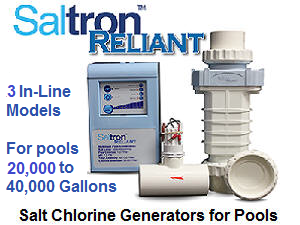
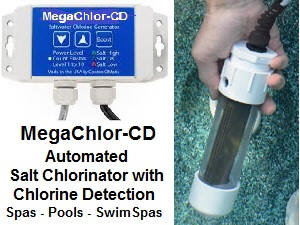
Salt Chlorine generators are a
better way to utilize chlorine, producing
more controllable results. They
eliminate the need to handle, measure or
store chlorine products, while reducing
buildup problems. An
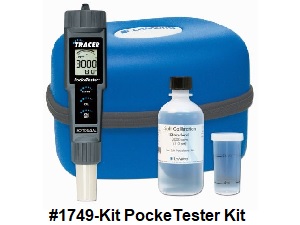
Electronic
PockeTester Kit is a convenient
way to monitor the salt level, as well
TDS and Temperature. |
|
Salt Chlorine Generators - 3 models |
Testing The Salt Level |
Salt Chlorine Generator - No
Installation |
 |
 |
 |
|
Product and Ordering Information |
Product and Ordering Information |
Product and Ordering Information |
If you have a pool or spa water
testing need, we should have the
product.
►
Scroll down to read through some
Question & Answer information.
◄
|
|
A
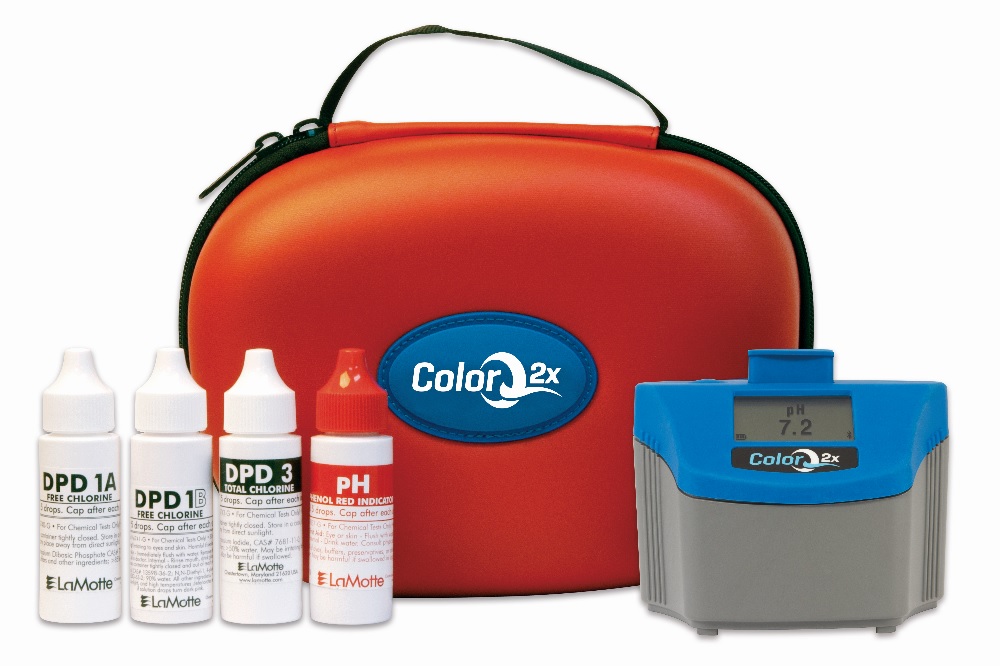
ColorQ 2X is a 2nd generation,
Bluetooth, Waterproof, all-digital tester,
that can
measure all the common test factors. There is a model, for every sanitizing
need.
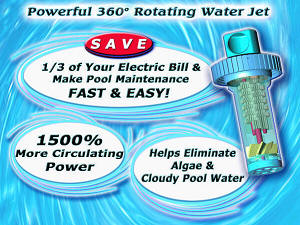
The Circulator is a
replacement return jet fitting,
that dramatically improves
circulation, by creating a
spiral return flow. Better
circulation helps sanitizers
work more effectively. The
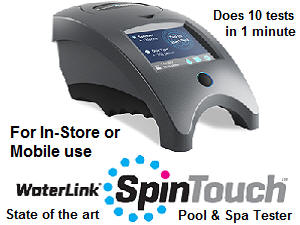
WaterLink SpinTouch Labs
are the ultimate tester, doing
up to 10 different water test
factors, in just 1 minute. |
|
ColorQ All-Digital Water Testers |
Circulation Boosting Return Jet
Fittings |
WaterLink SpinTouch Labs |
 |
 |
 |
|
Product and Ordering Information |
Product and Ordering Information |
Product and Ordering Information |
If you have a pool or spa water
testing need, we should have the
product.
►
Scroll down to read through some
Question & Answer information.
◄
|
|
|
How to use
bromine, as
a pool sanitizer? |
Bromine pool water sanitizing has
gained in popularity in recent years, especially in indoor
pools and spas. While it shares a
similar chemistry with that of chlorine, there are major
differences in how the products are used in a swimming pool.
Bromine is available in solid form and is very slow
dissolving. Typically, it is used in a feeder specifically
designed for bromine. Its main advantage over chlorine is
the reduced odor and potential for irritation. Its
disadvantages include: higher cost, not stabilized for use
in outdoor pools, limitations of slow-solubility and
requirements for larger-sized, specialized feeders. If
problems arise, refer to the
Pool Problems Page, as
a source of problem-solving information, broken down into
various categories. Scroll down the page and click on the linked
keywords,
catch phrases
or images, in the archived answers below, to access additional information, on that topic or product.
 |
Join our E-Letter Mailing List.
You'll receive 1-3 E-Letters a
month, featuring helpful pool
and spa advice, new product
information and sale
announcements. All we
require is your e-mail address
and you can opt out anytime you
wish.
Your information
will never be shared or sold. |
|
▼
Helpful,
Problem-Solving Information, in a question and
answer format.
▼ |
►
Bromine Test Readings Rise
Over Time?
Hello Alan - I have a
ColorQ 2X PRO 7 and I'm very pleased with it. My question: When testing the Bromine
levels, the readings from any particular sample tend to rise over time.
Sometimes significantly. Not sure if I should rely on the initial (lower)
reading or the higher reading after waiting 2 - 3 minutes. Your thoughts?
Thanks!
Bill S., 12/14/2020
Glad to hear, that you are pleased with the ColorQ 2X PRO 7. It sure beats
color-matching! The initial readings are the ones to use.
The bromine oxides the DPD, forming a reddish color. If left to stand, the
oxygen in the air, will start to oxidize the DPD and that causes the color to
deepen, over time, suggesting a higher, but false, bromine reading. I hope that the information provided was helpful.
Sincerely. Alan Schuster, 12/14/2020
►
Considering Switching To
Bromine And Ozone?
Hi
Alan. I just read through a slew of your Q and A's, but did not find my
question specifically. I have a saltwater pool that is just too much of a
problem to run anymore. I am wanting to convert to a bromine pool with an ozone
generator. Do I have to drain the water to do this or not? Thank you!
David B. Fort Mohave, AZ, 10/24/2016
It is not absolutely necessary to drain the pool.
However, I am unconvinced, that switching to bromine will make things easier.
Bromine will not last long, under the Arizona Sun, as it
cannot be protected from being destroyed by the Sun's UV rays, as can chlorine.
Adding an ozone generator, to what
you have, will make things easier. The salt cell will last longer and the rise
in pH will slow down, because you will need to generate less chlorine. I would
start by adding an ozonator. The combination of a
salt chlorine generator and ozonator
really complements each other, producing better results and fewer issues. We
hope that the information provided was helpful.
Sincerely. Alan Schuster, 10/24/2016
► High pH Problems
And Bromine?
It seems that the pH of my pool is
always high. It started a few days after I switched from
chlorine to bromine. Can that have anything to do with the
problem? The water is clear, but the pH seems to be very
high. I keep adding acid and testing, but nothing seems to
be happening. I need some advice.
Allen L., Highland
Park, IL, 7/23/2013
The problem can very well be related to the bromine.
However, the fault lies, not with the bromine, but with the
chemicals used to test the pH. Bromine can react with phenol
red (chemical used to test for pH) and form a purplish-red
color that makes it appear that the pH i s very high. In
fact, the formation of this color has nothing to do with the
pH. The problem lies in the fact that the phenol red
solution may not have had enough neutralizer (to prevent
bromine from reacting with phenol red) in its formulation.
This can lead to false high pH readings. You are using a
bromine product that is acidic in nature and that should
preclude the need for you to have to add acid reducers.
Pools maintained, in this manner, will require pH increasers
and total alkalinity increasers - never acids. I suggest
that you bring in a water sample into a local pool
professional, for confirmation If confirmed, you need to use
a pH test that is formulated to work with bromine or add a
drop of chlorine neutralizer (available in most pool stores)
to the test vial, just prior to adding the phenol red
solution. Now that we have established why the pH can
actually be very low, we must take another step. The low pH
could have caused corrosion. In order to avoid discoloration
or staining, I suggest that you add a double of a Quality
Mineral Treatment, such as phosphate-free,
Liquid METALTRAP,
prior to raising the pH or TA. I hope that I have been
helpful. Good luck and enjoy the summer. s very high. In
fact, the formation of this color has nothing to do with the
pH. The problem lies in the fact that the phenol red
solution may not have had enough neutralizer (to prevent
bromine from reacting with phenol red) in its formulation.
This can lead to false high pH readings. You are using a
bromine product that is acidic in nature and that should
preclude the need for you to have to add acid reducers.
Pools maintained, in this manner, will require pH increasers
and total alkalinity increasers - never acids. I suggest
that you bring in a water sample into a local pool
professional, for confirmation If confirmed, you need to use
a pH test that is formulated to work with bromine or add a
drop of chlorine neutralizer (available in most pool stores)
to the test vial, just prior to adding the phenol red
solution. Now that we have established why the pH can
actually be very low, we must take another step. The low pH
could have caused corrosion. In order to avoid discoloration
or staining, I suggest that you add a double of a Quality
Mineral Treatment, such as phosphate-free,
Liquid METALTRAP,
prior to raising the pH or TA. I hope that I have been
helpful. Good luck and enjoy the summer.
Sincerely.
Alan Schuster, 7/23/2013
► Extremely
High Bromine Level?
I am getting an extremely high bromine reading in my 25 year
old gunite pool. The only option I have been given is to
drain the pool. Any other ideas?
P. B., 4/4/2010
Bad option! Assuming that your bromine level is really that
high and I'm not at all certain, it is not necessary to
drain any water. First, I would have the water retested to
be sure. If the level is way too high, all you have to do is
to temporarily stop adding more bromine and add a chlorine
neutralizer. Many dealers carry this product, which is meant
to very quickly neutralize high levels of chlorine. In case
the product does not have bromine neutralizing directions,
follow the chlorine instructions and add 1/2 as much of the
product. In any event, I would break the recommended amount
into 2-3 increments and test after each addition. There's no
point in overshooting the mark and having to add shock. In
the future, adjust the amount of bromine being added to
avoid a repetition. I hope that I have been helpful.
Sincerely. Alan Schuster, 4/4/2010
► Water
Chemistry With Bromine Generator?
If I have a Bromine Generator system
it is salt that I have to test for correct? Do I still have
to test pH, Alkalinity and Calcium Hardness? And what is the
ideal range for all of these things if there is a Bromine
Generator system? Do I still have to test for Bromine? Thank
you so much for your help. Your website has been super
helpful to me a few times.
Cherise, 2/4/2011
You have to add salt, to the level recommended, by the
manufacturer. A salt test is required. You have to add
sodium bromide, t o a level that is recommended by the
manufacturer. As chlorine is produced, it concerts the
bromides to bromine. The chlorine reverts back to salt. When
the bromine has done its work, it reverts back to bromide.
The cycle keeps repeating. Bromine has advantages, but it cannot
be protected from the Sun's UV rays, as can chlorine. This
could shorten the life of the salt cell. You need to
test for salt, bromine, pH, total alkalinity and calcium
hardness. Cyanuric acid does not have to be added, nor does
it need to be tested. Test range for bromine is 3-5 PPM and
for the other tests it is similar to a chlorine pool, except
a pH as high as 7.8 is acceptable. Proper salt level is
important. Too little and not enough chlorine will be
produced. Too much could shorten the life of the salt cell.
This use of sodium bromine and a salt chlorine generator
performs better, in indoor pools. The reason this is so is
because there is no Sunlight or UV rays, to destroy the
bromine. PockeTesters are the easy way to test the salt level. Even
tough the pool contains potassium chloride, maintain it to
the same test reading standards, as if it contained sodium
chloride. The new ColorQ water analyzers are all digital,
use no look up charts and completely eliminate all color
matching and guesswork. You will find ColorQ Testers for
pools using Chlorine or Bromine, pools using Copper
Ionization and pools using Biguanide. There's one just right
for your pool. I hope that this information is helpful. o a level that is recommended by the
manufacturer. As chlorine is produced, it concerts the
bromides to bromine. The chlorine reverts back to salt. When
the bromine has done its work, it reverts back to bromide.
The cycle keeps repeating. Bromine has advantages, but it cannot
be protected from the Sun's UV rays, as can chlorine. This
could shorten the life of the salt cell. You need to
test for salt, bromine, pH, total alkalinity and calcium
hardness. Cyanuric acid does not have to be added, nor does
it need to be tested. Test range for bromine is 3-5 PPM and
for the other tests it is similar to a chlorine pool, except
a pH as high as 7.8 is acceptable. Proper salt level is
important. Too little and not enough chlorine will be
produced. Too much could shorten the life of the salt cell.
This use of sodium bromine and a salt chlorine generator
performs better, in indoor pools. The reason this is so is
because there is no Sunlight or UV rays, to destroy the
bromine. PockeTesters are the easy way to test the salt level. Even
tough the pool contains potassium chloride, maintain it to
the same test reading standards, as if it contained sodium
chloride. The new ColorQ water analyzers are all digital,
use no look up charts and completely eliminate all color
matching and guesswork. You will find ColorQ Testers for
pools using Chlorine or Bromine, pools using Copper
Ionization and pools using Biguanide. There's one just right
for your pool. I hope that this information is helpful.
Sincerely. Alan Schuster, 2/5/2011
► Hassled
Opening A Bromine Pool?
I pray that you can help. I have so
far found that owning a pool is a huge hassle and pool
companies are not all that helpful. They just seem to charge
me a fortune. I have a bromine inground pool and need to
open it for the first time this year. I find that most
information is geared toward chlorine pools. I would love to
find a good source for helpful information like what
chemicals I should purchase and what steps to take to clean
and care for my pool. Can you please give me some guidance
as to what to do. I would love a basic list of what
chemicals to purchase, so that I can get ready. I can't seem
to find any step by step care instructions for my pool. I
also have a DE filter. Please help.
Tracey, 4/2/2005
Opening a bromine pool is just about the same as a
chlorine pool. If the pool is covered, pump off the water and remove
the debris. Try very hard not to let material get into the
pool, as it will only add to the cleanup. If you are unsure
about the possibility of iron and other heavy metals, being
present in the tap or pool water, have a sample tested
beforehand. Raise the water level and get the filter
operating. Add enough shock, any kind of chlorine shock will
do, as it will convert to bromine and raise the bromine
level to 5-10 PPM. Maintain this high level until the water
is free of algae and is essentially clear. Adjust the pH to
7.2-7.8, by adding chemicals as needed. If the total
alkalinity is below 80-120 PPM, as chemicals to raise it
into this range. Chlorine stabilizer is not needed. Operate
the filter for extended periods, until the water is clear.
Test the water frequently, maintain proper bromine levels
and there should be few hassles. The right tester can be a
real plus. The
ColorQ Testers
are all digital and there's no guess work or color matching. Good luck and enjoy the
pool.
Sincerely. Alan Schuster, 4/3/2005
► Sensitivity
Issues?
My husband and I just had our
in-ground plaster pool finished and are about to add
chemicals. We are not sure which system to use... Bromine,
Chlorine or ionization? We would rather go with something
that is better for skin, we have a family member that is
sensitive to Chorine. We use Bromine for our above-ground
spa and like it, but have read that Bromine in a pool (ours
is very large) in HOT (we live in AZ) does not do as well as
Bromine. We want what will be most effective. Not to
concerned about extra cost if better. Can you educate us on
the differences and what may be best. I believe our pool
will come with an ozonator. Thanks for your help.
Phyllis, Arizona, 2/26/2010
Assuming that your pool will be equipped with an ozonator,
there are some good choices. Ozonators require a persistent,
backup sanitizer to help keep the pool sanitized, as ozone's
presence can be short lived. Ionization or a mineral
sanitizer would
ordinarily be a good choice. Ho wever, I believe that you
might be better off avoiding this type of sanitizer for the
first six months, in order to allow the plaster to
completely cure.
You have ruled out chlorine. Bromine has
not been ruled out, except as related to cost. Bromine usage
will be more
expensive because of the heat and the strong Arizona Sun.
However, the bromine requirements will be drastically
reduced by the use of the ozonator. In short, the amount of
bromine required, to maintain any given PPM level, will be
much less because of the ozonator. Given the sensitivity
issues, I would give this approach the first try. Trey
and add the bromine, after sunset, so that it is able to
work through the evening hours. Run the ozonator,
throughout the day. I hope
that this information proves useful. To better assure proper
overall pool water chemistry, visit a pool store that has a
very reliable, professional lab such as a
WaterLink SpinTouch Lab,
rather than a less accurate test kit or strip reader. Good luck with the
pool. wever, I believe that you
might be better off avoiding this type of sanitizer for the
first six months, in order to allow the plaster to
completely cure.
You have ruled out chlorine. Bromine has
not been ruled out, except as related to cost. Bromine usage
will be more
expensive because of the heat and the strong Arizona Sun.
However, the bromine requirements will be drastically
reduced by the use of the ozonator. In short, the amount of
bromine required, to maintain any given PPM level, will be
much less because of the ozonator. Given the sensitivity
issues, I would give this approach the first try. Trey
and add the bromine, after sunset, so that it is able to
work through the evening hours. Run the ozonator,
throughout the day. I hope
that this information proves useful. To better assure proper
overall pool water chemistry, visit a pool store that has a
very reliable, professional lab such as a
WaterLink SpinTouch Lab,
rather than a less accurate test kit or strip reader. Good luck with the
pool.
Sincerely. Alan Schuster, 2/27/2010
► Using A
Chlorinator With Bromine Tablets?
I, too, am grateful to have found your
site! You are now bookmarked forever! I have just replaced
my liner on my 16x32 inground pool and have chosen to go to
bromine as my chemical. I have been told by my dealer that a
brominator is the same as a chlorinator, and therefore am in
the process of buying and installing a chlorinator from them
for my bromine tablets. Any reading I have done on this
suggest that I am being misdirected and now need some
intelligent advice. Sincerely.
S. B., New Brunswick, Canada, 8/2/2005
Unless that piece of equipment states that it can be used
with chlorine or bromine and it suitable for a pool of your
size, you are not using the correct product. Bromine tablets
are far less soluble than are the popular trichlor products.
In order to help assure that enough bromine dissolves, the
brominators are larger in order to accommodate more tablets.
Possibly, how the water passes through is different as well.
You should only use a product that is labeled as suitable
for bromine. Otherwise, there could be a safety risk and the
possibly that you will not be able to get the bromine
tablets to dissolve quickly enough to meet the demands of
the pool. I hope this information proves helpful.
Sincerely. Alan Schuster, 8/3/2005
► Bromine
Compatibility?
Hi Alan, I am a new inground pool
owner and am overwhelmed with all the products out there for
sanitizing and for control of pH, algae, and so forth. I am
using bromine products currently because that is what I
received when the pool was installed in July. I really like
the bromine compared to chlorine that my friends use and
want to continue with it. Are all bromine sanitizers the
same? Can I use another companies product? Can I use
any algae prevention product with bromine, or are some only
to be used with chlorine, and some with bromine products? I
would ask my pool supply store, but not sure if they would
tell me the truth since I wouldn't be purchasing the
products they sell. Thanks.
R T., 9/3/2008
Bromine and chlorine share a similar chemistry.
Compatibility is not an issue. All bromine, in solid forms,
are not exactly the
same. There are slight chemical
differences that effect how the material can be made into
solid shapes. These differences do not lead to any
significant differences in the actual use of the bromine. In
general bromine is difficult to tabletize and some tablets
make keep from chipping better than others. They all work
the same. The only chemical that you should not use is
chlorine stabilizer, as it will serve no useful purpose in a
bromine pool. If you're interested in doing more of your own
testing, a ColorQ Digital Water Analyzer can do
it without any color-matching or guesswork. I hope that I
have been helpful.
Sincerely. Alan Schuster, 9/3/2008
► Looking To
Save Money, Because of High Bromine Usage?
Hi Alan, we just put in a large
inground pool. We are going through bromine tablets like
crazy. I pay $250 per 50 pounds of bromine. Do you know of a
place I can order bromine cheaper? Thanks.
Dan B., 8/30/2016
I don't have any chemical pricing information. You can
reduce your bromine consumption, by supplementing the
bromine tablets with regular additions of a chlorine product
or shock. For example, lower the settings on the brominator
and add liquid chlorine to boost the bromine level. It will
work because the
chlorine will convert to bromine. As a bonus, you'll find
the pH will remain more stable. It does work. The
Sun's UV rays will destroy the bromine. By adding
bromine and chlorine, after the Sun goes down, it will
remain active, throughout the evening.
It doesn't eliminate the need to add an oxidizer, like
bromine or chlorine, but does help reduce their usage.
I hope that this is helpful.
Sincerely. Alan
Schuster, 8/30/2015
► Choosing A
Bromine Test Kit?
What is the best way to test for
bromine in a pool? Thanks for any help you can offer.
Harry A., Bloomington, IN, 5/12/2009
I would not suggest that you use any swimming pool test kit,
unless it is specifically made to test for bromine!
Bromine can interfere with the pH test and give a false high
test result, if the pH test materials are not formulated
properly or the bromine levels are very high. There are
several different test methods in use.
Test Strips have come
a long way in terms of reliability, accuracy and the
majority of them can perform the bromine test. The
convenience and lack of liquid chemicals makes them a choice
of growing popularity. DPD Test Kits are suitable for
bromine testing. There are several
ColorQ
all-digital water analyzers, that would be ideal, for
your needs. They are all digital and completely
eliminate the color-matching and guesswork. I hope that I have been of assistance.
Enjoy the pool.
Sincerely. Alan Schuster, 5/12/2009
► From
Chlorine To Bromine?
Is it possible to convert a chlorine
pool to a bromine pool without draining the pool? If you
know the procedure, would you please email it to me. Thank
you.
Greg C., 2/8/2015
There really isn't anything that you have to do. If you add
some sodium bromide, all of the chlorine will quickly
convert to bromine. Otherwise, all you need is to keep the
pH at 7.2-7.8 and the bromine level at 3-5 PPM. However,
bromine cannot be protected from destruction, by the Sun's
UV rays. Cyanuric
acid helps protect chlorine, but there is no chemical that
protects the bromine. You will find your operating
costs higher, because of the destruction of the bromine,
during daylight hours. Instead of giving up on
chlorine, why not do it better? A
salt chlorine
generator is the better way to do chlorine, providing
better control and results. Once you start with bromine,
there is no turning back, short of water replacement. Good luck
and have fun!
Sincerely. Alan Schuster, 2/8/2015
►
Bromine-Chlorine Shuffle?
Is it
possible to use Bromine in the summer and Chlorine in the
winter. My daughter's hair turns green from the chlorine and
our eyes burn somewhat after long swim days, so I would like
to use Bromine in the summer. The pool is not used much in
the winter and I would like to save some money by using
Chlorine we have an automatic feeder that says it will work
with either.
Larry G., 8/11/2009
Yes!!! Once you start using bromine, you will establish a
reservoir of bromide ions. Subsequent additions of chlorine
will convert into bromine. I am not sure that you'll save
much money. Once bromide ions are present, the chlorine
consumption will increase, due to the fact that
bromide is
not protected against destruction by the Sun's UV rays.
Green hair isn't necessarily due to chlorine. Have the water
tested for copper. If you have a heater, it is a virtual
certainty that you caused copper corrosion, as a result of
low pH conditions. At the very least add a double dose of a
quality metal treatment, such as
phosphate-free liquid MetalTrap. The eye irritation can be due to
high levels of combined chlorine. The ideal level for free
chlorine is 1-3 PPM. Total chlorine should not be more than
1 PPM higher. The difference is combined chlorine. Make sure
that you are testing for free and total chlorine. A product
such as the ColorQ all-digital water analyzer, will provide a better
picture of the state of the pool's chlorine level. Have you
ever considered a salt chlorine generator? It will provide
better results, with fewer problems. I hope this information
proves helpful.
Sincerely. Alan Schuster, 8/11/2009
► It Is Not
Cold Fusion?
I read many of your responses to
questions about using chlorine shock in a brominated system
and your answer has been: "When you add a non-chlorine shock
to bromine maintained water it destroys contamination or
converts into bromine. Guess what? The same thing will
happen, if you use chlorine. It all ends up as bromine.
Isn't chemistry great! " and "Because you are on bromine,
any chlorine or non-chlorine shock will be converted into
bromine. Isn't chemistry great! " Essentially you're saying
chlorine (17 protons) turns into bromine (35 protons), but
I'm not sure that is technically possible. Could you
explain more of the chemistry of using typical chlorine or
non-chlorine shock chemicals interacting with typical
brominating tablet chemicals? Also, do you think it is
possible for chlorine to end up as bromine, if there is no
bromine introduced into the system? Chemistry is great!
Thanks.
Erika, 4/12/2006
You are not the first to bring this up. I am not advocating
cold fusion! You are taking it too literal. By chlorine, I
mean hypochlorous acid - the active form of chlorine in
water. Bromine refers to hypobromous acid. If bromide ions
are present, hypochlorous acid will oxidize it to
hypobromous acid and the hypochlorous acid will be reduced
to chloride ions. With non-chlorine shock, the persulfate
ions oxidize the bromide ions and, in the process, are
reduced to sulfate ions. This is simply an
oxidation-reduction reaction. The confusion is in the use of
the popular terminology for chlorine and bromine. I hope
that I have clarified the matter. No cold fusion - not even
close!
Sincerely. Alan Schuster, 4/12/2006
► High
Bromine Usage?
Hello Alan! I'm a health inspector and
I've been told of this situation below. A health club pool
contacted a local inspector with an unusual problem: their
~25,000 gallon pool won't hold Bromine levels at all. Even
after shocking, the Bromine level won't pass 4 ppm. The next
day, the Bromine level is barely detectable. These folks are
literally shocking everyday and spending a fortune. The pool
has been in operation for 18 years, and this problem started
approximately 2 months ago. I've quizzed the manager on
what, if anything, changed 2 months ago in regards to the
pool/pool operation, and nothing jumps out. The brominator
has been replaced. The pool has been shocked, super-shocked,
etc. pH, Alkalinity, etc. are all monitored and in range.
Their usual brand of Bromine has been replaced with another
brand, test kits have been swapped out, etc. UV doesn't seem
to be a cause. The sand filters have been checked and, if I
recall correctly, the sand has even been replaced. Any
ideas? Thanks!
L. W., 1/12/2009
There is no simple answer, as you have concluded. Very high
bromine levels will destroy the testing chemicals,
especially DPD, and could yield erroneous low results. A
more likely possibility is that the pipes and some
underwater water surfaces are coated with biofilm. This
would consume bromine, at a higher rate. I suggest that
liquid chlorine be added, until bromine level is over 10
PPM. Keep it elevated, until there appears to be some
modicum of stability. From the point forward, it should be
easier to maintain a normal level with more modest chemical
additions. Urine is the worst contaminant, in terms of
bromine concentration. Is it possible that some new users
are subjecting the pool to this undesirable situation,
through lack of proper use of rest room facilities. Good
luck.
Alan Schuster, 1/12/2009
|
Visit The Website Stores . . . for
better informed shopping!!! |
|
|
Shipping is FREE* . . . within
the Continental U.S.
A $9.99
handling charge will apply
to Continental U.S. Orders,
under $75.00. Orders
outside of the Continental
U.S. may require some
additional charge, based on
quantity and destination.
Most products can be
shipped World-Wide. International
and orders outside of
Continental U.S. - see
comments on the ordering
pages. |
|
|
Major
Credit Cards and PayPal are accepted. |
|
▲
Return To Top Of Page
▲
Aqualab Systems, LLC does not
make any warranty or
representation, either expressed
or implied, regarding the
accuracy or completeness of the
information provided by this
website; nor does Aqualab
Systems., LLC. assume any
liability of any kind whatsoever
related to, or resulting from,
any use or reliance on this
information. The content of this
website should not be used, if
it is conflict with any
applicable federal, state or
local regulations or guidelines.
© Aqualab Systems, LLC. All
rights reserved
|
|