| |
|
Scroll
down to browse through some archived SWIMMING POOL
questions and answers. Please click the Pool
Problems Link, on top of every page, to access a complete
listing of Pool Problem subjects, an alphabetized
Website Table of Contents, Pool Equipment Information,
About Alan Biographic Material and a Pool Glossary. Use
the other links to access additional subject
information. More information about some new and unique
products, for pools and spas, can be found by visiting
The Website Store.
You'll never know what you'll find and that's always
fun. Be better prepared and avoid costly problems!
|
|
 |
Shipping is FREE* . . . within
the Continental U.S.
A $9.99
handling charge will apply
to Continental U.S. Orders,
under $75.00. Orders
outside of the Continental
U.S. may require some
additional charge, based on
quantity and destination.
Most products can be
shipped World-Wide. International
and orders outside of
Continental U.S. - see
comments on the ordering
pages. |
|
 |

Major
Credit Cards and PayPal are accepted. |
|
On-line
shopping since 2002 - Safe and Secure!!! |
|
Avoiding Staining and Discoloration
every time new water is added!!! |
|
Iron and
other heavy metals can be present. in
the water supply, especially when well
water is used. If
there is a possibility that new water
additions will contain sediments,
dissolved metals or contaminants, you
should consider using something to
pre-filter the new water. Test your
source water for iron, copper and
manganese, to determine if dissolved
metals present a potential problem.
It is better to avoid a problem, than to
try and treat it, after the water has
been added to the pool. The
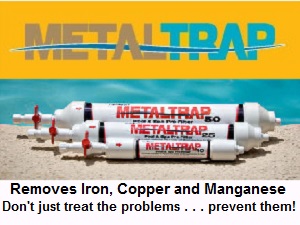
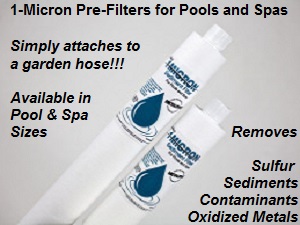
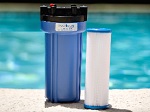
MetalTrap
1-Micron Filter removes
ultra-fine contaminants, including
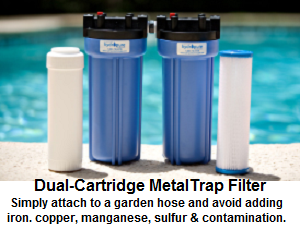
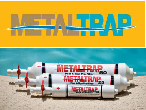
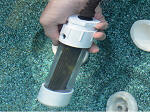
sulfur. The
MetalTrap
Dual-Cartridge Filter, available
in 3 sizes,
attaches
to a garden hose and removes dissolved
heavy metals and sediments. One
cartridge is washable and reusable and
the other is replaceable. |
|
|
If you have a pool or spa water
testing need, we have a product
that suits your needs.
► ► ►
Scroll down to read through some
Question and Answer information.
◄ ◄ ◄
|
|
Removing Stains and Discoloring Metals,
from the pool water!!! |
|
Look for
the presence of tan, tea-colored,
rusty-red or brown-black stains, as
these can indicate iron and other heavy
metals. Test for the presence,
of iron, copper and manganese Even
if there is no obvious staining, the
presence of heavy metals will cause
water discoloration and possible
staining, after chlorine or bromine are
added or the pH is raised. Depending
upon the severity of the problem, the
products below can help you eliminate or
avoid problems. The
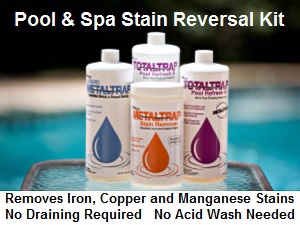
Stain Reversal
Kit contains everything needed
to remove the metal stains, eliminate
the heavy metals and help prevent a
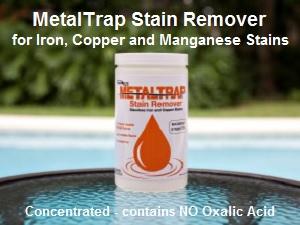
recurrence. The
Stain Remover
removes iron, copper and manganese
stains.
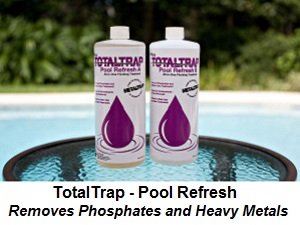
Pool
Refresh-Total Trap helps
eliminate heavy metals and phosphates,
by filtering or vacuuming them out of the
pool water. |
|
|
If you have a pool or spa water testing
need, we should have the product.
►
Scroll down to read through some
Question & Answer information.
◄
|
|
Optimizing the water chemistry and
improving pool water clarity!!! |
|
Test the water chemistry and
adjust the pH, total alkalinity, calcium
hardness and cyanuric acid, as might be
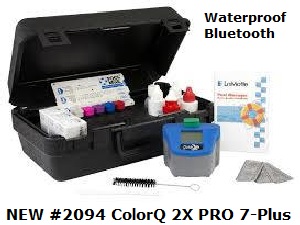
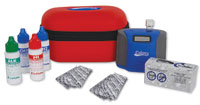
necessary. A
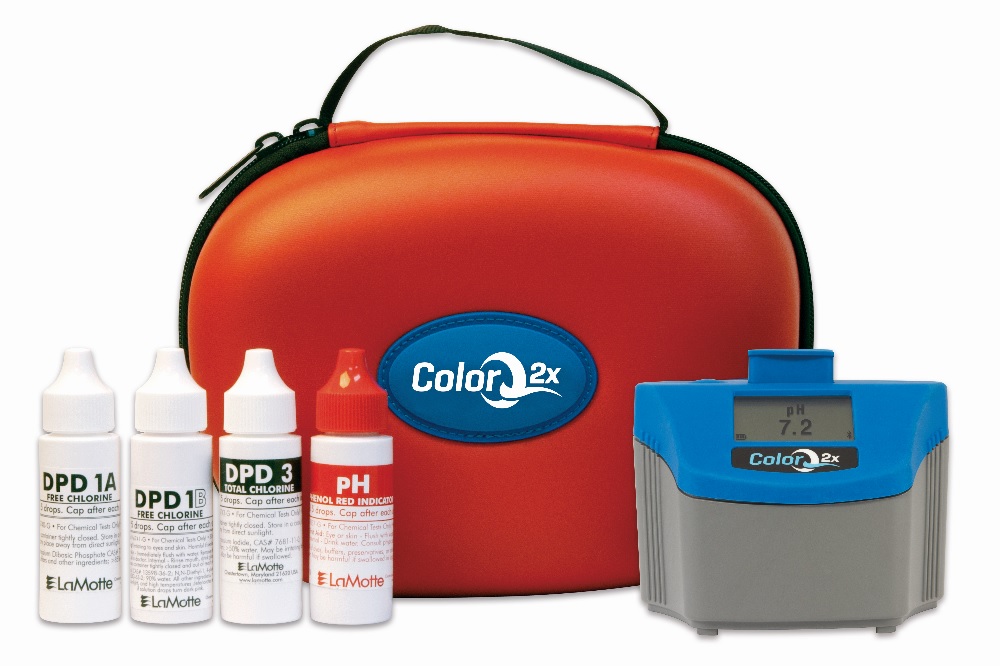
ColorQ, All-Digital Tester can
perform all of the common pool water
tests and eliminates the color-matching
and guesswork. Some tester models,
such as the #2067 ColorQ PRO 9-Plus,
perform all of the common pool water
tests, plus copper and iron. Reliable water testing will
help get the pool swimming-ready. Better
Circulation helps make everything work
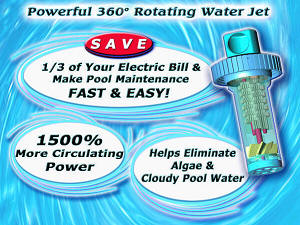
more effectively. The
Circulator is a return jet
replacement fitting, that improves
filtration, eliminates dead zones that
promote algae growth, improves sanitizer
distribution and improves chemical
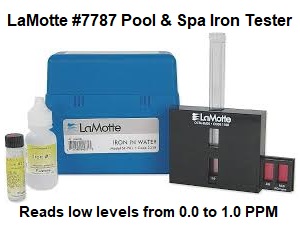
dispersion. A convenient
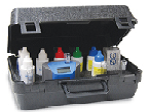
ColorQ Tester or
Iron Test Kit
can help you monitor the iron level and determine the course of
treatment. |
|
|
If you have a pool or spa water testing
need, we should have the product.
►
Scroll down to read through some
Question & Answer information.
◄
|
|
How to treat
iron problems, in swimming pool water? |
Iron makes its
presence known as a rusty or amber-brownish
stains or even as a green - amber - rusty-brown
colored pool water. In certain areas, iron is a
fairly common pool water problem and is
especially true, if the water is sourced from a
well. The discoloring pool problems are related
to the dissolved heavy metals, that are
oxidized, as chlorine or shock is added. Iron
can be treated with Mineral Treatment Products
(chelating agents). It is important to add an
excess amount of product, in order to make sure
that enough has been added to treat all of the
iron and other problematic minerals, that might
be present. Stain avoidance treatment should be
used, whenever a water analysis indicates even a
trace amount is present. Choose a product such a
Liquid MetalTrap, which is phosphate-free and
works over a very wide pH range. There is no
sense in trading an iron problem, for a
phosphate problem. An alternative method of
dealing with known iron and heavy metal problems
is to use the METALTRAP Filter, which can
physically remove the metals, as the pool water
is being added. If the new water contains
sediments, a METALTRAP dual-Cartridge Filter can
remove both ion-containing precipitates, as well
as dissolved iron and other heavy metals. Iron and other heavy metal
problems can treated with
Pool Refresh, a
2-part product, that can be used to vacuum and
filter out heavy metal and phosphates, at the
same time.
If problems arise, refer to the
Pool Problems
Page, as a source of problem-solving
information, broken down into various
categories. Scroll down the page and click on the linked
keywords,
catch phrases
or images, in the archived answers below, to access additional information, on that topic or product.
Do you know what's in
your water? If you're having problems, with stains
and discoloration, due to the presence of metals, you should
be testing for iron and copper, to better understand the
extent and cause of the problem. This helps select the
best treatment option. Understanding the nature of
the problem, should be step one. For information
about our full selection of testing options, visit our
Test Equipment Store.
For information about treatment options, visit our
Stain Treatments Store.
|
There are many causes of
stains and discolorations,
which can appear in a
variety of colors.
The color can sometimes point to a cause and solution.
Water Testing can help
verify the cause of the
problem. |
|
Stain or Discoloration Color |
Cause and Treatment |
|
Green
or
Brown |
Most likely, these are
organic, in nature, and are
due to algae and/or tannins,
leaching from many common
varieties of tree leaves.
This is more likely to
happen, if the sanitizer
(oxidizer) levels are low
and/or if there is poor
circulation, across the pool
floor.
Superchlorination and
improving circulation,
are the best course of
action. |
|
Dark
Blue,
Green
or Black |
Dark blue, green or black
colors or mixtures are
likely caused by copper.
High calcium hardness levels
tend to cause the stains to
darker, in appearance.
The source could be
corrosion of the copper heat
exchanger, natural sources,
over use of copper
algaecides, ionizer or
mineralizers. This
type of problem requires
proper chemical treatment,
such as provided by the
MetalTrap Stain Reversal Kit.
If present in the source
water, a
MetalTrap Dual-Cartridge
Filter can be connected
to the garden hose, used to
add new water. This
will help prevent the
addition of more metals,
with each new water
addition. |
|
Green,
Brown,
Tea-Colored or
Rusty-Red |
Green, Brown, Tea-Colored or
Rusty-Red colors are usually
indicative of an iron
problem. The most
likely source is the water
being used to fill the pool.
This is especially true,
when well water is used.
While the use of a
MetalTrap Stain Reversal Kit
will help solve the problem,
a
MetalTrap Dual-Cartridge
Filter should be
attached to the garden hose,
in order to avoid future
recurrences. |
|
Brown,
Black or
Purple |
Brown, Black or Purple
colors are usually an
indication of manganese
being present. This
most often occurs, when well
water is being used. A
test of the source water
should confirm the presence
of manganese. While
the use of a
MetalTrap Stain Reversal Kit
will help solve the problem,
a
MetalTrap Dual-Cartridge
Filter should be
attached to the garden hose,
in order to avoid future
recurrences. |
|
Red
or
Blue |
Red or Blue Stains can be
associated, with the
presence of berries or
vegetation.
This is more likely to
happen, if the sanitizer
(oxidizer) levels are low
and/or if there is poor
circulation, across the pool
floor.
Superchlorination and
improving circulation,
are the best course of
action. |
 |
Join our E-Letter Mailing List.
You'll receive 1-3 E-Letters a
month, featuring helpful pool
and spa advice, new product
information and sale
announcements. All we
require is your e-mail address
and you can opt out anytime you
wish.
Your information
will never be shared or sold. |
|
▼
Helpful,
Problem-Solving Information, in a question and
answer format.
▼ |
► Dealing
With Iron, Before A Problem Happens?
I have close to 1 PPM of iron in the
water, that will be used to fill my pool, inground 20,000
gallon vinyl lined. What should I do, to avoid problems with
staining?
Jack B. Jackson, NJ, 7/23/2020
After the pool is filled, most of the iron may be in
solution and some may be in suspension.
POOL REFRESH, is a
2-part product, that will help precipitate the iron and
other heavy metals, so that they can be vacuumed and
filtered to waste. Nothing beats, physically removin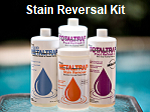 g the
iron. And this will help remove any phosphates, as well.
After this is done, I would add a quart per 10,000 gallon of
Liquid METALTRAP. This true, phosphate-free, chelating agent
will scavenge up any remaining traces of heavy metals and
keep them in a harmless state. Wait a day, for the chelating
agent to find all remaining traces of heavy metals. During
this entire process keep the filter going 24/7. Now, you're
ready to adjust the water chemistry and sanitizer levels.
During the course of the season, it will be necessary to add
water, due to evaporation, splashout or backwashing. Use a
METALTRAP Filter, connected to a garden hose to treat all
new additions of water. The metals will get trapped in this
cartridge-like filter and be kept out of the pool water.
Next spring make sure that the METALTRAP Filter is used to
treat the new water. To add an additional degree of
protection, each spring add a quart of Liquid Metal trap,
per 20,000 gallons, if the previous steps were followed.
This may sound complicated and tedious, but I can assure you
it is a lot simpler and less expensive that dealing with the
staining and coloration, that untreated iron and heavy
metals can cause. Planning ahead was a wise thing to do. g the
iron. And this will help remove any phosphates, as well.
After this is done, I would add a quart per 10,000 gallon of
Liquid METALTRAP. This true, phosphate-free, chelating agent
will scavenge up any remaining traces of heavy metals and
keep them in a harmless state. Wait a day, for the chelating
agent to find all remaining traces of heavy metals. During
this entire process keep the filter going 24/7. Now, you're
ready to adjust the water chemistry and sanitizer levels.
During the course of the season, it will be necessary to add
water, due to evaporation, splashout or backwashing. Use a
METALTRAP Filter, connected to a garden hose to treat all
new additions of water. The metals will get trapped in this
cartridge-like filter and be kept out of the pool water.
Next spring make sure that the METALTRAP Filter is used to
treat the new water. To add an additional degree of
protection, each spring add a quart of Liquid Metal trap,
per 20,000 gallons, if the previous steps were followed.
This may sound complicated and tedious, but I can assure you
it is a lot simpler and less expensive that dealing with the
staining and coloration, that untreated iron and heavy
metals can cause. Planning ahead was a wise thing to do.
Sincerely. Alan Schuster, 7/24/2020
► Do Some
Metal Treatments Break Down?
I have treated my pool with products
containing organic phosphonic acid and, while it seems to
help, over time the problem returns. Is this because the
chemical breaks down?
Janet H., 8/9/2016
That type of product is known to degrade over time, allowing
for a return of the problem. As it degrades, it forms
ortho-phosphate and that can leave you with a phosphate
problem. In addition, its effectiveness is limited, if the
pH is over 7.8. If you have a
salt chlorine generator or
plan to add one, that type of product is not the best
choice. A salt chlorine generator tends to keep the pH at
7.8 or higher, unless daily attention is paid to the pH. A
product, such as Liquid METALTRAP is phosphate-free and is
unaffected by the pH of the pool. There are other METALTRAP
products to help you remove metals, from new water additions
and products to remove stains. I hope that this will help
you resolve the issue.
Sincerely. Alan Schuster, 8/9/2016
► Iron Stains?
There is an amber-brownish colored stain in the deep end of
my vinyl liner, in-ground pool. According to the dealer, I
have 0.2 PPM of iron. He is not sure that it is an iron
stain. What should I do? Thank you for any help.
G.F., Milton, PA, 7/14/2017
It is probable that the stain is iron. We know there is iron
present in the water and 0.2 PPM of iron is enough to cause
a pool water problem. First start by adding a dose of
Liquid
MetalTrap: a quality, phosphate-free, Mineral Treatment
Product, that works over a wide pH range. This will chelate
(complex) with iron and help prevent further staining. To
determine, if the stains can be removed with an acidic
solution try this: put a 1/2 pound of pH decreaser in a
white sock and drop onto a stained area. Leave in place for
about 10 minutes. If improvement is seen, as expected, a
very practical method of removal would be to use a
stain-remover accessory. This gadget (available at many pool
stores) will allow you to siphon an acidic solution onto the
stains. To make a suitable solution: to a 1/2 gallon of
water, in a plastic container, add 1 quart of a Liquid
MetalTrap and 1 quart of muriatic acid. Make sure that you
wear rubber gloves and eye protection! Use the
stain-remover accessory to siphon the liquid onto the
stains. If the area is large you might want to allow the
chlorine to bottom out and then add ascorbic acid, as
directed. Give it a day or two, before adjusting the pH or
adding chlorine, as necessary. There is another non-chemical
solution, to the problem. Using the METALTRAP Filter, you
can treat all new water, which helps keep new additions of
iron and other metals out and minimizes the possibility of
staining. You could, also, use The METALTRAP Filter to
recirculate the pool water and lower the iron and heavy
metal content, already present in the pool water. I hope
that these instructions will prove helpful. works over a wide pH range. This will chelate
(complex) with iron and help prevent further staining. To
determine, if the stains can be removed with an acidic
solution try this: put a 1/2 pound of pH decreaser in a
white sock and drop onto a stained area. Leave in place for
about 10 minutes. If improvement is seen, as expected, a
very practical method of removal would be to use a
stain-remover accessory. This gadget (available at many pool
stores) will allow you to siphon an acidic solution onto the
stains. To make a suitable solution: to a 1/2 gallon of
water, in a plastic container, add 1 quart of a Liquid
MetalTrap and 1 quart of muriatic acid. Make sure that you
wear rubber gloves and eye protection! Use the
stain-remover accessory to siphon the liquid onto the
stains. If the area is large you might want to allow the
chlorine to bottom out and then add ascorbic acid, as
directed. Give it a day or two, before adjusting the pH or
adding chlorine, as necessary. There is another non-chemical
solution, to the problem. Using the METALTRAP Filter, you
can treat all new water, which helps keep new additions of
iron and other metals out and minimizes the possibility of
staining. You could, also, use The METALTRAP Filter to
recirculate the pool water and lower the iron and heavy
metal content, already present in the pool water. I hope
that these instructions will prove helpful.
Sincerely. Alan Schuster, 7/15/2017
► Turned
Brown?
Dear Alan, we have put up a small pool
(2400 gallon) that was a kit from a local store, complete
with a water pump/filter, cover and such. Problem is we
filled it from a well. The well is known to have both iron
and sulfur in the water. When I added the initial set of
chemicals (stabilizer, shock and chlorine) the water turned
real brownish in color. I presume (from one of your
articles) it's because of the iron, but I'm also wondering
about the sulfur. Do I only need to address the iron issue
with a chelating agent, or do I need to do something special
for the sulfur too? Thanks and Regards,
Mitch, 5/18/2012
A quality mineral treatment (chelating agent) is one of the
proper treatments, for the iron problem.
Liquid METALTRAP is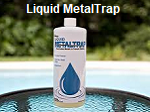 especially well suited, as it is phosphate-free and works
over a wide pH range. It works best before chlorine has been
added or the pH has been increased. In fact, you should to
add the product as the pool is being filled. If you would
have used a METALTRAP mineral removing filter, which
attaches to a garden hose, you might have been able to
remove a lot of the particulated iron and other metals.
Using it on all future water additions, also makes sense. A
shock treatment should take care of the sulfur. Make sure
that there is a 1-3 PPM level of Free Chlorine, that
persists for an over night period. The sulfur will be
oxidized to harmless sulfates. I hope that I have been
helpful. Enjoy the pool.
especially well suited, as it is phosphate-free and works
over a wide pH range. It works best before chlorine has been
added or the pH has been increased. In fact, you should to
add the product as the pool is being filled. If you would
have used a METALTRAP mineral removing filter, which
attaches to a garden hose, you might have been able to
remove a lot of the particulated iron and other metals.
Using it on all future water additions, also makes sense. A
shock treatment should take care of the sulfur. Make sure
that there is a 1-3 PPM level of Free Chlorine, that
persists for an over night period. The sulfur will be
oxidized to harmless sulfates. I hope that I have been
helpful. Enjoy the pool.
Sincerely. Alan Schuster, 5/19/2012
► Rusty-Brown
Water?
The area that I live in has iron in
the water. Several times, in the past, I have had the pool
water suddenly turned rusty or brown, right after I added
some chlorine. I'm sure that it was because of the iron. The
dealer had me treat the water with a chemical and everything
seems to be all right. Is there something that I can do to
avoid it from happening again?
Betty J., Littleton, MA, 6/2/2009
In all likelihood, the dealer had you add a Mineral
Treatment, that was a chelating agent, but may not have been
phosphate-free. Liquid MetalTrap is phosphate-free and
works over a wide pH range. Hopefully, you are not
exchanging an iron problem, for a future phosphate problem.
This complexed the iron and allowed it to remain in
solution, without discoloration
or staining. From now on, it is
important to add this chemical
before any make up water is added.
In addition, I would add some every
month, just to make sure that there
is an excess. The iron is still in
the water: it has been chelated and
is now soluble and colorless and you
want to keep it that way. Springtime
opening: add some more. Pool
closing: add some more. It may sound
like overkill, but it will save you
aggravation and the possibility of
staining and discoloration problems.
Considering that your water is known
to contain iron, there is another solution, to the problem.
A MetalTrap
Stain Reversal Kit contains a
regimen of products, that will
dissolve the stains, help you vacuum
and filter the metals out of the
pool and help avoid a recurrence.
Afterwards, you can use a
METALTRAP Filter,
to treat all new water,
which helps keep new additions of iron and other metals out
and minimizes the possibility of staining. In the long run you'll probably save money,
by staying ahead of the problem. I hope the advice does the trick.
Sincerely. Alan Schuster, 6/2/2009
► Lots Of
Rust?
I sure hope you can help, we just
purchased an above ground pool, we live in a small town in
Illinois on it's own well system the water is very hard and
often has rust (iron oxide) in it. We filled our pool using
this water now we have the rust settled on the bottom of the
pool unless it gets stirred up then the water is brown and
nasty looking. What can we do to clean the water, we tried
vacuuming the bottom but the deposits are like a fine silt
and only stirs not vacuuming up. A rapid response would sure
be appreciated my grandkids are so excited they want to get
in anyway, but I won't let them.
Diane M., Illinois, 6/11/2009
Avoid adding chlorine and other chemicals right now. I
suggest that you keep trying to vacuum as much as possible
through the filter and not to waste. Try adding a dose of a
"Blue" Clarifier. It should help coagulate the particles for
easier removal. Keep the filter
operating non-sto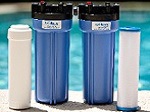 p. Try to get as much out as possible and
then backwash to waste or clean the filter. Before adding
chemicals, have the water tested for iron. For each 0.5 PPM
of iron or fraction, add a dose of a quality mineral
treatment. Allow to circulate for several hours before
adding other chemicals. When adding new water, try and place
the hose in the skimmer to allow the filter an opportunity
to remove the suspended iron. Precede each new water
addition with a dose of phosphate-free, chelating agent,
such as Liquid METALTRAP and add another dose on a monthly
basis. Well water is almost always a problem and there is a
better solution, for the problem. You can use a
METALTRAP
Dual-Cartridge Filter to pre-treat all new water, which helps keep new
additions of iron and other metals out and minimizes the
possibility of staining. You could, also, use The METALTRAP
Dual-Cartridge Filter
to recirculate the pool water and lower the iron and heavy
metal content, already present in the pool water. Well water
can be a challenge and is best when treatment is started
early. Good luck. I hope that this information is helpful. p. Try to get as much out as possible and
then backwash to waste or clean the filter. Before adding
chemicals, have the water tested for iron. For each 0.5 PPM
of iron or fraction, add a dose of a quality mineral
treatment. Allow to circulate for several hours before
adding other chemicals. When adding new water, try and place
the hose in the skimmer to allow the filter an opportunity
to remove the suspended iron. Precede each new water
addition with a dose of phosphate-free, chelating agent,
such as Liquid METALTRAP and add another dose on a monthly
basis. Well water is almost always a problem and there is a
better solution, for the problem. You can use a
METALTRAP
Dual-Cartridge Filter to pre-treat all new water, which helps keep new
additions of iron and other metals out and minimizes the
possibility of staining. You could, also, use The METALTRAP
Dual-Cartridge Filter
to recirculate the pool water and lower the iron and heavy
metal content, already present in the pool water. Well water
can be a challenge and is best when treatment is started
early. Good luck. I hope that this information is helpful.
Sincerely. Alan Schuster, 6/11/2009
Alan, Thank you for your help. A pool
owner in our town said that they add pH minus to their pool
after filling it up and that clears it up after a couple of
applications. We put that in last night then an hour later
we shocked, will this cause a problem with the Blue? Thanks
once again you are very helpful.
Diane, 6/11/2009
I was trying to help you get the iron discoloration out of
the water. Adding the pH minus will dissolve the iron and it
will remain in the water. The Liquid METALTRAP should
complex the iron and help keep it in a colorless and soluble
state. You must add the Liquid METALTRAP and add enough of
it. Have the water tested for iron! You can add the "Blue"
Clarifier, the following day. Good luck.
Alan, 6/11/2009
Thanks so much, I've passed your
information on to the person that told me to use the pH
minus so they can try the mineral treatment instead. I loved
your website.
Diane, 6/11/2009
► Mineral
Stain Avoidance?
I plan on filling a 16,000 gallon
vinyl pool with water from my private well. I know that
there is a low level of manganese in the water. How should I
treat the water after I fill the pool up? I hope that you
will be able to offer some advice. Sincere thanks.
Don C., Westhampton, NY, 6/26/2007
Fortunately, you know that there is manganese in the water.
It would have been helpful to know how much.
Testing for
Iron and or Manganese is very important for planning a
successful treatment. Having lived on Long Island, I know
what a problem manganese can be in some pools on the south
shore. Those brown-black stains and discoloration are not
great to look at. In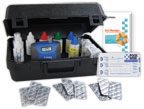 addition to having manganese, it is
likely that the water has iron and other minerals. Manganese
is frequently associated with a purplish discoloration or
stain. The incidence of manganese problems, is for the most
part, limited to well water or corrosion of stainless steel.
Both iron and manganese can be treated along similar lines.
As the water is being fed into the pool, add 2 quarts of
phosphate-free, Liquid METALTRAP, for each 1 PPM of iron and
manganese present in the fill water. Adding more is better
than adding less. After the pool has been filled,
recirculate the water for an hour. At this point, you can
begin to adjust the overall water chemistry. The early
addition of the Mineral Treatment should spare you from the
problems associated with manganese. Now, there is a better
option! Well water is almost always a problem and there is a
better solution, for the problem. The
METALTRAP Filter
enables you to pre-treat all new water, which helps keep new
additions of iron and other metals out of the pool water and
minimizes the possibility of staining. You could, also, use
The METALTRAP Filter to recirculate the pool water, lowering
the iron and heavy metal content, already present in the
pool water. The METALTRAP Filter does it all and you may not
need any chemicals, depending on your water quality. Good
luck and enjoy the season. addition to having manganese, it is
likely that the water has iron and other minerals. Manganese
is frequently associated with a purplish discoloration or
stain. The incidence of manganese problems, is for the most
part, limited to well water or corrosion of stainless steel.
Both iron and manganese can be treated along similar lines.
As the water is being fed into the pool, add 2 quarts of
phosphate-free, Liquid METALTRAP, for each 1 PPM of iron and
manganese present in the fill water. Adding more is better
than adding less. After the pool has been filled,
recirculate the water for an hour. At this point, you can
begin to adjust the overall water chemistry. The early
addition of the Mineral Treatment should spare you from the
problems associated with manganese. Now, there is a better
option! Well water is almost always a problem and there is a
better solution, for the problem. The
METALTRAP Filter
enables you to pre-treat all new water, which helps keep new
additions of iron and other metals out of the pool water and
minimizes the possibility of staining. You could, also, use
The METALTRAP Filter to recirculate the pool water, lowering
the iron and heavy metal content, already present in the
pool water. The METALTRAP Filter does it all and you may not
need any chemicals, depending on your water quality. Good
luck and enjoy the season.
Sincerely. Alan Schuster, 6/27/2007
► Yikes It's Iron?
Alan, when we opened the pool this
year, and "yikes" for the first time ever, we have rust all
around the pool sides. The winter waterline down, but none
on the floor of the pool. Why would we have this problem
now? Our water source hasn't changed and it's not well
water. Well, my better half decided to put a mineral
treatment in the pool (not a lot, but it's still in there).
Have we made a terrible mistake? Will our chemical levels be
out of whack all summer and will we be able to swim in the
pool? Now I am afraid to add any of the chemicals from the
pool opening kit. Please help, thanks.
Karen from Ohio, 6/10/2017
If the pool water problem is really iron, adding an iron
mineral treatment was the right thing to do! It is possible
for trace amounts of iron to be present in tap water.
However, that should not have caused the problem. If it is
iron, it somehow made its way into the pool. It could have
been that the last time water was added, a fire hydrant was
opened in the neighborhood. This can lift sediments off the
bottom and deliver them to your pool. Try this. Put 1/2
pound of pH reducer powder in a white sock, tie a string
onto the sock and drape it over the wall of the pool. Let it
contact the stained area. If improvement is seen, within
15-30 minutes, it is confirmation that the problem is iron
and/or other metals. Source unknown! It might be necessary
for you to lower the pH drastically to approximately 6. Use
the brush on the walls and keep the filter
going. Afterwards, add a triple dose of a quality,
phosphate-free, mineral treatment, such as
Liquid METALTRAP,
to help prevent a recurrence. When everything is back to
normal, backwash or clean the filter. This will help prevent
the material from being redissolved in the water. Yes, you
will be able to swim and the chemistry can be corrected. To
better assure proper overall pool water chemistry, visit a
pool store that has a very reliable, professional lab such
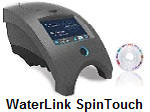
as a WaterLink
SpinTouch
Lab, rather than a less accurate test kit or strip
reader. I hope that I have
provided the solution. This can lift sediments off the
bottom and deliver them to your pool. Try this. Put 1/2
pound of pH reducer powder in a white sock, tie a string
onto the sock and drape it over the wall of the pool. Let it
contact the stained area. If improvement is seen, within
15-30 minutes, it is confirmation that the problem is iron
and/or other metals. Source unknown! It might be necessary
for you to lower the pH drastically to approximately 6. Use
the brush on the walls and keep the filter
going. Afterwards, add a triple dose of a quality,
phosphate-free, mineral treatment, such as
Liquid METALTRAP,
to help prevent a recurrence. When everything is back to
normal, backwash or clean the filter. This will help prevent
the material from being redissolved in the water. Yes, you
will be able to swim and the chemistry can be corrected. To
better assure proper overall pool water chemistry, visit a
pool store that has a very reliable, professional lab such
as a WaterLink
SpinTouch
Lab, rather than a less accurate test kit or strip
reader. I hope that I have
provided the solution.
Sincerely. Alan Schuster, 6/10/2017
► Using
Sodium Gluconate To Chelate Iron?
Please help. I have a pool of 10,000
gallons of water and somehow a lot of iron has been found in
the water. Someone told me about sodium gluconate. Is this
Ok to use in the pool water to chelate the iron? Also how
much would I need to use in 10,000 gallons of water and at
what pH? Thank you.
Demetries, A., 10/27/2011
I have never heard of sodium gluconate used in the pool
industry, as a treatment for iron. It is considered to be a
chelating agent for iron, but at near neutral pH. At the
more alkaline pH, found in most pools, it is more apt to
chelate the far more abundant calcium. Therefore it would
seem a poor choice. In addition, I have no idea of how well
it could survive in a chlorine-based pool. On the other
hand, Liquid MetalTrap will chelate iron, in the presence of
chlorine and over the widest pH range, that might be
encountered. It is also phosphate-free. A
MetalTrap Filter
Cartridge can be used, with a small submersible pump, to
remove iron, as the water passes through it. It can also be
used to treat all new water being added to the pool. I hope
that you will find this information helpful.
Sincerely. Alan Schuster, 10/7/2011
|
Visit The Website Stores . . . for
better informed shopping!!! |
|
|
Shipping is FREE* . . . within
the Continental U.S.
A $9.99
handling charge will apply
to Continental U.S. Orders,
under $75.00. Orders
outside of the Continental
U.S. may require some
additional charge, based on
quantity and destination.
Most products can be
shipped World-Wide. International
and orders outside of
Continental U.S. - see
comments on the ordering
pages. |
|
|
Major
Credit Cards and PayPal are accepted. |
|
▲
Return To Top Of Page
▲
Aqualab Systems, LLC does not
make any warranty or
representation, either expressed
or implied, regarding the
accuracy or completeness of the
information provided by this
website; nor does Aqualab
Systems., LLC. assume any
liability of any kind whatsoever
related to, or resulting from,
any use or reliance on this
information. The content of this
website should not be used, if
it is conflict with any
applicable federal, state or
local regulations or guidelines.
© Aqualab Systems, LLC. All
rights reserved
|
|