| |
|
Scroll
down to browse through some archived SWIMMING POOL
questions and answers. Please click the Pool
Problems Link, on top of every page, to access a complete
listing of Pool Problem subjects, an alphabetized
Website Table of Contents, Pool Equipment Information,
About Alan Biographic Material and a Pool Glossary. Use
the other links to access additional subject
information. More information about some new and unique
products, for pools and spas, can be found by visiting
The Website Store.
You'll never know what you'll find and that's always
fun. Be better prepared and avoid costly problems!
|
|
 |
Shipping is FREE* . . . within
the Continental U.S.
A $9.99
handling charge will apply
to Continental U.S. Orders,
under $75.00. Orders
outside of the Continental
U.S. may require some
additional charge, based on
quantity and destination.
Most products can be
shipped World-Wide. International
and orders outside of
Continental U.S. - see
comments on the ordering
pages. |
|
 |

Major
Credit Cards and PayPal are accepted. |
|
On-line
shopping since 2002 - Safe and Secure!!! |
|
Avoiding Staining and Discoloration
every time new water is added!!! |
|
Manganese
and other heavy metals can be present.
in the water supply, especially when
well water is used. If there is
a possibility that new water additions
will contain sediments, dissolved metals
or contaminants, you should consider
using a
pre-filter. It
is better to avoid a problem, than to
try and treat it, after the water has
been added to the pool. The products
below can remove sediments, metals such
as iron, copper and manganese and
contaminates such as sulfur. The
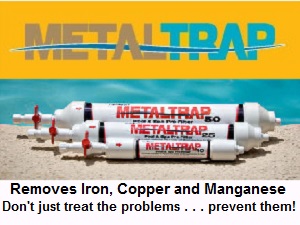
MetalTrap
Filter, available in 3 sizes, attaches to the garden
hose and removes dissolved iron, copper
and manganese. The
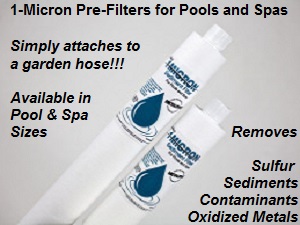
MetalTrap
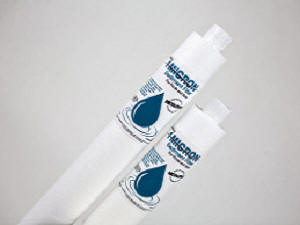
1-Micron Filter removes
ultra-fine contaminants, including
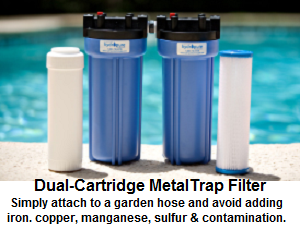
sulfur. The
MetalTrap
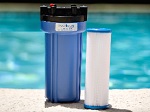
Dual-Cartridge Filter, available
in 3 sizes,
attaches
to a garden hose and removes dissolved
heavy metals and sediments. One
cartridge is washable and reusable and
the other is replaceable. |
|
|
If you have a pool or spa water
testing need, we should have the
product.
►
Scroll down to read through some
Question & Answer information.
◄
|
|
Removing Stains and Discoloring Metals,
from the pool water!!! |
|
Look for the presence of
purple, brown
or black stains, as these can indicate
manganese and other heavy metals.
The added presence, of copper or iron.
can add different discoloration
possibilities. Even
if there is no obvious staining, the
presence of heavy metals will cause
water discoloration and possible
staining, after chlorine or bromine are
added or the pH is raised. Depending
upon the severity of the problem, the
products below can help you eliminate or
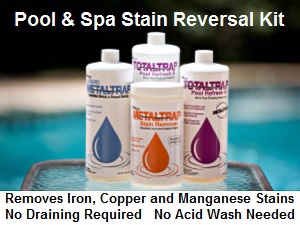
avoid problems. The
Stain Reversal
Kit contains everything needed
to remove the metal stains, eliminate
the heavy metals and help prevent a
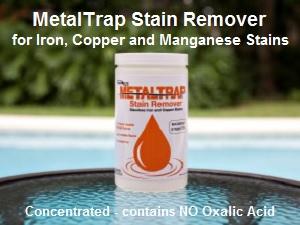
recurrence, of the problem. The
Stain Remover
removes iron copper and manganese
stains.
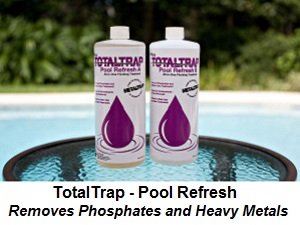
Pool
Refresh-Total Trap helps
eliminate heavy metals and phosphates,
by filtering or vacuuming them out of the
pool water. |
|
|
If you have a pool or spa water
testing need, we should have the
product.
►
Scroll down to read through some
Question & Answer information.
◄
|
|
Optimizing the water chemistry and
improving pool water clarity!!! |
|
Test the water chemistry and
adjust the pH, total alkalinity, calcium
hardness and cyanuric acid, as might be
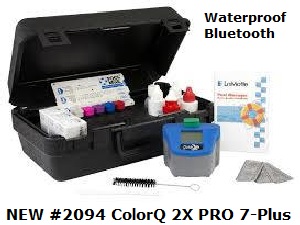
necessary. A
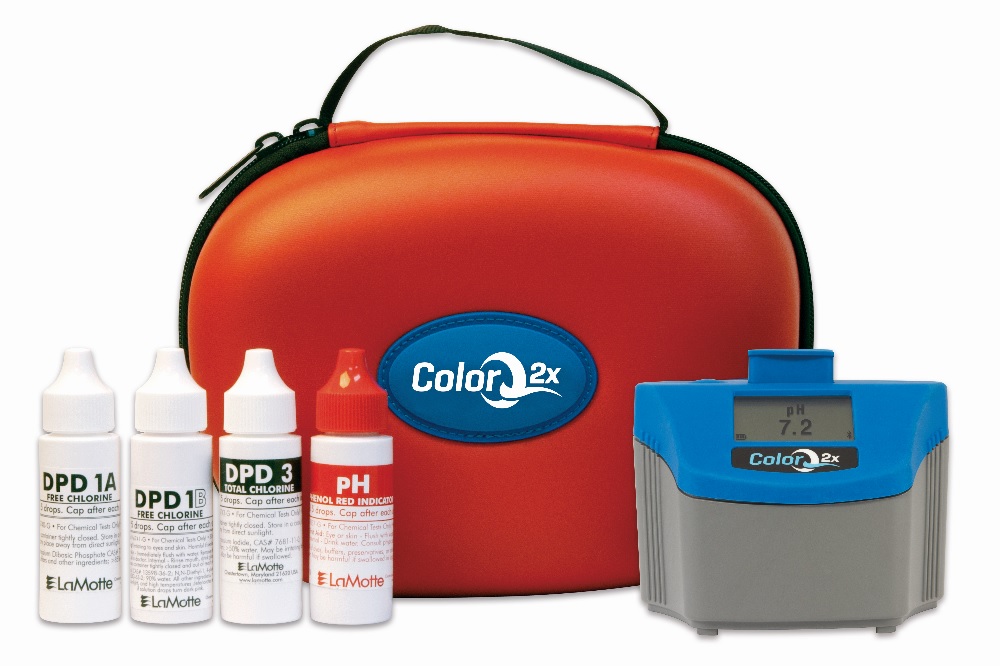
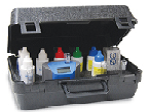
ColorQ, All-Digital Tester can
perform all of the common pool water
tests and eliminates the color-matching
and guesswork. Some tester models,
such as the #2067 ColorQ PRO 9-Plus,
perform all of the common pool water
tests, plus copper and iron. Reliable water testing will
help get the pool swimming-ready. Better
Circulation helps make everything work
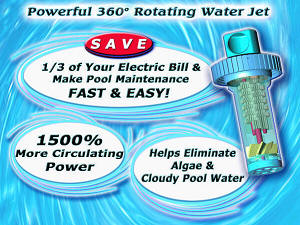
more effectively. The
Circulator is a return jet
replacement fitting, that improves
filtration, eliminates dead zones that
promote algae growth, improves sanitizer
distribution and improves chemical
dispersion. A simple
Manganese Test
Kit can help you monitor the
level and determine the course of
treatment. |
|
|
If you have a pool or spa water
testing need, we should have the
product.
►
Scroll down to read through some
Question & Answer information.
◄
|
|
How to treat manganese problems in swimming
pools? |
Manganese is one of the more troubling swimming
pool mineral problems. This is especially true,
if the water is sourced from a private well.
Manganese shows up as a brown-black stain or
discoloration and, thankfully, is not common in
most areas. Purple stains or even
crystal-clear purple water can occur, due to the
presence of manganese. Corrosion of stainless
steel (contains manganese) can lead to purple
discolorations. In most cases the pool
discoloration problem, is associated with the
oxidation of the heavy metals, that are present
in the water. Manganese can be treated with
Mineral Treatment products (chelating agent).
Higher than normal dosages should be used
because of the likelihood that other minerals
are present, but not necessarily detected. Stain
avoidance treatment should be used, whenever a
water analysis indicates even a trace amount of
manganese is present. An alternative method of
dealing with known manganese and heavy metal
problems is to use the METALTRAP Filter, which
can physically remove the metals, as the pool
water is being added. If sediments are present
in the source water, a METALTRAP Dual-Cartridge
Filter will remove both the precipitated metals,
as well as the dissolves metallic ions, greatly
reducing the likelihood of staining and
discoloration. Manganese problems can
treated with Pool Refresh,
a 2-part product that will help you filter and
vacuum the manganese and other heavy metals out
of the pool. If problems
arise, refer to the
Pool Problems
Page, as a source of problem-solving
information, broken down into various
categories. Scroll down the page and click on the linked
keywords,
catch phrases
or images, in the archived answers below, to access additional information, on that topic or product.
Do you know what's in your
water? If you're having problems, with stains and
discoloration, due to the presence of metals, you should be
testing for iron, copper and manganese, to better understand
the extent and cause of the problem. This helps select
the best treatment option. Understanding the nature
of the problem, should be step one. For
information about our full selection of testing options,
visit our Test
Equipment Store. For information about treatment
options, visit our Stain Treatments
Store.
|
There are many causes of stains and discolorations,
which can appear in a variety of colors.
The color can sometimes point to a cause and solution.
Water Testing
can help verify the cause of the problem. |
|
Stain
or Discoloration Color |
Cause
and Treatment |
|
Green or
Brown |
Most likely, these are organic, in nature, and are
due to algae and/or tannins, leaching from many
common varieties of tree leaves. This is more
likely to happen, if the sanitizer (oxidizer) levels
are low and/or if there is poor circulation, across
the pool floor. Superchlorination and
improving circulation,
are the best course of action. |
|
Dark Blue, Green
or Black |
Dark blue, green or
black colors or mixtures are likely caused by
copper. High calcium hardness levels tend to cause
the stains to darker, in appearance. The
source could be corrosion of the copper heat
exchanger, natural sources, over use of copper
algaecides, ionizer or mineralizers. This type
of problem requires proper chemical treatment, such
as provided by the MetalTrap
Stain Reversal Kit. If present in the
source water, a MetalTrap
Dual-Cartridge Filter can be connected to the
garden hose, used to add new water. This will
help prevent the addition of more metals, with each
new water addition. |
|
Green,
Brown,
Tea-Colored or
Rusty-Red |
Green, Brown, Tea-Colored or Rusty-Red colors are
usually indicative of an iron problem. The
most likely source is the water being used to fill
the pool. This is especially true, when well
water is used. While the use of a
MetalTrap Stain Reversal Kit
will help solve the problem, a
MetalTrap Dual-Cartridge
Filter should be attached to the garden hose, in
order to avoid future recurrences. |
|
Brown, Black or Purple |
Brown, Black or Purple
colors are usually an indication of manganese being
present. This most often occurs, when well
water is being used. A test of the source
water should confirm the presence of manganese.
While the use of a MetalTrap
Stain Reversal Kit will help solve the problem,
a MetalTrap Dual-Cartridge
Filter should be attached to the garden hose, in
order to avoid future recurrences. |
|
Red or
Blue |
Red or Blue Stains can be associated, with the
presence of berries or vegetation.
This is more likely to happen, if the sanitizer
(oxidizer) levels are low and/or if there is poor
circulation, across the pool floor.
Superchlorination and
improving circulation, are the best course of
action. |
 |
Join our E-Letter Mailing List.
You'll receive 1-3 E-Letters a
month, featuring helpful pool
and spa advice, new product
information and sale
announcements. All we
require is your e-mail address
and you can opt out anytime you
wish.
Your information
will never be shared or sold. |
|
▼
Helpful,
Problem-Solving Information, in a question and
answer format.
▼ |
►
Keeping Manganese Out Of The Pool?
Hi Alan. I am looking for a
filter that I can attach to an outdoor garden
hose, that will remove manganese, when I need to
add water to my pool. Would the MetalTrap
1-Micron Pre-Filter, model PS-PF for pools, work
for that? Thanks.
Paul C. 8/17/2020
Manganese can be a serous staining
and discoloration problem. Manganese can exist
in two forms: fine sediments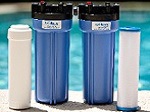 and in the soluble, dissolved state. The
MetalTrap 1-Micron
Pre-Filter will remove all types of
sediments, down to 1-micron,
but will have no
effect on removing dissolved manganese, copper
or iron. It will help, but probably will not
solve the problem. The
MetalTrap Dual-Cartridge Filter is a better
option and does connect to a standard garden
hose. It use two different filter cartridges.
The first is a 5-micron filter cartridge that
removes sediments and is washable and reusable.
The second cartridge can remove up to 1 PPM, of
dissolved metals, from up to 28,000 gallons of
water. If the level is over 1 PPM, it will treat
proportionally less than 28,000 gallons. This
cartridge is not reusable, but is replaceable.
This product treats manganese, iron and copper,
whether present as a sediment or in a dissolved
state. I hope that this will be your solution.
and in the soluble, dissolved state. The
MetalTrap 1-Micron
Pre-Filter will remove all types of
sediments, down to 1-micron,
but will have no
effect on removing dissolved manganese, copper
or iron. It will help, but probably will not
solve the problem. The
MetalTrap Dual-Cartridge Filter is a better
option and does connect to a standard garden
hose. It use two different filter cartridges.
The first is a 5-micron filter cartridge that
removes sediments and is washable and reusable.
The second cartridge can remove up to 1 PPM, of
dissolved metals, from up to 28,000 gallons of
water. If the level is over 1 PPM, it will treat
proportionally less than 28,000 gallons. This
cartridge is not reusable, but is replaceable.
This product treats manganese, iron and copper,
whether present as a sediment or in a dissolved
state. I hope that this will be your solution.
Sincerely. Alan Schuster, 8/17/2020
►
The Gardeners Caused Manganese Stains?
Our gardeners accidentally spilled some manganese
sulphate into our pool when applying it to our
pigmy palms. This has created some stains at the
bottom of our pool. Which of the products listed
is the best to use for removing these stains?
Doug H., 1/27/2017
The most
common metals to cause staining
are iron, copper and manganese.
Manganese is the least common
and usually the hardness to
treat. Few dealers have the
ability to test for manganese,
to make matter worse. Simply
adding a metal treatment is very
unlikely to work. This will take
a regimen. Before attempting the
solution below, add a dose of a
60% polymer algaecide, to help
maintain water quality, during
the necessary absence of
chlorine. The information below
is based on 1 PPM of manganese,
which is just a few ounces in
10,000 gallons of water. Should
you find a dealer with a tester, it does not
measure the manganese that
already has precipitated and
lead to staining. Removing
stains can sometimes be easier
than keeping them from
returning. The oxidized salts of
metals such as iron, copper and
manganese are much less soluble,
than their reduced forms. By
adding METALTRAP Stain Remover
to a chlorine-free pool, it will
solubilize the manganese, by
converting it to a more soluble
and less colored state. When the
stains are gone, even though the
water may be discolored, now is
when you want to add
POOL
REFRESH-TOTALTRAP. This
product will precipitate the
manganese. for easy removal by
filtration or vacuuming to
waste. Use as directed. To
prevent any manganese that might
have collected in your filter,
prior to treatment, clean of
backwash the filter. Otherwise,
you could be adding to the
problem.
Once
the POOL REFRESH and
filtration/vacuuming to waste
has solved the problem, add
1-quart of Liquid MetalTrap, for
each 10,000 gallons. This will
help scavenge up any remaining
traces and prevent a recurrence.
Wait a day or two, before
starting to add chlorine. The
amount required will be high,
because it will be destroying
the excess MetalTrap Stain
Remover. The
METALTRAP Stain Reversal Kit
contains most of what is needed.
Manganese test kits are
available, but are much more
expensive that most other pool
test.
I hope that I have been helpful.
If so, please tell your friends
and dealers about the website.
with a tester, it does not
measure the manganese that
already has precipitated and
lead to staining. Removing
stains can sometimes be easier
than keeping them from
returning. The oxidized salts of
metals such as iron, copper and
manganese are much less soluble,
than their reduced forms. By
adding METALTRAP Stain Remover
to a chlorine-free pool, it will
solubilize the manganese, by
converting it to a more soluble
and less colored state. When the
stains are gone, even though the
water may be discolored, now is
when you want to add
POOL
REFRESH-TOTALTRAP. This
product will precipitate the
manganese. for easy removal by
filtration or vacuuming to
waste. Use as directed. To
prevent any manganese that might
have collected in your filter,
prior to treatment, clean of
backwash the filter. Otherwise,
you could be adding to the
problem.
Once
the POOL REFRESH and
filtration/vacuuming to waste
has solved the problem, add
1-quart of Liquid MetalTrap, for
each 10,000 gallons. This will
help scavenge up any remaining
traces and prevent a recurrence.
Wait a day or two, before
starting to add chlorine. The
amount required will be high,
because it will be destroying
the excess MetalTrap Stain
Remover. The
METALTRAP Stain Reversal Kit
contains most of what is needed.
Manganese test kits are
available, but are much more
expensive that most other pool
test.
I hope that I have been helpful.
If so, please tell your friends
and dealers about the website.
Sincerely, Alan Schuster, 1/28/2017
► Manganese Stains?
I plan on filling a 16,000 gallon
vinyl pool with water from my private well. I know that
there is a low level of manganese in the water. How should I
treat the water after I fill the pool up? I hope that you
will be able to offer some advise. Sincere thanks.
Don C., Westhampton, NY, 7/14/2013
Fortunately, you know that there is manganese in the water.
It would have been helpful to know how much. Testing for
Iron and/or Manganese is very important
is planning a successful treatment.
Having lived on Long Island, I know
what a problem manganese can be on
the south shore. Those brown-black
stains and discoloration are not
great to look at. In addition to
having manganese, it is likely that
the water has iron and other
minerals. Manganese is frequently
associated with a purple discoloration or stain. The
incidence of manganese problems, is for the most part,
limited to well water or corrosion of stainless steel. Both
iron and manganese can be treated along similar lines. The
use of the METALTRAP Filter can help remove manganese and
other heavy metals as the water is being fed into the pool.
This will help prevent discoloration and/or staining, that
might follow upon the addition of chlorine and other
chemicals. Thereafter, use the METALTRAP Filter, when adding
all new water. This preventative maintenance could spare you
a lot of grief and the risk of unsightly staining. Good luck
and enjoy the season.
and/or Manganese is very important
is planning a successful treatment.
Having lived on Long Island, I know
what a problem manganese can be on
the south shore. Those brown-black
stains and discoloration are not
great to look at. In addition to
having manganese, it is likely that
the water has iron and other
minerals. Manganese is frequently
associated with a purple discoloration or stain. The
incidence of manganese problems, is for the most part,
limited to well water or corrosion of stainless steel. Both
iron and manganese can be treated along similar lines. The
use of the METALTRAP Filter can help remove manganese and
other heavy metals as the water is being fed into the pool.
This will help prevent discoloration and/or staining, that
might follow upon the addition of chlorine and other
chemicals. Thereafter, use the METALTRAP Filter, when adding
all new water. This preventative maintenance could spare you
a lot of grief and the risk of unsightly staining. Good luck
and enjoy the season.
Sincerely. Alan Schuster, 7/14/2013
► Manganese
or Magnesium?
I am confused about manganese and
magnesium. What's the difference?
Ed. B., 8/14/2020
Magnesium chemistry is closely related to that of calcium.
However, it is much more soluble in a swimming pool. It is
not associated with any staining or colored pool water
problems. Magnesium contributes to the TOTAL HARDNESS of the
water and unless the water is very hard, there should not be
a problem. Manganese is completely unrelated and is almost
always the center of a staining and/or a colored pool water
problem. Manganese is not common in municipal water
supplies. However, in some areas, it can be present in well
water. If manganese is suspected of being a potential
problem, a water analysis will help determine the
concentration. This is important in order to help assure
proper treatment. In areas where the problem exists, dealers
should test for manganese. Although manganese discoloration
and stains can be treated with chemicals, such as
a METALTRAP Stain Reversal
Kit, which contains everything
you need to remove the stain and
eliminate the metals, for the pool
water. The physical removal of
the manganese and other heavy
metals, helps assure that staining
and discoloration will nor recur. A
METALTRAP Filter can be used to remove metals from
all new water, being added
to the pool, thereby avoiding another potential problem. I hope that I
have eliminated the confusion and been of assistance.
Sincerely. Alan Schuster, 8/14/2020
► Manganese
Test Kit?
Hi, Alan, I have a pool service
business on the east end of Long Island. There is a
manganese problem in some areas of the south shore. Is there
a simple test kit that I could use, in the field, to test
for manganese. It just might help solve a lot of problems
for me. Thanks.
Tommy C., Quogue, NY, 3/19/2011
There are compact and portable field
manganese test kits
that are suitable for your needs. Your customers will
appreciate all the aggravation that you're are helping them
avoid. If you know manganese is present before the pool is
filled, you can use METALTRAP Filter
or METALTRAP
Dual-Cartridge Filter to remove the
manganese and iron. It should remove it all and can make a
huge difference. The Dual-Cartridge Filter is preferred, if
sediments are present. Thereafter, it should be used to treat all
new water, as it is being added. It simply attaches to the
garden hose, being used to add the water. I hope that I have
been helpful. One more word of advise. Add 1 dose of a
true, phosphate-free chelating agent, such as
Liquid
MetalTrap, for each 0.5 PPM of manganese found. This
product works over a wide pH range and should help deal with
other minerals that might, also, be present. Have a good
season.
Sincerely. Alan Schuster, 3/19/2011
► Keeps
Coming Back?
My well water does contain a small
amount of manganese. I add a metal treatment, on a regular
basis, but the problem keeps returning. I have a salt
chlorine generator and have never used a copper or silver
algaecide. Is there a solution, as I feel that I am on a
merry-go-round. Thank you.
Jeff B., Michigan, 7/30/2011
The high pH that results from the salt chlorine generator
will make metal treatments, containing organic phosphonic
acid, less effective. In addition, they degrade, over time,
forming ortho-phosphate: which can add to algae woes and
require phosphate removal. Every time you add water, you are
adding manganese. If you used a METALTRAP Filter to treat
all new water, you would keep the manganese out of the pool
and that is as good as it gets. If sediments are present, a
METALTRAP
Dual-Cartridge Filter is
preferred. Adding
Liquid METALTRAP will
chelate any manganese and other heavy metals, present in the
pool water. Unlike most other metal treatments it is
phosphate-free and is unaffected by higher pH readings. If
staining is present, it can be dealt with, using METALTRAP
Stain Remover along with the liquid METALTRAP. I hope that
this information helps clear up the problem.
Sincerely. Alan Schuster 7/31/2011
► Purple Pool
Walls?
Gunite pool, pink algae year ago, used
algaecide to get rid of it, and it worked until it got warm.
Then blue-purple color was on the walls, step walls (not on
the bottom) of the pool. When got cold, went away. Now with
it warmer, it's back. Water testing shows Calcium 600 (that
is after 2 1/2 pool drains) chlorine is high, rest ok.
Minerals - no iron. Pool people thought needs to be washed.
Lowered water 1/2 way, and used liquid chlorine on the
steps. What ever the chlorine touched, that was purple in
color, TURNED BLACK! The towel I used to put the chlorine on
turned warm. It did come off when brushed & some elbow
grease. Questions: what is going on, besides a chemical
reaction of some type? Should a chlorine wash get rid of
this? We are selling the house and need to have it fixed for
new buyer. Thank you.
Susan R., 5/2/2007
THIS IS DEFINITELY NOT AN ALGAE PROBLEM! IT IS DEFINITELY A
MINERAL PROBLEM!. The action of the chlorine turning the
discoloration from purplish to black is indicative of an
oxidizing chemical reaction. A chlorine "wash" or shock
treatment will probably be a waste of time and money. Purple
color of the pool water and the colored staining can be
indicative of manganese. It is not a common problem and most
dealers do not test for it. If your water came from a
private well, there is a greater likelihood that manganese
could be involved.
Another more likely possibility is
copper. Copper in the presence of
high levels of calcium hardness,
which you do have, can cause dark or
black stains, under certain
conditions. Copper and cyanuric acid
can produce purplish colors, as
well. When the pool
people suggested a "wash", I suspect that they were
referring to an acid wash. This type of treatment is
periodically done on masonry pools to remove surface
deposits and restore the look of the pool finish. It may be
possible to remove the deposits by chemical treatment. Try
this. Put 50 of the 500-mg vitamin C tablets in a white
sock, shut off the filter and drop
onto a stained area. Check after
15-30 minutes. If improvement is
seen, this would be indicative that
chemical treatment might work. A
MetalTrap
Stain Reversal Kit contains
everything required, to remove the
stains, eliminate the metals from
the pool water and help prevent a
recurrence. Where
did the copper come from? If you have a heater you may have
subjected it to corrosion. Copper algaecide is another
possibility. Refer to other related topics in the archives.
I hope it works out for you.
Sincerely. Alan Schuster, 5/2/2007
Thank you Alan. Yours has been the
first sensible response I have had. It does come off with
the sock and vitamin C tablets. Took no brushing. We cannot
bypass our filter. Can we lower the pH, then bring it back
up and still have swimable water? Thank you again.
Susan R., 5/2/2007
The purpose of the bypass was to minimize corrosion. Clean
the filter out before treatment and again afterwards, so as
not to redissolve what you are trying to remove from the
pool walls. Don't neglect to add the mineral treatment, at
the end!
Otherwise, you could get a recurrence. You can swim as soon
as you restore the pH and the chlorine levels. It seems that things will work
out for you. Good luck with the sale of the house.
Sincerely. Alan Schuster, 5/2/2007
► Purple
Problems?
Is their a way to get rid of manganese
in our pool without turning everything purple and having to
brush, vacuum, and clean the filters. We use chemicals from
our local pool dealer and we keep having purple results from
the metals out chemical. I have contacted the chemical
company and they said that the only thing that would cause
their product to react in purple would be manganese. The
supposed pool Dr. from this area of the country, said that
this is becoming an epidemic. (Manganese in pools) We have a
steel manufacturing plant within 20 miles and a many
refineries within 30 miles. Could this have something to do
with our manganese problem?
Sandy P., 5/6/2014
Manganese does not come up often, as a problem, so I doubt
it qualifies as a new epidemic. Still, if you have to deal
with manganese, it is a real problem. The source is usually well
water. A manganese test
will confirm the present and concentration. I have seen
concentrations so high, that it was suggested that water be
trucked in. If you are using municipal drinking water, it is
not likely to have a concentration over 0.5 PPM. It is
treated on the same basis as iron. It may take more
chemicals and time and knowing the extent of the problem
will help. I would add a dose for each 0.1 PPM of manganese,
because of the purple reaction. The metal treatments will
work better, if the pH is under 7.0 and there is no chlorine
present. Wait 1-2 days, after treatment, before raising the
pH and restoring the free chlorine level. Usually, if
manganese is present, other metals are there, as well. Have
the water tested for iron and copper and add extra doses,
for each 0.5 PPM found. Not all brands are the same and some
contain phosphates, which can lead to other problems. The
combination of Liquid METALTRAP
and METALTRAP Stain Remover can provide
effective treatment. These products and liquid MetalTrap are
bundled, as a money-saving
METALTRAP
Stain Reversal Kit. Used with the METAL TRAP Filter, it can
physically remove the metals from the pool water and can be
to treat new water, being added to top off the pool. Stay
away from bargain brands. Good luck and I hope that this
information is helpful. have seen
concentrations so high, that it was suggested that water be
trucked in. If you are using municipal drinking water, it is
not likely to have a concentration over 0.5 PPM. It is
treated on the same basis as iron. It may take more
chemicals and time and knowing the extent of the problem
will help. I would add a dose for each 0.1 PPM of manganese,
because of the purple reaction. The metal treatments will
work better, if the pH is under 7.0 and there is no chlorine
present. Wait 1-2 days, after treatment, before raising the
pH and restoring the free chlorine level. Usually, if
manganese is present, other metals are there, as well. Have
the water tested for iron and copper and add extra doses,
for each 0.5 PPM found. Not all brands are the same and some
contain phosphates, which can lead to other problems. The
combination of Liquid METALTRAP
and METALTRAP Stain Remover can provide
effective treatment. These products and liquid MetalTrap are
bundled, as a money-saving
METALTRAP
Stain Reversal Kit. Used with the METAL TRAP Filter, it can
physically remove the metals from the pool water and can be
to treat new water, being added to top off the pool. Stay
away from bargain brands. Good luck and I hope that this
information is helpful.
Sincerely. Alan Schuster, 5/6/2014
► Lots Of
Manganese?
I have a 97,000 litre pool with a salt
chlorinator. Due to local drought conditions in Australia, I
now have to use bore water to keep the pool levels for
continued use. (My property is on the market). The
bore water has Manganese concentration of 2.6 mg/l. The
chlorine now produces a black and unsightly precipitate.
Alan, is there a product that can be added to the pool water
or skimmer box to cope with the manganese problem? What
other advice can you give me regarding same? With thanks.
Chris B., 9/13/2007
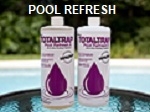
That is about fifty times the concentration in marginally
drinkable water. I would use POOL REFRESH to remove the
manganese, by allowing it to be
vacuumed and filtered out of the
pool. Make sure you monitor the
concentration, before and after
treatment, as the level seems
usually high. A simple and effective way to
reduce most minerals problems,
resulting from the use of well water, is to use the
METALTRAP Filter,
or even better, when sediments are
present, would be a
METALTRAP
Dual-Cartridge Filter.
This attaches to a garden hose and
removes the manganese and other
heavy metal mineral content,
that would get into the pool.
otherwise. Use it when all new
water is added, to help avoid future
problems. I hope that this information will prove helpful.
Sincerely. Alan Schuster, 9/13/2007
|
Visit The Website Stores . . . for
better informed shopping!!! |
|
|
Shipping is FREE* . . . within
the Continental U.S.
A $9.99
handling charge will apply
to Continental U.S. Orders,
under $75.00. Orders
outside of the Continental
U.S. may require some
additional charge, based on
quantity and destination.
Most products can be
shipped World-Wide. International
and orders outside of
Continental U.S. - see
comments on the ordering
pages. |
|
|
Major
Credit Cards and PayPal are accepted. |
|
▲
Return To Top Of Page
▲
Aqualab Systems, LLC does not
make any warranty or
representation, either expressed
or implied, regarding the
accuracy or completeness of the
information provided by this
website; nor does Aqualab
Systems., LLC. assume any
liability of any kind whatsoever
related to, or resulting from,
any use or reliance on this
information. The content of this
website should not be used, if
it is conflict with any
applicable federal, state or
local regulations or guidelines.
© Aqualab Systems, LLC. All
rights reserved
|
|