| |
|
Scroll
down to browse through some archived SWIMMING POOL
questions and answers. Please click the Pool
Problems Link, on top of every page, to access a complete
listing of Pool Problem subjects, an alphabetized
Website Table of Contents, Pool Equipment Information,
About Alan Biographic Material and a Pool Glossary. Use
the other links to access additional subject
information. More information about some new and unique
products, for pools and spas, can be found by visiting
The Website Store.
You'll never know what you'll find and that's always
fun. Be better prepared and avoid costly problems!
|
|
 |
Shipping is FREE* . . . within
the Continental U.S.
A $9.99
handling charge will apply
to Continental U.S. Orders,
under $75.00. Orders
outside of the Continental
U.S. may require some
additional charge, based on
quantity and destination.
Most products can be
shipped World-Wide. International
and orders outside of
Continental U.S. - see
comments on the ordering
pages. |
|
 |

Major
Credit Cards and PayPal are accepted. |
|
On-line
shopping since 2002 - Safe and Secure!!! |
|
Avoiding Staining and Discoloration,
when new water is added!!! |
|
If
there is a possibility that new water
additions will contain sediments,
dissolved metals or contaminants, you
should consider using something to
pre-filter the new water. Test your
source water for iron, copper and
manganese, to determine, if dissolved
metals present a potential problem. It
is better to avoid a problem, than to
try and treat it, after the water has
been added to the pool. The products
below can remove sediments, metals such
as iron, copper and manganese and
contaminates such as sulfur. The
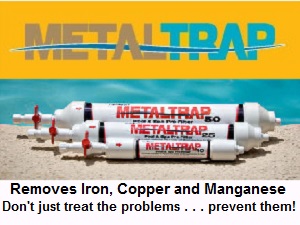
MetalTrap
Filter, available in 3 sizes, attaches to the garden
hose and removes dissolved iron, copper
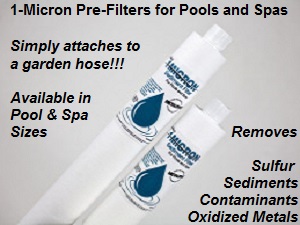
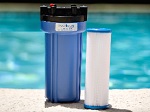
and manganese. The
MetalTrap
1-Micron Filter removes
ultra-fine contaminants, including
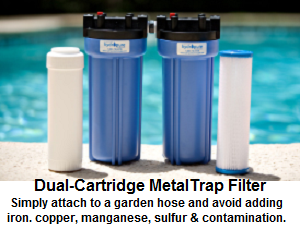
sulfur. The
MetalTrap
Dual-Cartridge Filter, available
in 3 sizes,
attaches
to a garden hose and removes dissolved
heavy metals and sediments. One
cartridge is washable and reusable and
the other is replaceable. |
|
|
If you have a pool or spa water
testing need, we should have the
product.
►
Scroll down to read through some
Question & Answer information.
◄
|
|
Removing Stains and Discoloring Metals,
from the pool water!!! |
|
Look for the presence of
rusty, tan, blue, green, purple, brown
or black stains. These are typically
due to the presence of heavy metals,
such as iron, copper or manganese. Even
if there is no obvious staining, the
presence of heavy metals will cause
water discoloration and possible
staining, after chlorine or bromine are
added or the pH is raised. Depending
upon the severity of the problem, the
products below can help you eliminate or
avoid problems. The
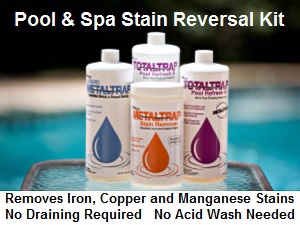
Stain Reversal
Kit contains everything needed
to remove the metal stains, eliminate
the heavy metals and help prevent a
recurrence, of the problem. The
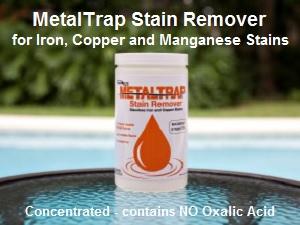
Stain Remover
removes iron copper and manganese
stains.
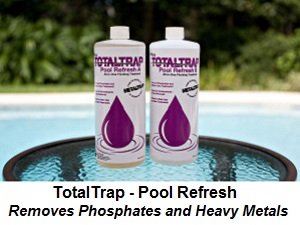
Pool
Refresh-Total Trap helps
eliminate heavy metals and phosphates,
by filtering or vacuuming them out of the
pool water. |
|
|
If you have a pool or spa water
testing need, we should have the
product.
►
Scroll down to read through some
Question & Answer information.
◄
|
|
Optimizing the water chemistry and
improving pool water clarity!!! |
|
Test the water chemistry and
adjust the pH, total alkalinity, calcium
hardness and cyanuric acid. Test
for heavy metals, as might be
necessary. A
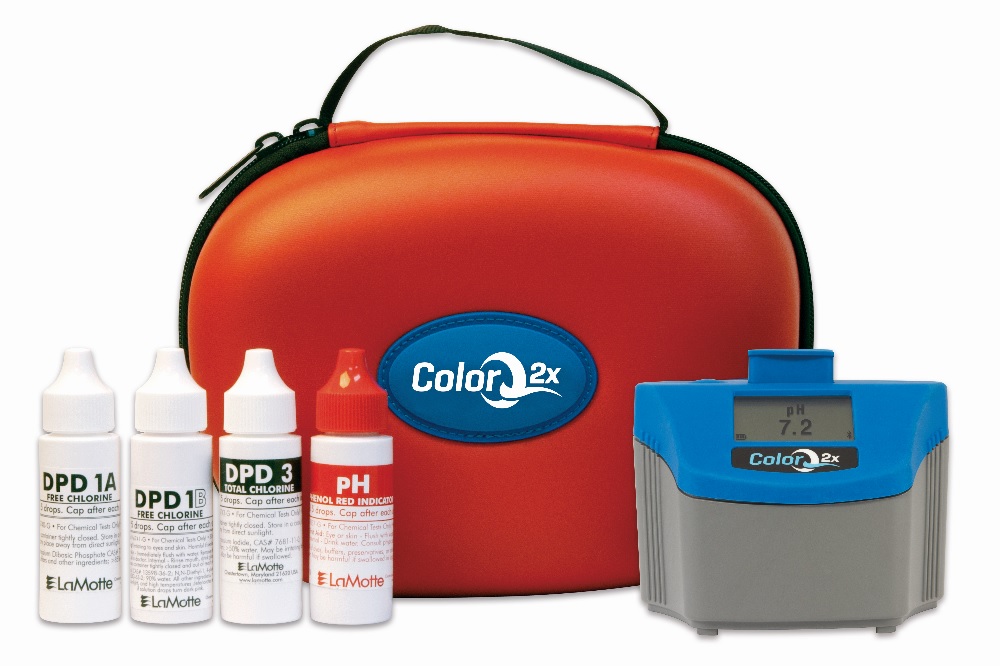
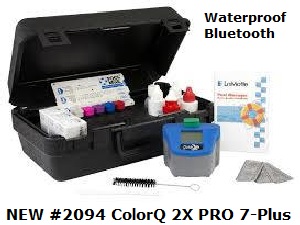
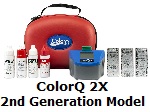
ColorQ, All-Digital Tester can
perform all of the common pool water
tests and eliminates the color-matching
and guesswork. Some tester models,
such as the #2067 ColorQ PRO 9-Plus,
perform all of the common pool water
tests, plus copper and iron. Reliable water testing will
help get the pool swimming-ready. Better
Circulation helps make everything work
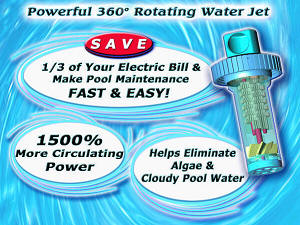
more effectively. The
Circulator is a return jet
replacement fitting, that improves
filtration, eliminates dead zones that
promote algae growth, improves sanitizer
distribution and improves chemical
dispersion.
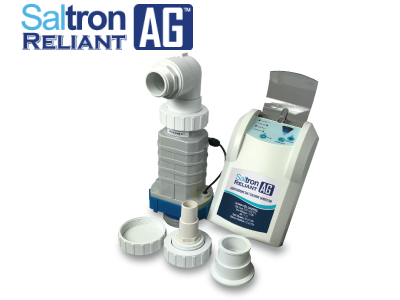
The model
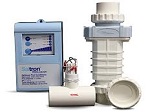
Saltron AG Salt Chlorine Generator
is designed for above-ground pools. |
|
|
If you have a pool or spa water
testing need, we should have the
product.
►
Scroll down to read through some
Question & Answer information.
◄
|
|
How to treat and avoid staining and
discoloration problems? |
Staining is a detraction from the overall
appearance or aesthetics of the pool, as well as
an annoyance. Colored stained walls, floors,
steps and other underwater surfaces can result
from the untreated presence of heavy metals,
such as iron, manganese and copper, in the pool
water. These metals can occur naturally in water
(especially well water) or may have been
introduced into the pool water, as a result of
corrosion. Copper algaecides are usually in a
chelated or stabilized form and are not normally
a problem, when used properly as directed.
However, the use of ionization products can
result in the addition of too much copper and
result in staining and or discoloration. Pool
stain and discoloration removal can be accomplished with the
proper materials and techniques. The products,
pictures above, will help you solve these
problems. New or freshly
resurfaced masonry pools can be more susceptible
to staining, until the underwater surfaces have
"cured" and come to equilibrium with the pool
water. Stain avoidance treatment should be
considered, whenever a water analysis indicates
the potential for a pool staining problem. If
possible, test the source water before it is
added to the pool, as it is best to add mineral
treatments prior to the addition of oxidizers
(chlorine, bromine or shock) or the pH and/or
total alkalinity are increased. An alternative
method of dealing, with pool water containing known heavy metal
problems, is to use the METALTRAP Filter, which
can physically remove the metals, as the pool
water is being added. When the new water
contains sediments, as well as dissolved metals,
it is best treated with a
METALTRAP
Dual-Cartridge Filters, which keeps out both
precipitated and dissolved forms of iron, copper
and manganese. Other
METALTRAP Products
treat stain removal and prevention, phosphate
removal and control of contaminants of all
types. If problems arise, refer to
the Pool
Problems Page, as a source of
problem-solving information, broken down into
various categories. Scroll down the page
and click on the linked
keywords,
catch phrases
or images, in the archived answers below, to access additional information, on that topic or product.
Do you know what's in your
water? If you're having problems, with stains and
discoloration, due to the presence of metals, you should be
testing for iron, copper ad manganese, to better understand the extent
and cause of the problem. This helps select the best
treatment option. Understanding the nature of the
problem, should be step one. For information about
our full selection of testing options, visit our
Test Equipment Store.
For information about treatment options, visit our
Stain Treatments Store.
|
There are many causes of stains and
discolorations, which can appear in a variety of
colors.
The color can sometimes point to a cause and solution.
Water
Testing can help verify the cause of the
problem. |
|
Stain or Discoloration Color |
Cause and Treatment |
|
Green or
Brown |
Most likely, these
are organic, in nature, and are due to algae
and/or tannins, leaching from many common
varieties of tree leaves. This is more
likely to happen, if the sanitizer (oxidizer)
levels are low and/or if there is poor
circulation, across the pool floor.
Superchlorination and
improving
circulation, are the best course of action. |
|
Dark Blue,
Green or Black |
Dark blue, green
or black colors or mixtures are likely caused by
copper. High calcium hardness levels tend to
cause the stains to darker, in appearance.
The source could be corrosion of the copper heat
exchanger, natural sources, over use of copper
algaecides, ionizer or mineralizers. This
type of problem requires proper chemical
treatment, such as provided by the
MetalTrap Stain Reversal
Kit. If present in the source water, a
MetalTrap Dual-Cartridge
Filter can be connected to the garden hose,
used to add new water. This will help
prevent the addition of more metals, with each
new water addition. |
|
Green,
Brown,
Tea-Colored or
Rusty-Red |
Green, Brown,
Tea-Colored or Rusty-Red colors are usually
indicative of an iron problem. The most
likely source is the water being used to fill
the pool. This is especially true, when
well water is used. While the use of a
MetalTrap Stain Reversal
Kit will help solve the problem, a
MetalTrap Dual-Cartridge
Filter should be attached to the garden
hose, in order to avoid future recurrences. |
|
Brown, Black or
Purple |
Brown, Black or
Purple colors are usually an indication of
manganese being present. This most often
occurs, when well water is being used. A
test of the source water should confirm the
presence of manganese. While the use of a
MetalTrap Stain Reversal
Kit will help solve the problem, a
MetalTrap Dual-Cartridge
Filter should be attached to the garden
hose, in order to avoid future recurrences. |
|
Purple |
Purple stains or
water discoloration can be due to manganese or
the presence of copper cyanurate. Test the pool
water, for the presence of both metals. While
the use of a
MetalTrap Stain Reversal
Kit will help solve the problem, a
MetalTrap Dual-Cartridge
Filter should be attached to the garden
hose, in order to avoid future recurrences.
Copper cyanurate can form, due to the prolonged use of
stabilized chlorines. |
|
Red or
Blue |
Red or Blue Stains
can be associated, with the presence of berries
or vegetation. This is more
likely to happen, if the sanitizer (oxidizer)
levels are low and/or if there is poor
circulation, across the pool floor.
Superchlorination and
improving
circulation, are the best course of action. |
 |
Join our E-Letter Mailing List.
You'll receive 1-3 E-Letters a
month, featuring helpful pool
and spa advice, new product
information and sale
announcements. All we
require is your e-mail address
and you can opt out anytime you
wish.
Your information
will never be shared or sold. |
|
▼
Helpful,
Problem-Solving Information, in a question and
answer format.
▼ |
►
Leaves Causing Pool Stains?
Hey Alan. We
live in Louisiana and we have 10,000 gallon fiberglass pool.
We do have Oak trees nearby and we now have brownish colored
stains on the bottom, walls, and steps of the pool. We have
treated it several times with metal away and we have used
something that was a metal treatment. We have investigated
and tried everything we possibly can and nothing has worked.
If you can help us with this matter we would be eternally
grateful. Thank you so very much.
Jill,
Louisiana,
12/9/2017
Many types of leaves, such as live oaks or black olive &
others, are more likely to cause problems. The leaves
remaining
in prolon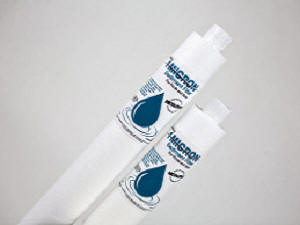 ged contact can release tannins and result in
tea-colored stains. The good news is that tannins are
destroyed by chlorine. All that should be
required is a shock treatment and some bottom circulation.
If your source water contains tannins and organic matter,
you can remove them using the
MetalTrap 1-Micron Pre-Filter. It attaches to a garden hose and
can be used to treat all new water being added to the pool.
Poor circulation can make chlorine distribution less
efficient and make tannins removal more difficult. You might
consider adding THE CIRCULATOR.
The easy to install device will eliminate the dead spots
that can promote tannin stains and algae growth. Helps to
better distribute heat & chemicals and reduce filtration
time. I hope that I have been helpful. If so, please
tell your friends and dealers about the website. If this website was helpful,
in solving your problem, please consider joining our
E-Letter Mailing List.
You'll receive E-Letters, with helpful
information, new product updates, suggestions and sale
announcements. I am
always glad to hear about a successful outcome. ged contact can release tannins and result in
tea-colored stains. The good news is that tannins are
destroyed by chlorine. All that should be
required is a shock treatment and some bottom circulation.
If your source water contains tannins and organic matter,
you can remove them using the
MetalTrap 1-Micron Pre-Filter. It attaches to a garden hose and
can be used to treat all new water being added to the pool.
Poor circulation can make chlorine distribution less
efficient and make tannins removal more difficult. You might
consider adding THE CIRCULATOR.
The easy to install device will eliminate the dead spots
that can promote tannin stains and algae growth. Helps to
better distribute heat & chemicals and reduce filtration
time. I hope that I have been helpful. If so, please
tell your friends and dealers about the website. If this website was helpful,
in solving your problem, please consider joining our
E-Letter Mailing List.
You'll receive E-Letters, with helpful
information, new product updates, suggestions and sale
announcements. I am
always glad to hear about a successful outcome.
Sincerely. Alan
Schuster, 12/9/2017
►
Pool Stains:
Yellowish-Grey?
Thank you so much Alan. I found your
website a year or more ago when I was still having trouble
with metal in my water, but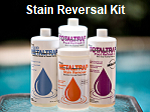 didn't take action at that time.
Over several years my pool has built up an out of control
level of metal in the water that has forced us to drain the
pool four times last summer alone at the guidance of our
local pool stores sadly enough. I was upset at the sight of
our pool and thinking surely we will not be able to get it
back in decent condition again. I was researching companies
to re-surface the fiberglass, until I found your website yet
again. I bought the METALTRAP liquid and stain remover and
although I had to dose it twice to get the necessary
results, it WORKED. I wasn't sure the yellow/grey stains
were metal but it turns out they were and this product is by
far the best I have come across. I have a white surface
again with crystal blue water & my chemicals are perfect for
the first time in years. So thank you Alan and I have
ordered even more product to maintain my pool for the
future. Wish I would have listened to my instincts the first
time I found your site. God Bless! didn't take action at that time.
Over several years my pool has built up an out of control
level of metal in the water that has forced us to drain the
pool four times last summer alone at the guidance of our
local pool stores sadly enough. I was upset at the sight of
our pool and thinking surely we will not be able to get it
back in decent condition again. I was researching companies
to re-surface the fiberglass, until I found your website yet
again. I bought the METALTRAP liquid and stain remover and
although I had to dose it twice to get the necessary
results, it WORKED. I wasn't sure the yellow/grey stains
were metal but it turns out they were and this product is by
far the best I have come across. I have a white surface
again with crystal blue water & my chemicals are perfect for
the first time in years. So thank you Alan and I have
ordered even more product to maintain my pool for the
future. Wish I would have listened to my instincts the first
time I found your site. God Bless!
Allen and Dawn S., 2/16/2018
About all I can add is that you consider using a
METALTRAP Filter, to treat all new water, added to the pool. This will
prevent, iron, copper and manganese, from getting into the
pool. With all that you have been through, this seems a
prudent last step. All you have to do is attach it to the
hose, used to fill the pool. Even if the water tests
metal-free, if a fire hydrant is opened down the line, it
can lift up sediments, that took years to collect.
Sincerely. Alan Schuster, 2/16/2018
► Short Work
Of Orange (Rust) Stains?
Alan, I have a iron issue in our pool
from the well water top off. Came home from a long vacation
to find an algae bloom in progress. Stupid me screwed up the
chlorine level. Anyway, shocked the pool and thought metal
magnet and clarifier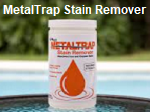 would help get the residue out of the
pool. With the high chlorine level, I got an iron
precipitate which left the pool surfaces a nice dark orange
color. My local pool company recommended oxalic acid which I
checked out on the web. Not nice stuff. I have been using
your METALTRAP Filter to pre filter the well water to remove
the iron for a while and checked your site. I knew about
METALTRAP Stain Remover and have used it to remove some iron
stains on occasion, but not to this extent. Bought your
METALTRAP Stain Remover and waited until the chlorine
dissipated, as directed. (Slow process since it is an indoor
pool) Sprinkled in the pool stain remover and all the dark
orange stain just vanished without the nasties of the oxalic
acid. Didn't even lower the pH by much. Truly pleased with
the product. By the way, the pool company had never heard
that METALTRAP Stain Remover could do the job. Thanks again.
A Satisfied Customer, would help get the residue out of the
pool. With the high chlorine level, I got an iron
precipitate which left the pool surfaces a nice dark orange
color. My local pool company recommended oxalic acid which I
checked out on the web. Not nice stuff. I have been using
your METALTRAP Filter to pre filter the well water to remove
the iron for a while and checked your site. I knew about
METALTRAP Stain Remover and have used it to remove some iron
stains on occasion, but not to this extent. Bought your
METALTRAP Stain Remover and waited until the chlorine
dissipated, as directed. (Slow process since it is an indoor
pool) Sprinkled in the pool stain remover and all the dark
orange stain just vanished without the nasties of the oxalic
acid. Didn't even lower the pH by much. Truly pleased with
the product. By the way, the pool company had never heard
that METALTRAP Stain Remover could do the job. Thanks again.
A Satisfied Customer,
Jerry S., Fairborn, OH. 3/30/2016
Now that you have removed the pool stains, you should use
the METALTRAP Filter to remove the stain-causing metals, by
recirculating the pool water through the METALTRAP Filter.
That way the problem will truly be solved. Use the METALTRAP
filter when adding all new water and you'll keep metals out.
Thanks for the letter.
Sincerely. Alan Schuster, 3/30/2016
► Purple Pool
Walls?
Gunite pool, pink algae year ago, used
algaecide to get rid of it, and it worked, until it got
warm. Then blue-purple color was on the walls, step walls
(not on the bottom) of the pool. When got cold, went away.
Now with it warmer, it's back. Water testing shows Calcium
600 (that is after 2 1/2 pool drains) chlorine is high, rest
ok. Minerals - no iron. Pool people thought needs to be
washed. Lowered water 1/2 way, and used liquid chlorine on
the steps. What ever the chlorine touched that was purple
TURNED BLACK! The towel I used to put the chlorine on turned
warm. It did come off when brushed & some elbow grease.
Questions: what is going on, besides a chemical reaction of
some type? Should a chlorine wash get rid of this? We are
selling the house and need to have it fixed for new buyer.
Thank you.
Susan R., 5/2/2015
THIS IS DEFINITELY NOT AN ALGAE PROBLEM! IT IS DEFINITELY A
MINERAL PROBLEM! The action of the chlorine turning the
color from purplish to black is indicative of an oxidizing
chemical reaction. A chlorine "wash" or shock treatment will
probably be a waste of time and money. Purple pool water and
stains can be indicative of manganese or possibly copper. It
is not a common problem and most dealers do not test for it.
If your water came from a private well, there is a greater
likelihood that manganese could be involved. Another more
likely possibility is copper. Copper in the presence of high
levels of calcium hardness, which you do have,
can cause dark or black stains, under certain conditions.
The purple color could have been due to copper,
normally bluish in color, and the presence of cyanuric acid,
from the prolonged use of stabilized chlorine products. When the pool people suggested a "wash", I
suspect that they were referring to an acid wash. This type
of treatment is periodically done on masonry pools to remove
surface deposits and restore the look of the pool finish. It
may be possible to remove the stains by chemical treatment.
Try this. Put 1/2 pound of pH reducer powder in a white
sock, shut off the filter and drop onto a stained area.
Check after 15-30 minutes. If improvement is seen, this
would be indicative that chemical treatment might work.
Chemical treatment will require that you add 2-3 doses of a
quality, phosphate-free metal treatment, such as
Liquid
MetalTrap, to help prevent further pool discoloration. Raise
the pool water level above all of the discoloration and
staining. Add muriatic acid until the pH has dropped to 6.8.
It may take considerable acid, depending upon the starting
pH and the total alkalinity. Without the lowering of the pH,
you are not likely to remove the pool stains. Add
MetalTrap
Stain Remover, which acts as a reducing agent, converting
the metals to a more soluble form. Combined, these products
form the basis of the MetalTrap Stain Reversal Kit.
This can help in removing the stains and can be added to the
acidic pool. This material will react with chlorine, so add
only when the chlorine level is very low. At that point the
addition will zero out the chlorine and create conditions
more favorable for pool stain removal. Use the brush to help
things along. Metal parts in the pool, pump and filter may
be affected by the acidic conditions. Clean or bypass the
filter, if possible, to remove stain causing debris from the
filter. Depending upon the pH, you should see improvement in
a day or so. Once the pool stains are removed, add another
2-3 doses of a quality mineral treatment, before restoring
the pH. It will be necessary to shock the pool, in order to
destroy all of the stain remover and reestablish proper pool
chemistry. Where did the copper come from? If you have a
heater you may have subjected it to corrosion. Copper
algaecide is another possibility. I hope it works out for you.
Sincerely. Alan Schuster, 5/2/2015
Thank you Alan. Yours has been the
first sensible response I have had. It does come off with
the sock and sodium bisulfate. Took no brushing. We cannot
bypass our filter. Can we lower the pH, then bring it back
up and still have swimable water? Thank you again.
Susan R., 5/2/2015
The purpose of the bypass was to minimize corrosion. Clean
the filter out before treatment and again afterwards, so as
not to redissolve what you are trying to remove from the
pool walls. Don't neglect
to add the Liquid MetalTrap!
Otherwise, you could get a recurrence. You can swim as soon
as you restore the pH and the chlorine levels. Inasmuch as
the pool stain was removed without the ascorbic acid, I
don't see the need to add the product. It seems that things
will work out for you. The METALTRAP Filter is a
non-chemical means of removing metals from the water. just
attach to a garden hose and a small pump and keep
recirculating. The longer you recirculate, the more metals
are removed. Use it to treat all new water and you'll avoid
pool stains and stay in the blue. Good luck with the sale of
the house.
Sincerely. Alan Schuster. 5/2/2015
► Acorn And
Leaf Pool Stains?
Our 72,000 gallon community pool was
resurfaced last year: the good news. The bad news-those in
charge did a poor job covering the pool and a lot of leaves
got in the pool, sat there, and stained a few large areas of
the surface. I tried 4 lbs of Stain Wipe, a concentrated
ascorbic acid powder, which removed only 50% of the stain.
Should I try the sock with the pH lowering chemical? Thanks.
Bert S., 10/27/2014
Acorns and many types of leaves, such as live oaks or black
olive, are more likely to cause staining problems. The
acorns, leaves and plant debris, remaining in prolonged
contact, can release tannins and result in tea-colored pool
stains. The good news is that tannins are destroyed by
chlorine. All that should be required is a shock treatment
and some bottom circulation. Ascorbic acid was not a viable
solution, for this problem, as it should only be used to
remove pool stains caused by copper, iron, manganese or
other heavy metals. Poor bottom circulation, may lead to a
lower chlorine level across the lower part of the pool.
Using a robotic pool cleaner on a regular basis will help
improve the circulation and remove the leaves that might
lead to pool staining. Weak overall circulation and dead
spots can add to this type of problem.
THE POOL CIRCULATOR is a
device that greatly improves circulation. It installs in the
return fitting quite easily. I hope that this information
will prove useful. and plant debris, remaining in prolonged
contact, can release tannins and result in tea-colored pool
stains. The good news is that tannins are destroyed by
chlorine. All that should be required is a shock treatment
and some bottom circulation. Ascorbic acid was not a viable
solution, for this problem, as it should only be used to
remove pool stains caused by copper, iron, manganese or
other heavy metals. Poor bottom circulation, may lead to a
lower chlorine level across the lower part of the pool.
Using a robotic pool cleaner on a regular basis will help
improve the circulation and remove the leaves that might
lead to pool staining. Weak overall circulation and dead
spots can add to this type of problem.
THE POOL CIRCULATOR is a
device that greatly improves circulation. It installs in the
return fitting quite easily. I hope that this information
will prove useful.
Sincerely. Alan Schuster. 10/27/2014
► Huge Black
Pool Stains?
Alan, I just decided to open my pool
for the summer. Unfortunately I do not have a lot of time to
care for it myself so it sat all winter without a cover. I
live in Ft Worth TX so temperatures stay pretty warm most of
the year. I have huge oak and maple trees in my back yard
and their leaves fell in the pool and decomposed. I had a
service empty the pool and acid washed it but they are TONS
of huge black stains at the bottom of my pool. I have a
30,000 gallon gunite and plaster pool and the plaster is
wearing off. The pool is at least 15 years old, and I have
lived here for 3 years. Is there something that can remove
these stains or should I just re-plaster the pool? I think I
am getting a fair deal on the replastering, so I am
considering it. Thanks.
Randall, Ft. Worth, TX, 6/5/2013
It does appear that you will be refinishing the pool sooner
rather than later. There's little sense investing a lot of
time and money, but it still might be a good idea to clean
up the pool. It might make for a better plastering job? Most
likely the pool discoloration and stains are the results of
tannins from all of the leaves, especially the oak leaves.
Boost the Free Chlorine level to 5-10 PPM and keep it there
for a day
or so or until the stains disappear. Adjust the
water chemistry as necessary and keep the filter operating.
This should do the trick and you'll be in a better position
to determine when to resurface the pool. If pool stains
resist the chlorine treatment, they are most likely caused
by metals. Just adding Liquid
METALTRAP and METALTRAP Stain
Remover may remove the stains, but it might not be
permanent. If you use the MetalTrap Stain Reversal regimen,
you'll remove the pool stain and remove the metals, as well.
You start by adding the METALTRAP Stain Remover, as
directed. This helps dissolve the stain. Next Liquid
METALTRAP is added, to complex or chelate the metals, in
order to keep them in solution. Next. you recirculate the
pool water through a METALTRAP Filter and those heavy metals
will be permanently removed. In you plan on refinishing the
pool, ask the contractor to add water to the plaster, after
it has been run through the
METALTRAP Filter. If might help prevent the
pool finish from slight discolorations. By all means, when
the pool is refilled, pass all the water through the
METALTRAP Filter. Removing metals, as the pool fills, is the best
insurance against future problems. Remember, always use the
METALTRAP Filter to treat all new water. The new pool
finishes today can be quite different from the one used in
your pool. It is not just plain old plaster any more. There
are all types of finishes, with different looks and
properties to consider. Good luck and I hope that I've been
helpful.
Sincerely. Alan Schuster, 6/5/2013
► How Does
The METALTRAP Work?
I do not understand how the METALTRAP
Pre-Filter works to filter the water that is already in the
pool. Do you install into the existing filter, pump
plumbing? I have treated the pool on several occasions with
100% ascorbic acid and a metal treatment, but the stains
come back a couple weeks later. Some metal treatment degrade
over time, causing a recurrence of the problem and adding
phosphates to the water. Liquid METALTRAP is more stable and
contains no phosphates. Thanks!
Tom M., 8/18/2017
Just get a small pump or submersible pump with garden hose
connections. Attach to the METALTRAP 1-Micron Pre-Filter
and pass water through the filter and back into the pool.
Slowly it will trap the metals in the pool water, reducing
the level, as time goes by. It only process 5-7 gallons a
minute, so it will take a while to turn over the pool water,
a few times. But, in the end, the metals are out of the pool
and the recurrence of pool stains should be gone. Use it to
treat all new water, added to the pool, to help keep them
out. Some metal treatment degrade over time, causing a
recurrence of the problem and adding phosphates to the
water. Liquid METALTRAP is more stable and contains no
phosphates. I hope this will make things a bit clearer.
Sincerely. Alan Schuster, 8/19/2017
► Grass Seed
Stains?
While spreading grass seed on the lawn
some of the seed got in the pool and left a rather large
brown stain down the side of the pool wall and down towards
the bottom , we just had the pool plastered 2 years ago, how
do I get the stains out Help me please.
Michael S., Bakersfield, CA, 4/3/2012
Regular grass seed should not do that. Some seeds are coated
with fertilizer and mulch to help it germinate. The minerals
in the fertilizer could cause this type of problem. The
information below should be helpful. However, the solution
could be as simple as shutting off the pump and sprinkling
some METALTRAP Stain Remover and letting it sink over the
pool stains. It will work best without any chlorine present.
Follow with a dose of phosphate-free Liquid METALTRAP, to
deal with the dissolved metals.
Place a dozen 500-mg Vitamin C (ascorbic acid) tablets on a
stained area. If it removes the pool stain, the directions
below will treat the whole pool. In the vast majority of
cases, merely adding a metal treatment will not remove the
stains., especially when covering large areas. A reducing
agent, such as METALTRAP Stain Remover must first be
applied, at the dosage rate of 1 pound per 10,000 gallons.
Before applying, the free chlorine, must be allowed to drop
to 0 PPM. otherwise, the chlorine will destroy the stain
remover. Chlorine neutralizer can be used to quickly drop
the level.
Allow the water, containing the METALTRAP Stain Remover to
circulate 24/7. Brush the surface to help speed the process.
After the stains are gone., do one of the following. Either
add 1 quart of Liquid METALTRAP, per 10,000 gallons of
water, for each 1 PPM of metals present. Test the water for
metals, to better understand the extent of the problem.
Alternatively, you can use a small submersible pump (flow
rate of not more than 5-8 gallons per hour) and recirculate
the pool water through the METALTRAP Filter. This will
remove the metals, that the stain remover dissolved from the
walls. A METALTRAP Filter uses garden hose connections and
can remove up to 1 PPM of metals, based on its rated
capacity. If you use the METALTRAP Filter, when adding all
new water, you can keep more metals out of the pool. It may
take several days, with the submersible pump running 24.7,
to get the levels down to a manageable point. Again, test
the water in the pool and coming out of the METALTRAP Filter
to monitor the progress. At the point, where the metals are
down to a nil level, add a dose of liquid METALTRAP, to
scavenge up the last traces. Wait 24 hours before adding
chlorine or raising the pH. A lot of chlorine will have to
be added, because it will react with the pool stain remover.
Because the process can get lengthy, it is a good idea to
add a dose of a polymer algaecide, to help maintain water
quality, in the interim period. I hope that I have been
helpful. If so, please tell your friends and dealers about
the website.
Sincerely. Alan Schuster, 4/4/2012
► Fertilizer
Stains In Pools?
We recently fertilized our yard, and
accidentally got some in our inground pool. The rust stains
are scattered throughout the pool. We called our pool
company, and they suggested adding ascorbic acid, which we
did, but to no avail. Is there anything else we can do to
fix this problem?
Jon G., 4/2/2016
The pool stains that resulted are due to iron and other
trace minerals, that are present in the fertilizer. If you
simply added the ascorbic acid to the pool, it is unlikely
that anything beneficial will result. The chlorine could
have destroyed the ascorbic acid, before it contacted the
pool stains. Try this. Add 1/2 pound of pH reducer powder to
a white sock, shut off the filter and drop onto a stain.
Position using the vacuum pole and leave in place for 5-10
minutes. Move the sock around with the vacuum pole after
this period. If the pool stain is gone, repeat elsewhere, as
needed. If this fails, try the same thing with some
METALTRAP Stain Remover, in the sock. Once the stains are gone, add a dose of
quality metal treatment, such as
Liquid METALTRAP, in order to avoid a recurrence. I
hope that this information proves helpful.
Sincerely. Alan Schuster, 4/2/2016
► Vitamin C
Treatment In Pools?
Hi Alan, I searched your site for
references to treating stains with vitamin C and couldn't
find anything. I have an inground fiberglass pool that came
with a house I purchase several months ago. The pool began
getting stains and with help from my local pool water
testing company tried unsuccessfully to get them out. I
tried algaecides, etc, and metal stain removers and nothing
worked. My water tested negative for iron and copper.
Someone mentioned to me to use vitamin C and I noticed the
original pool/house owner had bottles of vitamin C stored
away and I said well maybe he used that - which made no
sense to me. I tried it and bam, the stains vanished almost
immediately. What in the world? Can you help me understand
this? What were the stains and why would vitamin C of all
things work? Thanks!
Sonny M., Wake Forest, NC, 6/4/2009
If the problem is a pool metal stain, adding algaecide or
shock is useless. Adding a metal treatment, without creating
mildly acidic conditions, rarely works. The vitamin C
tablets worked because it is an acidic, reducing
(antioxidant) agent and you were able to put it right on the
pool stain. METALTRAP Stain Remover has been
formulated, for use in treating stubborn metal stains. If an
entire pool needs to be treated, all of the chlorine should
be discharged, the pH lowered to about 6.8 and then the
ascorbic acid is added. Fiberglass pools can attract
metallic ions and chemical treatment is not necessarily the
same as removal. The METALTRAP Filter actually, physically
removes the metals, from the pool, as the water is
recirculated through the Metal Trap. Using the METALTRAP
Filter to treat all new water helps keep new metals out and
minimizes the possibility of staining.
Liquid METALTRAP and
METAL TRAP Pool Stain Remover should be used, in conjunction
with the METALTRAP Filter to first remove the pool stains
from the underwater surfaces and, finally, to remove the
metals from the pool. These product contains no phosphates
or use toxic oxalic acid. The important thing is that there
is a plan that will work. Enjoy the season.
Sincerely. Alan Schuster, 6/5/2009
► Treating
Metals Without Adding Phosphates?
Recently, I added some metal treatment
to my pool, to control a trace level of iron. All seemed to
go well. No staining and discoloration. I wasn't sure that I
really needed the product, but better safe than sorry? A
month later, I brought in a water sample to have a
mid-season check done. I was told that I had 800 PPB of
phosphates. So I questioned the source of the problem and
was told that it probably came from the metal treatment. I
looked at the label and it stated that it contained "Organic
Phosphonic Acid." Now it seems that I traded one problem for
another. Was there an alternative?
Henry H., 7/19/2009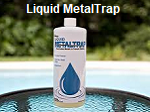
Yes, there was an alternative! Liquid METALTRAP contains a
completely different active ingredient and is
phosphate-free. In fact, it reacts with metals and resists
degrading, over time, which is what causes the other product
to form phosphates and allow a possible return of the
original problem. In your case, it was only a trace and may
have gone unnoticed. On the other hand, the formation of
phosphates can allow algae to grow faster, especially, if
the free chlorine level is low. It is possible to treat for
phosphates, but one should question was it avoidable? Liquid
METALTRAP would have solved the initial trace metal problem,
without adding any phosphates. I hope that you have been
enlightened. Enjoy the season.
Sincerely. Alan Schuster, 7/20/2009
► Rusty Nail
Pool Stains?
Your website has a most amazing amount
of information, but does not appear to cover our specific
problem. We bought the house to do a major renovation.
During construction we had the pool (vinyl liner) covered
but much debris got onto it anyway. After cleaning out the
pool we are left with quite a few rust spots on the bottom
of the liner, probably from nails among other things! Do you
have any suggestions as to how to get rid of the rust?
Thanks so much.
Nancy, White Rock, BC, Canada, 5/19/2009
The information was there, but not spelled out in terms of a
rusty nail. It happens a lot, so I will add it. Place a few
vitamin C (ascorbic acid) tablets on a stain, shut off the
filter and leave in place for 15 minutes. If this worked,
put a handful of 500-mg Vitamin C tablets, in a white sock
and drop onto a stain. Slowly move around with a wooden
pole. Sometimes, just using pH reducer granules, in a sock,
will work, so you might try that first. I hope that this
information will solve the problem. It should!
Sincerely. Alan Schuster, 5/19/2009
► Working
Stain Removal Scenario?
A Staining question for you. We have an inground 45,000
litre pool with a vinyl liner. We have been getting a
yellow/gray discolouration on the vinyl liner (bottom and
sides). We thought it was algae but chlorine seemed to have
no effect. I then tried METALTRAP Stain Remover in a sock
and after about 30 minutes, about a 4' diameter area in the
deep end (where I laid the sock in) was nice and bright
again. Will this scenario work?
1) Neutralize the Chlorine or allow to fall to nil.
2) Lower the pH to 7.0 to help eliminate the stain
3) Add METALTRAP Stain Remover to help treat the
minerals/metals
4) Add Liquid METALTRAP, after
stains are removed. Wait at least 24 hours, before
proceeding further.
5) Raise the Chlorine level. It will take a relatively
large amount, so add in increments.
6) Adjust the balance of the chemicals.
7) Add a dose of Liquid METALTRAP
monthly.
Is this the right methodology? Thanks.
Dennis, Canada, 5/2/2007
Your scenario should work. ADD A DOSE
OF A PHOSPHATE-FREE LIQUID METALTRAP, FOR EVERY 0.5 PPM OF
IRON OR COPPER. At the very least add two doses. If the
stained area is too broad to be treated with the "sock", you
may have to lower the pH of the pool to 6.8, discharge all
of the chlorine and add a few pounds of MetalTrap Pool Stain
Remover. Thereafter, add a dose of Liquid METALTRAP monthly
or prior to adding new water, in order to avoid minimize the
possibility of a recurrence. Even better, use a
METALTRAP Filter to treat all
new water. I hope that I have been
helpful.
Sincerely. Alan Schuster, 5/2/2007
► The Source
Of The Pool Staining?
Many thanks for the Metal Trap Stain
Reversal Kit which has arrived safely here in France. I am
currently battling away to achieve the right chemical
balance before using it. The cyanuric acid level was as high
as 140ppm and I am seeking to reduce it by part emptying the
pool and then re-filling as you suggest. The pH at 7.6, I
will lower to your recommended level, whilst the chlorine is
currently at zero after my emptying and re-filling
processes. Should I add some chlorine before using the kit?
An analysis of the pool water has established that the iron
content is less than 0.1 PPM! This is making me wonder
whether the staining has in fact been caused by metals and
if not, whether the stain removal kit you have sent me will
prove effective? Can you envisage any other cause for the
staining? As mentioned previously, a test with a Vitamin C
tablet did prove effective. Does your stain remover contain
ascorbic acid as it seems this is what is required? The only
other bit of info. which may be relevant is that the local
water board did some work last year on the supply pipes in
this area. I would be most grateful for your replies to the
above questions and for any further advice in general. With
all best wishes and thanks for help to date.
Mick P. France
There is a paradox, with metal pool stains. If the metal has
stained the walls, it is no longer in the pool water, at the
original concentration. Therefore, getting a low reading,
does not mean that metals were not present, at some time,
and caused the pool stain. If Vitamin C made a difference
and removed the stain, where it was placed, it is most
certainly a metals problem and
METALTRAP Stain Remover. Your CYA level does need to be
lowered, by replacing water. Use the METALTRAP Filter,
to treat all replacement water. Water Supply Companies working on
underground pipes, tend to lift sediments off
the bottom of the pipes, that may have been accumulating for
years. That could very well be the source of the iron. You
want the chlorine level to be zero, or else the METALTRAP
Stain Remover will be destroyed, to some extent, by the chlorine.
Adding a dose of 60% polymer algaecide will help maintain
the water quality, during the treatment process. Good luck
and I hope things clear up.
Sincerely. Alan Schuster, 9/17/2009
|
A Great Decorative Option |
|
 |
|
Use a Premium Pool Art Graphics Mat
to decorate your pool floor.
The image appears to be
tiled on your pool floor,
but that's just an illusion.
Actually, you simply set one
of these colorful graphics
on the water and push it to
the bottom, with a pool
brush. Its weight keeps it
there. Choose from 9
attractive designs, plus a
custom monogram model.
Most are available in 3
sizes: 47" diameter,
23" diameter or 10.5"
diameter. No adhesives
needed and installation is
just that simple. To remove
or place elsewhere, just
lift it off. |
|
Click
Here For Product and
Ordering Information |
► The
Swimming Pool Blues?
Just want to get a head start on this
years pool season. Last July our Alkalinity. was low so we
were told by our local pool store to put alkalinity plus
into our inground pool (32000 gallons give or take). Within
24 hours we had a blue stain throughout the pools liner. on
the walls and steps etc. It even stained our son's scalp
blue. Our pool store, that sold us the alkalinity plus said
this is common when you raise the alkalinity (used 50lbs) as
much as we had to. I put a ton of stain remover in the water
and it cleared up around August. Is this blue stain common
when you raise the TA in a pool? We use a well, that might
have some iron, but it never positive tested for copper.
Wondering, 1/18/2016
Such a thing will only happen, if there is copper present.
It seems likely that your pH and TA were low for an extended
period of time and that you have a heater. This corrosive
chemistry caused some copper to dissolve from you heater or
copper pipes. When you raised the pH and/or TA, it
precipitated. You would have been better off adding a metal
treatment first. From now on I would add a dose of a metal
treatment monthly and avoid low pH conditions. Proper TA is
part of that. There is a better solution: the
METALTRAP
Filter actually, physically removes copper, from the pool,
as the water is recirculated through the METALTRAP. Using
the METALTRAP Filter to treat all new water helps keep new metals
out and minimizes the possibility of new pool staining.
Liquid METALTRAP and
METALTRAP Stain Remover should be used,
in conjunction with the METALTRAP filter to first remove the
pool stains from the underwater surfaces and, finally, to
remove the metals from the pool. These product contain no
phosphates or toxic oxalic acid. If you use trichlor in a
feeder, it must be last in line and separated from the
heater by a check valve. Otherwise, corrosive solutions can
backup into the heater, after the pump is shut off. I hope
that this information will help you understand what
transpired.
Sincerely. Alan Schuster, 1/19/2016
► An
Ionization/Staining Conundrum?
Great site! I have a 25000 gal gunite
pool that is two years old. The previous owners used
chlorine and last year I switched to an ionizer/oxidizer.
Toward the end of the summer I started to get brown-black
staining of the bottom. I have a problem with the pH
constantly creeping up. What is the best way to remove the
mineral stains and use the ionizer/oxidizer? How long should
I use the oxidizer every day? One turn of the filter is 4
hours. We do have a well, which might have some iron
present. The previous owners never mentioned that it was a
problem. Thanks.
Dr. Ed S., 3/8/2009
The pool stains could be the result of iron, manganese or
other heavy metals that might have been present in the well
water. You should test both the pool and source water for
heavy metals. The sanitizing system that you are using seems
to be one that utilizes copper ions and oxidation. Too high
a copper level, especially in the presence of high calcium
hardness and high pH, can cause dark pool staining. Testing
the pool for copper can determine if the level is too high.
Dealing with the copper, iron or manganese or pool staining
usually requires metal treatments and that could temporarily
eliminate or limit the algaecidal function of the copper.
However, there is an effective way to approach this problem.
Allow any free chlorine to zero out and turn off the
ionization unit. Add a quart of 60% polymer algaecide to
maintain the water, while there is no oxidation present. Get
the pH to about 7.0. Now add METALTRAP Stain Remover
and keep the filter on 24/7. Scrub the walls, to help things
along. In due course, the pool stains will be removed.
There are two choices to make, at this point. You can use
the cartridge-like, METALTRAP Filter
with a garden hose and a small submersible or cover pump and
recirculate the pool water. As the water passes through the
METALTRAP Filter, the heavy metals, including the copper,
are trapped and removed permanently. Or, you can add Liquid
METALTRAP to the pool and
that will chelate the metals. The metals will still be in
the water, but in a solubilized state. They may still
register on tests. If you use the MetalTrap Filter instead,
it may take a few days, but if you test the water, you will
see the iron and copper levels (in your case) dropping. Once
the iron level gets down to under 0.05 PPM and the copper
level is under 0.3 PPM, you can restart the ionization unit.
Add chlorine, to destroy the remaining METALTRAP Stain
Remove, until you get a
free chlorine reading that lasts through the night. From
this point on, operate your pool in the usual manner. The
iron was removed, by the METALTRAP Filter. It also took out
some of the copper, but that can be replaced. Use the
METALTRAP Filter to treat all new water added to the pool. I
hope that this information will provide you with an easy way
out.
Sincerely. Alan Schuster, 3/8/2009
► Reverse
Side Stain In Vinyl Liner Pool?
Alan: I have a medium size stain in
the deep end of my pool. It is dark looking and appears only
to be in one spot. I had a new liner installed two years
ago. The local dealer said it was a problem that sometimes
arises under liners, because the government banned a certain
treatment that companies were using on the liners before
installation. I have a 20x40 pool and use chlorine. The
locals said to try a chlorine tablet inside panty hose
and let it set on the spot up to one minute. This did not
work. Now they tell me to treat the surrounding soil with
ferrous (iron) sulfate to change the soils pH. The pool tech
said this was a new treatment and has worked on some stains.
Have you heard of this and do you think this might work?
These are reputable businesses and I have done business with
them since buying this property ten years ago. Please
advise? I live in Decatur Alabama. Thank you.
Daryl G., Decatur, AL, 1/25/2005
I have heard of this treatment. I believe that the premise
is based on treatments used in landfills. Ferrous (iron)
sulfate is added to the ground around the perimeter of the
pool. If it works, it is not because it is acidic. If that
were the case, there are better acids to add. Ferrous
sulfate is a reducing agent, that will react with oxygen
containing products. The theory is that it creates an oxygen
reduced zone, as it diffuses under the pool. The stains are
probably being caused by the growth of certain molds or
fungi. Treatment with the chlorine tablet in the panty hose,
will only serve to bleach the liner. It will not work on a
problem that exists on the reverse side of the liner. You
have nothing to lose by trying this ferrous sulfate
treatment. Make sure that none of the chemical gets into the
pool water or else pool staining and pool water
discoloration will result. Please let me know how it turns
out, as I will share this information with others. I have no
information on any recently banned treatment. Good luck and
I hope that I have been of some help.
Sincerely. Alan Schuster, 1/25/2005
► Using
Ascorbic Or Oxalic Acid?
I have tested the two options that you
have recommended and the one that works best is the Vitamin
C. It works very smoothly, no damage to the finish and
cleans almost completely the stains Only a little shade
remains, but it's not very noticeable. Now I suppose I would
have to move to the acid for the other stains. Which one
should I use, oxalic or ascorbic acids, and how do I apply
it? Are they expensive? Would another option be to continue
using the vitamin C? Once again your help is highly
appreciated. Before I got your advice, I tested
unsuccessfully a test kit for stains and a treatment
product, which didn't work and eroded the finish. Have a
great holiday season. Best regards.
Gustavo B., 12/21/2008
PS All my friends and my pool service guy already know about
your site!
Your already know that vitamin C will work, so
MetalTrap Stain Remover is the
product that I would recommend. It is not inexpensive, but
is by no means prohibitively costly. Most people shy away
from oxalic acid, because it is toxic. If MetalTrap Stain
Remover works, it is less expensive than products
that don't perform satisfactorily! To help get the best
effect, allow the chlorine level to drop to near zero. If
you are dealing with limited areas, as is the usual case
with fertilizer stains or a foreign object, put some in a
sock and drop onto the stained area. Slowly move around with
a pole. To treat the entire pool, broadcast the product over
the surface. If the filter is off, it may reach the bottom,
in greater strength. It won't damage pool finishes. Start
the filter running, after about 1/2 hour. Once the pool
stains are gone, add a dose of a quality, phosphate-free
metal treatment, such as Liquid MetalTrap and wait 1-2 days,
before restoring the chlorine and pH levels. Enjoy the
holidays - stain free hopefully.
Sincerely. Alan Schuster, 12/21/2008
► Using
Ascorbic Acid In A Pool?
First off, great site. You have been
the only person that has steered me in the right direction.
My wife and I bought a house last year and opened the pool
for the first time (2003). The pH level was unreadable (very
low). After about 1.5-2 weeks we were able to get it to 7.2
(don't even ask me what the previous owner did). Mid pool
season last year we noticed some purple and tan staining. We
spoke to pool places, but they were no help. This year we
were told it may be metal, so we tried a metal out product.
Nothing. Then we finally got directed to your web page from
a pool message board. This evening I took a Vitamin C
tablet, and sure enough, I was practically able to draw in
the stain. The bright blue liner popped right through. So
now that I know I have to get some ascorbic acid, drop Cl
and pH way down, I have a question. Since the vitamin C took
it right off without messing with the Cl or pH, why couldn't
I put some ascorbic acid in a sock the way the chemical
level is now and scrub the stains, then add a metal remover?
Would the stains be harder to remove? Or would the pool
stains, I am removing, float through the water and stain
other areas? Again, thanks for your website, my wife and I
are so anxious that we may now be able to have a nice
looking liner.
Greg O., 6/10/2008
You could put ascorbic acid in a sock and run it across the
bottom. The problem is that chlorine will destroy ascorbic
acid and that is why I suggest dropping the chlorine level
to zero. The vitamin C tablet is useful to determine if the
treatment, will work. If the whole bottom and/or walls are
stained, the sock trick may prove difficult. I would lower
the pH to about 6.8, discharge all the chlorine by adding
chlorine neutralizer and then follow with ascorbic acid,
using the label dosage recommendations. Add
MetalTrap Stain Remover, at the dosage rate of about 1-pound per
10,000 gallons Once the pool stains are removed, add a dose
of a quality, phosphate-free metal treatment, such as
Liquid
MetalTrap. This is important to help avoid a recurrence.
Have your tap water tested. If iron is present, add a dose
of metal treatment monthly and prior to any new water being
added. There is a another solution: the
METALTRAP Filter
physically removes iron, from the pool, as the water is
recirculated through the Metal Trap. Using the METALTRAP, to
treat all new water, helps keep new additions of iron and
other metals out and minimizes the possibility of pool
staining. Liquid METALTRAP and METALTRAP Pool Stain Remover
should be used, in conjunction with the METALTRAP filter to
first remove any stains from the underwater surfaces and,
finally, to remove the metals from the pool. These product
do not contain phosphates or use toxic oxalic acid. I'm glad
the you found the website. Enjoy the season.
Sincerely. Alan Schuster, 6/10/2008
► Oxalic
Acid Effect On Pool Chlorine?
My pH at this point is only slightly
low. What I'm concerned about now is I used the pool today
and tested after use and there is a VERY low chlorine level.
How can that be? I just shocked the pool 2 days ago. I just
put 2 tablets in the skimmer and am letting the pool run
now. The water is clear and blue. (I also have a UV
sterilizer connected to this pool.). But I'm just shocked that
the chlorine level went down so fast. Maybe consuming all
the algae really depleted the chlorine? Or, do you think my
using the oxalic acid used for the step stains effected
the chlorine level?
Pat T., 4/10/2007
Oxalic Acid reacts with chlorine. That is why you want the
chlorine level low to before addition. After the pool stains
are removed and metal treatment has been added, you must
keep adding chlorine, until a stable 1-3 PPM level is
established. Enough fast dissolving chlorine has to be added
to destroy both the residual oxalic acid and any remnants
of algae or organic waste. Once this is done, it should be
easier to maintain. Handle oxalic with care, as it is toxic. I hope the information is helpful.
Sincerely. Alan Schuster, 4/11/2007
►
Yellowish-Brown Pool Stain?
Alan, I came across your website from
the Aquatics International magazine. I have had a staining
problem for a couple of years that maybe you can answer. I
operate two indoor, commercial pools. One is a 110,000
gallon recreational pool, the other is a 300,000 gallon
competitive pool. The recreational pool has a
yellowish-brown stain on the bottom of it. I have tried
scrubbing with metal brushes and other tools with no luck.
Last year we drained the pool completely and acid washed the
bottom which did get rid of the pool stains but they have
come back. We use calcium hypochlorite for sanitation and
muriatic acid to lower pH. We keep the temperature in the
recreational pool at 85-87 degrees and the temperature in
the competitive pool at 80 degrees. For some reason I do not
have a problem with staining in the competitive pool. I have
never checked for levels of iron or copper. Do you know what
is causing this stain? Thank you for any input.
Kevin B., 1/18/2008
It is difficult explain why only one pool is experiencing
this problem, especially if the chemicals are the same and
the materials of construction are similar. The only thing
that comes to mind is that they were filled at different
times - one after the other - and this introduced sediments,
that were lifted off the bottom of the pipes. Your
description and the fact that the pool stains are removed
with acid washing, suggests the problem is metals. Iron
would be the most likely. Copper can produce blue pool
stains and, in the presence of high calcium hardness levels,
can produce dark pool stains. Manganese can be present in
some well water and produces dark pool stains. I suggest
that you have the pool water and source water tested for
iron, copper and manganese. Metals problems can be avoided
by the prior treatment of the pool with appropriate,
phosphate-free chelating agents, such as
Liquid MetalTrap or
the use of a metals remover filter, such as the
METALTRAP
Filter. Even if no metals are detected, I would add a dose
of Liquid METALTRAP now and additional product prior to
adding new water. I hope that this information helps to
explain the mystery.
Sincerely. Alan Schuster, 1/19/2008
► Tannin
Stains: Maybe Yes - Maybe No?
Hey Alan. Far and away, yours is the
best site I have seen on stain removal. I have looked
through all of the suggestions and I am hoping you will
clarify a couple of things for me. I have reddish-brown
stains that are all in the area of where leaves deposited
themselves, so I am 90% sure they are stains of the tannin
variety. I have read where you suggested a chlorine ratio of
5 ppm to get rid of the stains. The thing is that I have a
salt chlorinator for my gunite / plaster pool that keeps the
level pretty steady between 4 and 5 parts per million
depending on the temperature. I have no algae problems, the
water is crystal clear, and all chlorine is free. The
problem is that the stains aren't even close to
disappearing. My pH has been difficult to steady, but has
been about 7.4 for the last week. The local pool specialist
suggested that I use ascorbic acid to remove the stains, but
that seems contrary to your advice. In fact, the pool
specialist explained that I had to drop my Chlorine level in
order for the ascorbic acid to be effective. Metal and
mineral tests proved negative. Should I try the pH down in
the sock trick or shock the pool with tablets to increase my
chlorine level? Thanks.
Tony D, 2/23/2008
The evidence does point towards tannins, but the elevated
free chlorine should have done the job. The only explanation
would be poor circulation, such as if there was no main
drain. Do you have a pool cleaner? Use it to improve the
bottom circulation! Try sprinkling some trichlor granules on
the pool stains and leave overnight. If this doesn't work,
the problem is not tannins! A metal pool stain becomes the
most likely cause of the problem. By all means try the pH
reducer in a sock. If it doesn't work, try placing a few
vitamin C tablets on the pool stain. If that works, then the
use of METALTRAP Stain Remover should be the next step. You
will have to lower the pH and zero out the chlorine level,
in order to prevent the chlorine from destroying the
stain remover. Once the pool stains are gone, add 2-3 doses
of a quality, phosphate-free, metal treatment, such as
Liquid METALTRAP. Allow to
recirculate for 24 or more hours before storing the pH and
chlorine levels. Good luck and I hope that
the information proves helpful.
Sincerely. Alan Schuster, 2/23/2008
► Yellow Pool
Staining After Salt Addition?
We have a 16 x 32 inground pool with a
"SALT" system. We have had to add salt in November and
December and on both occasions once the salt was dispensed
it has left a discolored stain in the area where the salt
was poured. The color is not black but a light brown. The
company where we purchased the pool has been of minimal
help. If you have the slightest bit of information please
let us know as this pool is only 5 months old and I am
trying to save the liner. Thanks.
Nameless, 12/31/2008
The pool staining that you are describing is not something
normal or inevitable. The salt could have been of industrial
quality and contained trace metals such as iron (yellow
prussiate of soda added as an anti-caking agent), the pool
water contained low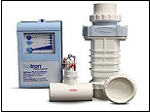 levels of iron and, perhaps, the
addition of the salt and the resultant high TDS caused the
iron to precipitate or the salt was not distributed around
the pool and/or was allowed to remain in prolonged contact,
without the benefit of being stirred. Always use a food or
water softener grade of salt. Never use rock salt! In either
case, I would try adding a dose of pH decreaser to the pool
and try to remove the pool stains (most likely iron) by
applying acid. To do this take a white sock with 1/2 pound
of pH decreaser powder and drop it onto the stained pool
area. Leave it in place for a few minutes and slowly move
around with the vacuum pool. Hopefully the acid will
dissolve the pool stains. You can also try a similar
technique using MetalTrap Stain Remover, which works better
and more often. Periodic addition of a dose
Liquid MetalTrap
will help prevent staining and, in addition, help keep the
salt chlorinator plates free of scale deposits. Liquid
MetalTrap, unlike most metal treatments is phosphate-free
and still performs, at a pH over 7.8. These high pH readings
can be common, when a salt chlorine generator is in use. I
hope that this information will prove helpful. Best wishes
for the new year! levels of iron and, perhaps, the
addition of the salt and the resultant high TDS caused the
iron to precipitate or the salt was not distributed around
the pool and/or was allowed to remain in prolonged contact,
without the benefit of being stirred. Always use a food or
water softener grade of salt. Never use rock salt! In either
case, I would try adding a dose of pH decreaser to the pool
and try to remove the pool stains (most likely iron) by
applying acid. To do this take a white sock with 1/2 pound
of pH decreaser powder and drop it onto the stained pool
area. Leave it in place for a few minutes and slowly move
around with the vacuum pool. Hopefully the acid will
dissolve the pool stains. You can also try a similar
technique using MetalTrap Stain Remover, which works better
and more often. Periodic addition of a dose
Liquid MetalTrap
will help prevent staining and, in addition, help keep the
salt chlorinator plates free of scale deposits. Liquid
MetalTrap, unlike most metal treatments is phosphate-free
and still performs, at a pH over 7.8. These high pH readings
can be common, when a salt chlorine generator is in use. I
hope that this information will prove helpful. Best wishes
for the new year!
Sincerely. Alan Schuster, 12/31/2008
► Where Did
The Copper Come From?
I have a 14,000 plaster pool with a
heater and was recently troubled with some discoloration.
The dealer found 1.3 PPM of Copper. I never used a copper
algaecide. So where did the copper come from? Please help.
Thanks.
Larry P., Clearwater, FL, 2/4/2011
It would appear that you have dissolved some of the copper
heater core. This is a result of low pH conditions over an
extended period and can be confirmed with a Copper Test. If
your pH is too low, you must add something to the water
before raising the pH. Add a double dose of a quality,
phosphate-free, chelating agent, such as
Liquid METALTRAP and recirculate
for a day, before raising the pH or total alkalinity. This
product should complex (chelate) the copper and avoid
further problems. If you are using TriChlor tablets there
is a tendency for the pH to drop over time. Test the pH
several times weekly, at the very least. If you have an
inline chlorinator, make sure that it is located after the
heater and filter - NEVER BEFORE! I hope that I have been
helpful.
Sincerely. Alan Schuster, 2/4/2011
►
Questionable Stain?
I have a 20 X 40 vinyl liner pool with
a very large sand filtration unit but I use zeolite
filtration media instead of sand. (Awesome stuff by the
way). About mid season last year I installed an Ionizer
(copper and silver type) on my pool to reduce the amount of
chemical use. Near the end of the season I started
developing a blackish stain in the creases of my pool (where
the pool walls meet the bottom). I've done some research and
believe it is a mineral stain from the copper or the silver
used by the ionizer. I have discontinued the use of the
ionizer and am simply using a chemical approach to
sanitizing the pool and the stain growth has stopped. First,
how do I get rid of the stain? Second, if I reintroduce the
ionizer to the mix, how do I keep it from coming back?
Tim Y., 5/15/2004
It could be due to heavy metal pool stains or possibly
algae. The trick is in narrowing the field, inasmuch as
treatment is quite different. I suggest that you try
something simple. Place a half pound of pH reducer powder in
a white sock. Shut off the filter and drop the sock onto the
pool stain. Position, as needed, with the vacuum pole. Leave
in place for about 15 minutes. If there is improvement, the
problem is positively due to a heavy metal: iron, copper or
manganese. If this does not work, try the same thing using
METALTRAP Stain Remover. If
the pool stains are removed, add a double dose of a quality
metal treatment, such as phosphate-free
Liquid METALTRAP,
now and add another dose monthly or whenever new water is
added. If this fails, it is possible that the problem is
black algae. Black algae is a resistant type and will
require a regimen to remove. You will need to boost the Free
Chlorine level to 10 PPM, add an initial dose of a polymer
algaecide, add an initial dose of a quat algaecide and lower
the pH to 7.0-7.2. Redirect the return flow to improve the
water circulation in the affected area. Use a scrub brush on
the stain, in order to expose the sub-surface to the
chemicals. If you have to use a metal treatment, it will
create a problem with the ionizer. The product will complex
with the copper and reduce its algaecidal action. I suggest
that you use a polymer algaecide, for at least a few months,
should you resume use of the ionizer. I hope that this
information proves helpful.
Sincerely. Alan Schuster, 5/15/2004
► Tan and
Brown Stains?
We have a 5000 gal fiberglass pool
with heater, that slowly develops stains (brown or tan) on
walls, pH 7.4, TA 120. These stains can easily be removed by
a stain remover (concentrated ascorbic acid), together with
a metal treatment. After treatment, pump is run for 12 hours
then filter is backwashed and new DE added. We treat this
problem when it becomes unsightly, approx every 6 weeks. Are
you aware of any chemical/product that could be added on a
continuing basis that would prevent this staining. It would
be nice to have pool walls clean all the time. Could
corrosion from heater be causing problem? Any other possible
cause of problem? Thank you.
Tom K, 3/22/2004
The color, of the pool stains, is not consistent with
copper, so I would rule out the heater. However, it is
consistent with iron and so is the treatment that you have
used. I suggest that you have the pool and source water
tested for iron. Any level can be a problem. Iron can be
present, even if the test results are negative, due to
interference from other chemicals that might have been added
or from the fact that it is on the walls and no longer
present in the water. It sounds like iron, so I suggest that
it be treated like iron. The recurrence could be due to not
having added enough of the metal treatment or having added
makeup water. Add a dose of the metal treatment now and add
an additional dose monthly or whenever new water is added.
Fiberglass has a negative electrical charge and can attract
positively charged metallic ions, causing the development of
a pool stain. The problem can be solved more effectively,
with The METALTRAP Filter. This cartridge-like filter is
used to recirculate the pool water and, as water passes
through its special media, metals are permanently removed.
If you use it to treat all new water and seasonally,
thereafter, you should be able to better maintain the pool's
appearance. Liquid MetalTrap is different from most metal
treatments. It is phosphate-free and does not degrade to
ortho-phosphate, over time and it is still effective at a pH
of 7.8 or higher. The right metal treatment could have made
a difference. Still nothing is better than removal and
avoidance. I hope that the information will prove useful. I
hope that the information will prove useful.
Sincerely. Alan Schuster, 3/22/2004
► Gray-Black
Pool Staining?
Wonderful website! I am desperate. We
have a 4 yr old gunite pool (16,000 Gal) we inherited when
we bought the house 1 year ago. The pool has a cartridge
filter and a heater. Although we don't use the pool in
winter, we have it maintained just like in summer, so we
could swim at any time, if we wanted to heat up the water
(but we haven't this year). We have been using a pool
company to clean and treat the water. We are on
their regular stain treatment program. Never had any stain
problems. Until this winter. First it started in the area
near the drains in the middle of the pool, a big dark
grayish/black area developed. Now within 2 months almost the
whole pool is covered with the gray black stuff. I tried
your pH minus in the sock trick - it worked. So I had the
pool guys give me 10 more pounds of the stuff and started at
7 am this morning with the tube sock, trying to move it
around the pool. The pH minus is dissolving very quickly,
when I move it around on the pool brush with a tube sock. By
now the whole pH of the pool is at or below 6.8 and all the
pH minus is gone but probably around 2/3 of the pool is
still stained. How should I proceed? Any ideas why all of
the sudden the pool would start staining like this and the
stain spreading over the months? We are in Houston, Texas
and we have lots of pines around us and lots of wax myrtles.
We do have an automatic cleaner and clean the skimmers and
scrub the pool 2x a week. Water was filled up 4 inches 3x
times last summer with no immediate effects on the staining.
Thanks in advance for your help.
Marita S., Houston, TX, 2/17/2009
The problem could be caused by something in the water: iron,
copper, manganese. Have the water tested. You may have
subjected the heater to the corrosive effects of chlorine
and low pH. If the acid made a difference, the problem is
not algae or something due to the trees. At least not
entirely. Tree stains and algae are best removed by
shocking. Mineral stains will not come off with chlorine! I
suggest you place some vitamin C tablets on a pool stain and
allow to dissolve. If this works, allow the pool's chlorine
level to bottom out. Drop the pH to about 6.8 and bypass the
filter, if possible. Add 2 pounds of MetalTrap Stain Remover
and recirculate the water. Brush frequently. Add a double
dose of a phosphate-free Liquid MetalTrap and wait 24 hours
before raising the pH or adding chlorine. It sounds like
the problem was too big for the sock treatment. Let me know
how it turns out. Good luck!
Sincerely. Alan Schuster, 2/17/2009
I just stopped after 10 solid hours
and 23 pounds of pH minus. I have not run the pump at all
today, since there is no way to bypass heater and filters.
My pH test kit only goes as low as 6.8, but it is much
lighter than that colour, so I assume the pH is way down.
After I emailed you, I used another 10 pounds of pH minus in
the sock and kept spreading it around, but the stuff really
only came off immediately underneath the sock this morning.
I have also scrubbed my heart out, and it appears overall
that probably 3/4 of the staining is gone or has lightened
up, which leaves me with light shadings of gray in some
areas. The pool guy only left me a pint of metal product. I
had asked him for 3. So I went ahead and used the one pint I
had, since I am worried about the dissolved stuff
resettling. I was thinking of leaving the pH low until
tomorrow PM and adding some more metal product in the
morning and scrubbing again really well. I won't run the
equipment until the pH is rebalanced. Do you think this will
damage the plaster? It is already kind of worn off on all
the corners by the pool cleaner and I had to patch 4 spots
where the gunite was showing! We did have some green algae
early this summer and it does appear that the very first
black/gray stain (1ft diameter by the drain) appeared within
a few weeks after the algae were gone. It seems like it
disappeared after that so. Could the algae treatment the
pool people used have caused this and, if yes, how could
that have been avoided? And if it did, why would it keep
spreading gray/black stuff for months after? And why is that
chelated metal treatment they are using monthly for iron,
copper, manganese etc not working? I know, lots of
questions, but I am a pool novice and so tired and
frustrated I am about ready to fill the thing with dirt and
plant flowers! Thank you so much for your support and I have
referred your web page to our pool guys!
Marita S., 2/18/2009
It is not algae. Algae wouldn't come off with acid. Yes, the
acid will etch the surface a bit. Try and keep the chlorine
level low, as long as the pH is under 7.0, in order to help
protect the heater. The overall acidic conditions should
even out the appearance. If some spots remain, try locating
a pool stain treating accessory and use it to siphon an
acidic solution onto any remaining pool stains. I can't
comment on why the products didn't work, as I have no
information relative to their content. Possibly enough
product was not added. It is possible that the algae
treatment caused the start of the problem. Copper can stain
masonry surfaces, especially in the presence of high levels
of calcium hardness. Adding some Liquid Metal Trap, after
the algae is gone, can help minimize the possibility of
staining. Good luck.
Alan Schuster, 2/18/2009
Boy, Alan! Do we have a sparkling pool
this morning! The pool guy just came by and couldn't believe
the change either! Your help REALLY is appreciated,
recommended your website to everyone I know has a pool.
Thanks a million.
Marita S., 2/19/2009
I guess it doesn't get much better that this. Just make sure
that you add a dose of a metal treatment monthly and prior
to adding an makeup water. If you use algaecide, try a
polymer based product. Glad that it all worked out.
Regards, Alan, 2/20/2009
► Black Spots
In Pool?
First of all the basics: 22,000 vinyl
liner pool with skimmer and main drain, Chlorine treated
Sand filtration. The pool gets black mud looking
spots. They can easily be brushed away, but return. I
usually use a copper based algaecide. It has given some
relief in the past but seems ineffective now. We keep our
pool open year round but only swim in summer, we live in
Atlanta. Have you got any ideas? Sincerely.
Mike G., Atlanta, GA, 3/10/2010
My best guess is that it is not black algae: this type of
algae is very difficult to remove and will not simply brush
away. It is possible that copper can cause some black
stains, especially if the pool water is high in calcium
hardness, although this is unusual with the proper use of a
chelated copper algaecide. I suggest that you discontinue
use of the copper algaecide and start using another type,
inasmuch as you stated that it seems not be effective. My
choice would a polymer algaecide. It is more expensive, but
worth the price. Try this on the pool stains. Put 1/2 pound
of pH reducer in an old white sock, drop onto a spot. Leave
in place for a few minutes and move around with a vacuum
pole. If improvement is seen, this will confirm that it is a
mineral problem and not algae. Repeat elsewhere as needed.
To help prevent a recurrence of the problem, add a double
dose of a quality, phosphate-free mineral treatment, such a
Liquid MetalTrap. There are pool stain scrubbers available
to help remove difficult spots. You might find more
information in other areas of the archives. I hope that I
have been helpful.
Sincerely. Alan Schuster, 3/10/2010
► Gray Pool
Stains?
I have a large in-ground pool/spa, 7
years old, kidney shaped, about 30,000 gallons. It has had a
Copper Ionization + ozone system on it for about 5 years.
Over the years, the pool service did not maintain the pH
properly and the pool has developed gray stains. A drain and
acid wash is recommended by my pool service but I am
reluctant to proceed due to the expense and the impact it
has on the pool surface finish. My pool technician, has
suggested that he has been successful in treating stains
like these with the addition of Muriatic acid to the water.
I am willing to give this process a try as it appears cost
effective and should not damage the finish. I would like to
try the treatment on the spa first, and see if it is
successful. If yes, than I would like to do it to the whole
pool. What are the pros and cons to this approach? How much
Muriatic acid needs to be added for success? My spa is 8
feet in diameter. How many gallons of acid for the 30,000
gallon pool? How long should I let this circulate? Are there
different strengths of Muriatic acid? Which one should I
use? What is the best way to restore the water chemistry
after this operation? Thanks.
Minoo B., 12/1/2007
I frequently recommend that a pool or spa be subjected to an
acid bath as a means of stain removal. Basically it
dissolves the top surface and hopefully takes the pool stain
with it. Lowering the pH will subject the metal parts to
corrosion, including the heater, if chlorine or bromine are
present. Therefore, treatment should be in terms of a short
period of time - a day or less. You have to add enough acid
to lower the pH below lower pH readings on the testers. A pH
of about 5.5-6.0 should suffice. Use the brush to scrub the
surface. Bypass the heater, if possible. Once the pool
stains are removed, add a dose of a quality metal treatment,
such as phosphate-free Liquid METALTRAP, in order to help
avoid a recurrence. Restore the pH and TA. Because the
addition of the metal treatment could interfere with the
copper being introduced by the ionization unit, I would
recommend using a polymer algaecide for a month or two,
while the copper ion content is re-established. I hope that
this information proves helpful.
Sincerely. Alan Schuster, 12/1/2007
I used your recommendation and the
pool/spa surfaces are now to almost all-new condition.
Thanks. There is one problem I am having that I have not
been able to solve. The pH continues to remain high (around
7.8 to 8), the TA is fine, and repeated attempts by my pool
service and me to lower the pH by adding acid have not been
successful. My pool service thinks that the pool/spa surface
areas are still leaching chemicals and are planning on
adding some chemicals that will help. Any suggestions based
on your experience? Sincerely.
Minoo B., 12/4/2007
It is possible that the walls are leaching into the water
and causing the pH to rise. To help prevent this, check the
calcium hardness level. If the level is below 200 PPM, raise
it to that level. If the calcium hardness is above 200 PPM,
the answer to the problem may lie elsewhere. I hope that I
have been helpful.
Sincerely. Alan Schuster, 12/4/2007
► Brown Pool
Liner Stains?
I have a 18x36 inground pool.
Rectangle with radius corners. The pool is 6 years old. We
have brown-colored stain on the pool liner. Is there any way
to remove this? What caused it? We have never had this type
of pool staining previously. Thanks.
Becky S., 5/7/2008
It is difficult for me to know, with any certainty, what has
caused the vinyl pool liner to become discolored and
stained. The problem could be pool stains from leaves and
debris or a stain from algae. If the pool was just opened,
these possibilities are likely. The colored pool stains
could, also, be caused by the presence of heavy metals such
as iron or copper. Having the water tested for iron and
copper could shed some light on these possibilities. If you
think the problem is leaves or algae, it, should be removed
by shocking the pool water. Raise the Free Chlorine level to
5-10 PPM. This should show improvement within a day or so.
If the problem is minerals, you can try this as a means of
confirmation. Put 1/2 pound of pH reducer granules in a
white sock. Shut off the filter. Drop the sock onto a
stained pool area and leave in place for 15 minutes. Use the
vacuum pool to move it around. after 15 minutes. If
improvement is seen, the problem is definitely minerals. To
treat the entire pool, it will be necessary for the pH to be
dropped to approximately 6.0. This will dissolve the pool
stains. Use the brush to speed things up. Afterwards, add
2-3 doses of a quality mineral treatment, such as
phosphate-free Liquid METALTRAP, in order to complex the
minerals and help prevent a recurrence. If you are on well
water, using the METALTRAP Filter, to treat all new water,
helps keep new additions of iron and other metals out and
minimizes the possibility of pool staining. You could, also,
use The METALTRAP Filter to recirculate the pool water and lower
the heavy metal content. I hope that I have been helpful.
Good luck.
Sincerely. Alan Schuster, 5/7/2008
► Stained
Gunite Pool?
Dear Alan, I tried your sock trick
with pH decreaser and it worked on the pool stain. My
problem is the pool store said that if I use to much
muriatic acid to lower my pH to 5 it would destroy the
surface of my gunite pool. They are in the business to sell
chemicals. Please advise as soon as possible. Thanks.
Bill L. from Florida, 11/11/2006
You'll need to fill in some of the blanks. The sock trick
worked? Did it work in a spot or everywhere? Is the stain
local or overall? You may have to just lower the pH into the
mild acidic ranges and that should no permanent damage. It
would be like an acid wash. I'll get back to you after your
reply.
Sincerely, Alan Schuster, 11/11/2006
I tried the pH decreaser on the steps
of my pool and also in the deep end I believe the stains to
be iron since I use well water to fill the pool. I used a
vitamin C tablet and it also removed the staining, but not
as quickly. How low can I lower my pH without adverse
effects? Also can I use muriatic acid since it is much less
expensive then dry acid. I hope you have enough info.
Sincerely.
Bill L., FL, 11/12/2006
You must have the pool and well water tested for iron. You
will need to add one dose of a quality iron treatment, for
each one PPM or fraction - ASAP! In the future add more
after each addition of new water. This will not remove the
pool stains, but should help prevent more. From what you are
saying, it is apparent that acid will remove the pool
stains. That being the case, I suggest that you allow the
chlorine level to drop to just a few tenths of a PPM. Lower
the pH to 6.0-6.5, by the addition of muriatic acid.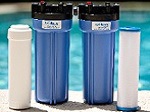 In this
application, there is no benefit in applying dry acid. It
will only cost more and make zero difference in the
corrosion. Only the pH matters. Once the pH is lowered, use
the brush to scrub the pool stains. Keep the filter
operating and, if possible, by pass. Periodically check the
pH to see if more acid is required. The acid will etch the
upper surface of the walls and by doing so will help remove
the pool stains. The same etching would result from acid
washing the pool. The lower the pH - the faster the removal
process. Once the pool stains are removed, add another dose
of iron treatment, prior to raising the pH.
MetalTrap Pool Stain Remover
will speed things up, if you add it just prior to adding the
acid and while the chlorine level is very low. This chemical
will discharge all of the chlorine in the pool and will make
a shock treatment necessary to restore a chlorine level,
after the pH has been optimized. However, before shocking
allow at least 24 hours for the iron
treatment to work. Inasmuch you are on well water, using the
METALTRAP Filter, to treat all new water, helps keep new
additions of iron and other metals out and minimizes the
possibility of staining. You could, also, use The METALTRAP
Filter
to recirculate the pool water and lower the heavy metal
content, already present in the pool water. If sediments are
also a problem, the MetalTrap Dual-Cartridge Filter would be
a better choice. It is a MetalTrap Filter, with a 5-micron
sediment/contamination filter. The filter cartridges are
replaceable and installation and use is simple. I hope that
this information will prove helpful. In this
application, there is no benefit in applying dry acid. It
will only cost more and make zero difference in the
corrosion. Only the pH matters. Once the pH is lowered, use
the brush to scrub the pool stains. Keep the filter
operating and, if possible, by pass. Periodically check the
pH to see if more acid is required. The acid will etch the
upper surface of the walls and by doing so will help remove
the pool stains. The same etching would result from acid
washing the pool. The lower the pH - the faster the removal
process. Once the pool stains are removed, add another dose
of iron treatment, prior to raising the pH.
MetalTrap Pool Stain Remover
will speed things up, if you add it just prior to adding the
acid and while the chlorine level is very low. This chemical
will discharge all of the chlorine in the pool and will make
a shock treatment necessary to restore a chlorine level,
after the pH has been optimized. However, before shocking
allow at least 24 hours for the iron
treatment to work. Inasmuch you are on well water, using the
METALTRAP Filter, to treat all new water, helps keep new
additions of iron and other metals out and minimizes the
possibility of staining. You could, also, use The METALTRAP
Filter
to recirculate the pool water and lower the heavy metal
content, already present in the pool water. If sediments are
also a problem, the MetalTrap Dual-Cartridge Filter would be
a better choice. It is a MetalTrap Filter, with a 5-micron
sediment/contamination filter. The filter cartridges are
replaceable and installation and use is simple. I hope that
this information will prove helpful.
Sincerely. Alan Schuster, 11/12/2006
Dear Alan, thanks for the advice. I
did as you suggested and it worked out great. The walls of
the pool look great. I will use an iron treatment, in the
future, whenever I put water in the pool. Thanks again.
Great site. Good advice. Sincerely.
Bill L., FL, 11/15/2006
► Brown Pool
Walls And Bottom?
Alan, Your pH-reducer-in-a-sock trick
did WONDERS for our 7 yr old vinyl lined pool BOTTOM. Within
literally minutes, the brownish stains on the bottom
disappeared. Problem: The stains are still on the sides of
the pool, however, and we cannot seem to get them off. Our
attempted solution. We tried rubbing the sock on the sides,
but were unable to stand there long enough for the trick to
work. We treated the whole pool, as you suggested, but the
pool stains persist, only on the sides. Any other
suggestions? Sincerely.
Stephanie M., Edmond, Oklahoma, 5/17/2004
Stains on a vinyl liner will rarely ever respond just to the
addition of Liquid MetalTrap. Acidic water
conditions are usually required. Such products can help
avoid further pool staining, but may not act upon a current
pool stain. The fact that the sock worked shows that the
problem has a solution. It is case of lowering the pH of the
entire pool to below 7.0. From your description, it appears
that iron pool stains are the problem and this treatment
should work. However, it may work faster and better, if you
allow the chlorine level to bottom out and add some
MetalTrap Stain Remover, after the pH has been lowered to
about 6.8. Once the pool stains are gone, add another dose
of the metal treatment. Thereafter, add a monthly dose or
whenever new water is added. Good luck and enjoy the summer.
Sincerely. Alan Schuster, 5/17/2004
Alan, I LOVE your site, and have told
all my pool owner friends about it! As a follow up to my
earlier question, we FINALLY got all the stains off of our
pool. In fact, it has never looked better. We followed your
advice about the pH reducer in a sock, and that got rid of
all the bottom stains. Then the local pool supply store told
us to rub a lemon/orange/vitamin C tab on the stains to see
if that got them off. They started coming off instantly, so
we went ahead and bought their stain remover product that
was sheer concentrated ascorbic acid. (Confirming what you
said about acidic conditions being necessary). We did not
follow the instructions and broadcast the product in the
water; rather we put it in a sock again and rubbed it along
the sides. Thought the vitamin C thing might help someone
else. Thanks a million!
Stephanie M., 5/18/2004
► Stains From
H--l?
Alan: I have a gunite pool built in
1959. The previous owner's neglect has created
brownish/black colored pool stains from leaves and there is
also a very light greenish blue colored pool stain. I
drained the pool thinking a muriatic acid wash would take
care of this. I was so wrong. Using a 4:1, acid to water, it
did not even scratch this stuff. I need to get water back in
the pool because of the massive amounts of rain we've had.
Please give me advice on chemicals, treatments, etc. I can't
really afford to refinish and I was told that paint, because
of the cratered surface, would peel quickly.
No Name, 5/13/2011
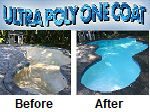
The brownish pool stains are probably tannins from the
leaves. Fill the pool up and a double dose of a quality
mineral treatment, such as phosphate-free
Liquid METALTRAP,
just in case the pool stains are more than tannins. Add
shock and boost the Free Chlorine level to 5-10 PPM. Tannins
will be destroyed by the chlorine. Keep the Free Chlorine
level elevated until the dark stains are removed. Keep the
filter operating and use the brush. After these pool stains
are removed, you will in a better position to access the
appearance of the pool. The greenish pool stains could be
algae and/or copper. If it is algae, the chlorine will take
care of it. I am no expert on painting the pool, but at the
very least you will have to thoroughly clean the walls
before painting them and this is a good start on that road.
One type of paint is especially easy to prepare for:
Ultra
Poly One Coat. Let me know how the first part turns out and
we'll try to deal with the remaining problem. Good luck and
I hope that the information proves to be helpful.
Sincerely. Alan Schuster, 5/13/2011
► Rusty
Stains On Fiberglass Pool Bottom?
Dear Alan, I recently had a fiberglass
pool put in.(4 months ago) A short time later I saw my first
couple of stains. One is a 2 inch streak 1/4 inch wide, my
pool man who only ads the chemistry thought it might have
been from a nail. I had a house built right next to the
pool. The others seem more round and streaks like a meteor
they are fairly small but I'd like to get rid of them
without destroying the gel coat on the fiberglass. Any
suggestions are welcome. The pool manufacturer thinks the
pool guy might be adding the chemicals that settles on the
bottom and causes these rust looking pool stains. Thank You.
Kris, 4/27/2007
None of the chemicals that the "pool guy" is adding should
be capable of creating a pool stain problem. There are two
likely causes of a discolored or stained pool. The source
water added to the pool contains iron or other heavy metals.
You can confirm this by having the pool water tested: most
pool professionals offer complimentary water analysis. The
other equally likely possibility is a foreign object. Start
by adding a dose of a Liquid MetalTrap This will complex
with iron and help prevent further staining. To remove the
pool stains, a good option would be to use a stain-remover
accessory. This inexpensive device is available at many pool
stores and will allow you to siphon a solution onto the
stains. To make a suitable solution: to a 1/2 gallon of
water, in a plastic container, add 1 quart of a
Liquid
METALTRAP and 1 quart of muriatic acid. Make sure that you
wear rubber gloves and eye protection! Because your pool is
still under warranty, I would discuss this treatment with
the builder, so as not to risk voiding the warranty. Use the
stain-remover accessory to siphon the liquid onto the
stains. Afterwards, adjust the pH, as necessary. Fiberglass
pools have a negative electrical charge and can attract
positively charged metallic ions, possibly causing the
development of a pool stain. Using the
METALTRAP Filter, to
treat all new water, helps keep new additions of iron and
other metals out and minimizes the possibility of pool
staining. You could, also, use the METALTRAP Filter to
recirculate the pool water and lower the heavy metal
content, already present in the pool water. The periodic
addition of Liquid METALTRAP should help maintain this condition and help keep
pool stain free. I hope that I have been of assistance. Good
luck.
Sincerely. Alan Schuster, 4/27/2007
► Stains From
The Reverse Side Of Liner?
My pool has some grayish pool stains
in the hopper. I have tried everything: shocking, rubbing
with a chlorine tablet and ascorbic acid and nothing has
helped. It seems to start in the spring and spread and
darken as time passes. The dealer says that it a fungus
growing on the reverse side of the liner and I'll have to
live with it. Is there any suggestion that might help? Thank
you.
Mike T., 6/11/2009
Information on this topic is very sketchy. The only person I
had a conversion with, in depth, does not want to have his
name made public. He is not in the liner business and,
therefore, does not want to handle the inquiries. It is not
a common problem. But if you have the problem that is no
consolation.
Some types of bacteria and/or fungi, found in the soil, can
actually appear to penetrate a vinyl liner and cause pool
stains to appear on the liner. Usually they will start off
as spots or cloud-like formations on the liner. Chemicals
used to elimination algae and other microorganisms have
little or no effect, on these types of pool stains, since it
doesn't get to the source of the microorganisms in the soil.
If a pool is thought to have a problem with microorganisms,
mold or fungus staining reverse-side of the liner, the
ground underneath the liner should be replaced with fresh
sand, vermiculite or pool base. Afterwards, treat with a
solution of one-part liquid pool chlorine and three-parts
tap water. Apply with a garden sprayer several times. Wait a
few hours, before prior dropping the liner into place. If it
is not a new liner, please bear in mind that the liner could
shrink and become useless, if allowed to dry out completely.
An alternative to the chlorine/water spray would be use a
non-solvent based herbicide on fresh sand, vermiculite or
pool base.
If the liner has been recently replaced, one method which
has been discovered that may provide a solution. The
application of Ferrous Sulfate (FeSO4), to the perimeter
around the outside of the pool can change the pH and the
soil chemistry. This chemical is a reducing agent and
exhibits acidic properties. This technique seems be
effective in retarding and/or killing the troublesome
bacteria, mold or fungus. This stems from a method used to
protect the vinyl liners used under some landfills. This may
not a guaranteed cure, but has been met with some success.
It can be tried without having to drain the pool and
replace the liner. For an typical inground pool, you might
require twelve to fifteen pounds of this chemical. Sprinkle
it on the ground, around the outside pool perimeter, near
the pool patio or deck, on as much of the pool perimeter, as
possible. Afterwards, turn a lawn sprinkler on the area, for
two or three days: long enough to get the ground around the
pool thoroughly saturated with water. The intent is to get
the ferrous sulfate to soak deep into the ground. Hopefully,
it will change the pH and soil chemistry enough and kill off
or retard the growth of these troublesome microorganisms.
Results may not be seen for a few weeks, depending upon the
nature of the soil's chemistry and drainage properties.
Direct application of chemicals can damage some plants or
grasses, so abundant watering and drainage is important.
Ferrous sulfate is used with plants such as: Rhododendrons,
Azaleas, Blueberries, Mountain Laurel, Holly and Blue
Hydrangea, that thrive best in acidic soil. Do not allow
this chemical to get into the pool, as it will cause water
discoloration and staining of underwater surfaces. An
alternative to the surface distribution would be the digging
of a series small holes around the pool perimeter and
burying some of the ferrous sulfate, in each one. Follow
with a thorough watering down of the area, for the next few
days.
Sincerely. Alan Schuster, 6/11/2009
► Grout
Stains?
Our pool has a salt chlorine generator
and the grout has become stained. Is there a specific kind
of grout that should have been used with our tiled salt
water pool? We feel that the problem may rest in the
minerals and metal leaching up from the gunite. Thanks.
Janet, 11/16/2011
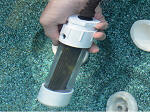
This is not a salt chlorine generator issue. There are
different types of grout and some are much more resistant to
staining. Products with silicone or epoxy should be less apt
to stain, than strictly masonry products. Try using
METALTRAP Stain Remover and a scrub brush, after
lowering the water level. Follow with phosphate-free,
Liquid
METALTRAP, which is a true chelating agent, to prevent a
recurrence. The minerals, in the plaster, should not have
cause the problem. It could be the nature of the source
water of the use of salt that contains Yellow Prussiate of
Soda, which contains iron. I hope that this will help solve
the problem.
Sincerely. Alan Schuster, 11/17/2011
► Ascorbic
Acid Worked Immediately?
I have the light brown pool stains on
a vinyl pool. An ascorbic acid product worked the best.
Immediately the stains disappeared. The problem is I can't
find any locally. Can you tell me of any other similar
products that national pool places would carry? Thanks.
Maria, 5/20/2009
Ascorbic acid be very effective in removing iron stains,
especially if you can get the chemical to the strain. It is
functioning as an acidic reducing agent.
MetalTrap Stain Remover is
available, in the website store. More people
prefer its use, to that of the more common oxalic acid
products, because oxalic acid is a toxic chemical. Good
luck.
Sincerely. Alan Schuster, 5/20/2009
► The Tough
Last 10%?
Without a doubt the very best site I
have seen yet on the problem of pool stains. We opened our 3
year old vinyl 20-40 pool and had a ton of dead leaves and
junk that ended up on the bottom. Pulled out as much as
possible and then vacuumed up all the brown "dirt" junk on
the bottom. 90% came right up but some did not, it is as
though it is "painted" on to the bottom. The interesting
thing is that it follows the pattern of the vacuum
attachment, that is, it looks as though the brownish color
was "rubbed into" the vinyl. The pool water is incredibly
clear. The stuff will not vacuum up easily. Using a rubber
gadget, sort of like a large eraser, allows me to rub some
of it off but this will take forever. Does this sound like a
metal stain (iron). I did have some brown chalky dirt on the
plastic returns in the pool which I understand is a sign of
metals but the stains have definitely been "rubbed into" the
vinyl which I would assume is more like a vegetable type or
tannin stain. Anyway, I am open to suggestions. Thanks.
Ray S., 6/19/2007
Obviously tannins would have been my first choice. The
circumstances all point to tannins as the cause. The
statement that the water is clear leads me to believe that
the chlorine reading is acceptable. The fact that you can
rub it off eliminates the possibility of it being a fungus
on the reserve side of the liner. That does leave open the
possibility of iron and or other metals. Try this! Put 1/2
pound of pH reducer powder in a white sock, shut off the
filter and drop onto a stained pool area. Leave in place for
15-30 minutes. Move with a vacuum pole and, if improvement
is seen, the problem is definitely minerals. You might be
able to treat the problem by repeating this procedure. If
the problem is mineral you will need to add a double dose of
phosphate-free Liquid MetalTrap, in order to help avoid a
recurrence. You can use a stain removal accessory to scrub
the remaining stubborn spots. If the sock trick, does not
work, I am inclined to believe that it is a plant-derived
pool stain or early stages of a resistant algae. I would
treat this on the basis of being black algae and add a
polymer based algae and boost the Free Chlorine to 10 PPM. I
hope that this leads to success. Refer to the archives on
Black algae for additional information. Thanks for the
encouragement. Enjoy the summer.
Sincerely. Alan Schuster, 6/20/2007
► Algae
Stains Or Mineral Stains?
Hello Alan. You have a great web site.
It has been so helpful. I do have a pool stain problem with
my in ground 16 X 38 pool. I have some stains that appeared
in the bottom of my pool. It is a vinyl liner. All of the
stains are at the bottom where the side walls meet the
bottom and at the corners of the slopes down to the deep
end. It is tan and beige in color. I tried scrubbing the
areas and no success. I was told to try putting a 3" tablet
in a sock and scrub the area and see if it lightens up. That
did not work either. I was told that it could be black algae
and I also was told that it could be a metal pool stain. The
testing of the water showed no metals in the water. What
would be my next step? Any help would be appreciated. Thank
You.
Ralph, 6/13/2008
I would advise you not to try that thing with the tablet in
the sock. It might work, but it might bleach the liner. You
can remove a stain, but you can't undo the bleaching out of
the liner color. The areas that you are describing are some
of the favorite hangouts of algae. It is also possible that
mineral particles accumulated in these areas and led to the
discoloration. From the color it is not clear cut, as to the
possibilities. T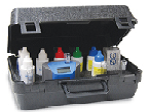 he fact that the water does not show metals
is not conclusive. The metals may have precipitated out of
the water or may not have been tested for. I suggest that
you start by trying my sock trick. Put 1/2 pound of pH
reducer in a white sock and drop onto a stained area.
Position with a vacuum pole, if necessary. Leave in place
for 1/2 hour. If the pool stains are removed, it is proof
that the problem is mineral. If this did not work, try it
with a pool stain remover, such a MetalTrap Stain Remover,
instead of the pH reducer. If the discolorations and pool
stains are not removed, it is possible to probable that it
is a resistant type of algae. If this is the case, I suggest
that you treat it on the basis of black algae. You'll find
more information in the archives on that topic. You might
want to take a more active role, in the water testing.
The ColorQ all-digital water analyzers have helped many a
pool owner get a handle on a problem. There is a model,
for every pool need. No color-matching and it eliminates the
guesswork. I hope that this information will point you in
the right direction. Good luck and let me know how it turns
out. he fact that the water does not show metals
is not conclusive. The metals may have precipitated out of
the water or may not have been tested for. I suggest that
you start by trying my sock trick. Put 1/2 pound of pH
reducer in a white sock and drop onto a stained area.
Position with a vacuum pole, if necessary. Leave in place
for 1/2 hour. If the pool stains are removed, it is proof
that the problem is mineral. If this did not work, try it
with a pool stain remover, such a MetalTrap Stain Remover,
instead of the pH reducer. If the discolorations and pool
stains are not removed, it is possible to probable that it
is a resistant type of algae. If this is the case, I suggest
that you treat it on the basis of black algae. You'll find
more information in the archives on that topic. You might
want to take a more active role, in the water testing.
The ColorQ all-digital water analyzers have helped many a
pool owner get a handle on a problem. There is a model,
for every pool need. No color-matching and it eliminates the
guesswork. I hope that this information will point you in
the right direction. Good luck and let me know how it turns
out.
Sincerely. Alan Schuster, 6/13/2008
► Pool Stains
Caused By Leaves?
Do you know of a stain remover that
will work on leaf pool stains? We had a problem when closing
the pool, and the water was not clear, and leaves set all
winter. The pool now has a green tint, and looks like algae,
but tests good. Thanks.
Trish, 4/20/2006
You don't need a pool stain remover. Most likely the stains
are tannins from the leaves and would have resulted in
brownish
colored pool stains. The green color of the pool water is.
most likely, due to algae. Shock the pool and keep the Free
Chlorine Test reading at approximately 5 PPM, until the
water clears up. The elevated chlorine level will decompose
the tannins and the algae at the same time. Use a brush on
the stained pool surfaces to speed things along. Keep the
filter operating continuously. Retest the Free Chlorine
periodically and add more shock as might be required. After
the water clears and the stains are gone, resume normal
filtration and chlorination. I hope that I have been
helpful.
Sincerely. Alan Schuster, 4/20/2006
► Cause Of
Exposed Aggregate Stains?
I have a 1-year old pool running on a
salt chlorinator. The water balance has been maintained
pretty much dead center. However, on two occasions the salt
system blew a fuse and stopped generating chlorine for a
week. In the shaded area of the pool I developed algae
after the second blown fuse. I’ve been told that the
discolored areas now on the exposed aggregate surface are
algae that have impregnated the surface. I’ve tried
recommended doses of stain removers for yellow, non-metallic
type pool stains with some success. The stains have
definitely been lightened, but they’re still there. My
questions: Is my information correct? Have algae impregnated
themselves into the aggregate? Can I double or triple the
dosage of products recommended for removing that sort of
pool stain? Is there a product on the market that will work
well on this sort of pool stain? Lastly, I know algae can
grow quickly, but, I’m skeptical that this pool stain was
caused within a 1 week period, simply because of the salt
system shut down. I’ve had pools in the past with tons more
algae and never any pool staining. Could this be because
the surface was so new when the outbreak occurred? It
happened within 3 months of being filled with water. Thanks
for your help.
Mark M., 2/3/2010
I can point you in the right direction, but the exact cause
is for you to discover. Algae can grow very quickly,
especially in warmer water that is lacking chlorine. Algae
can stain and get imbedded in the rough surface. Given that
the salt chlorinator was inoperable for a week, this seems
the most likely cause of the problem. Metals can stain,
especially in a pool that is relatively new. I doubt that
there was anything inherently wrong with the finish. So
which is it? Adding all the metal treatments will do
nothing, if the problem is algae-related. A high dose - 10
PPM - of free chlorine would be much better in this case.
Try and redirect the flow to send more water towards the
effected areas. If the stain is metals-related, shocking the
pool will accomplish nothing. You might need to lower the pH
and add some MetalTrap Pool Stain Remover, after the
chlorine level has been dropped closer to zero. Give the sock trick a try or
place a few vitamin C tablets on a pool stain. If this
works, the problem is definitely metals. If it fails to
work, it is most likely algae. Good luck and I hope that the
information proves helpful. Please let me know how it turns
out.
Sincerely. Alan Schuster, 2/3/2010
► A
Wintertime Mistake?
Greetings Alan, I came across your
website and I am unclear if some of the questions pertain to
me. We covered our pool last winter with the cover and tied
most of it off. During some windy days my husband put some
weights round the pool to hold the liner down, unfortunately
one fell in and left quite a large size rust mark. We live
in the Toronto Canada area and are looking for ways to scrub
away the rust stain. Some removed with a pool brush however
there is a significant amount left. Could you please assist!
Thank You. First time pool owners.
Dale and Jacquie H., Toronto, Canada, 6/10/2009
I'll assume that the pool is vinyl lined. Try this! Put 1/2
pound of pH reducer powder in white sock and drop onto a
stain - use the vacuum pole to position the sock. Leave in
place for 15 minutes. If improvement is seen, repeat
elsewhere, as needed. If it doesn't work, you might try
using MetalTrap Stain Remover, instead of the pH
reducer. You can also use a stain-remover accessory to
remove the pool stain, by siphoning an acidic cocktail onto
the stains. This device is available at many pool stores. In
the future, use water bags to hold the winter cover in
place. Good luck and I hope that I have been helpful.
Sincerely. Alan Schuster, 6/10/2009
► Stained By
Neglect?
Hello, I appreciate your advice. I am
a new home owner with a new pool, which is said to have been
re-plastered last year w/ blue plaster. I expected the pool
to be in good shape when we moved in. However, it appears
the previous owner had stopped maintaining the pool for at
least two months. By the way, this is in El Paso. We get
high winds this time of year with lots of dust, the pool has
no cover. I immediately vacuumed the pool and tested the
water. It was low on chlorine. I expected the floor of the
pool to get clean completely. However, I was surprised to
find that not all of the dirt came up. Throughout the floor
of the pool there is a faint grayish layer of what appears
to be dirt. However, there appears to be tracks running back
and forth along the whole bottom of the pool, that I would
assume were made by the wheels of a vacuum. These tracks run
back and forth in predominantly one direction, and the pool
surface looks clean where the tracks are. I don't know how
to describe it further, other than the bottom just looks
dirty with all these "clean" tracks running through it. Can
you help with any advice? Your recommendations are greatly
appreciated.
Frank H., El Paso Texas, 4/25/2007
There are several possibilities. The neglect could have
resulted in algae and debris accumulating and causing a
discolored, stained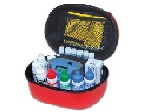 pool. If this is the case, a shock
treatment should remove the discoloration. Boost the Free
Chlorine level to 5-10 PPM and keep it there for a few days.
The problem could be minerals. A water analysis should shed
some light on this possibility. Have the water tested for
iron and copper. You might try this. Put 1/2 pound of pH
reducer powder in a white sock and drop onto a stained pool
area. Shut off the filter and allow to remain in place for
15 minutes. If improvement is seen, the problem is minerals.
If no improvement is seen, algae and debris staining are
more likely. Your local pool store should have a gadget that
can attach a 3" inch tablet to the end of a vacuum pole. Use
this to rub a chlorine tablet on a stained pool area. If
improvement is seen, the shocking of the pool should do the
trick. The right kind of water analysis information can
solve many problems. The all-digital ColorQ testers
eliminate the color-matching and guesswork. If it helps you
avoid problem, that is time and money saved. Browse through
the archives for more on this topic. Good luck and I hope
that I have been helpful. pool. If this is the case, a shock
treatment should remove the discoloration. Boost the Free
Chlorine level to 5-10 PPM and keep it there for a few days.
The problem could be minerals. A water analysis should shed
some light on this possibility. Have the water tested for
iron and copper. You might try this. Put 1/2 pound of pH
reducer powder in a white sock and drop onto a stained pool
area. Shut off the filter and allow to remain in place for
15 minutes. If improvement is seen, the problem is minerals.
If no improvement is seen, algae and debris staining are
more likely. Your local pool store should have a gadget that
can attach a 3" inch tablet to the end of a vacuum pole. Use
this to rub a chlorine tablet on a stained pool area. If
improvement is seen, the shocking of the pool should do the
trick. The right kind of water analysis information can
solve many problems. The all-digital ColorQ testers
eliminate the color-matching and guesswork. If it helps you
avoid problem, that is time and money saved. Browse through
the archives for more on this topic. Good luck and I hope
that I have been helpful.
Sincerely. Alan Schuster, 4/25/2007
You've given me some good ideas on how
to proceed. Sincere thanks for your response.
Frank H., 4/28/2007
► Mystery
Pool Stains?
The pool store we used closed this
past year. Right after that, we installed a chlorine
generator on our 18 x 48 inground vinyl lining pool. We
always had clean sparkling water with chlorine, and for the
first couple of months, the water was fine with the
generator. Now the sides of the pool have become stained.
This LOOKS like an algae but it is a pool stain - even the
stainless steel ladders have stains around the water level.
This baffles me! The generator registers 2800 to 3200 so I'm
sure we're putting enough salt in the water. Is this a
normal occurrence with these generators? We've always had
the prettiest pool in our neighborhood and now it looks like
it's dirty. I know the water is clean though. I worry that,
should we put in a new liner, will it become discolored too?
If you can help me, I surely would appreciate it!
Colleen, Central Georgia, USA, 5/12/2009
The pool stains are probably due to iron, copper and other
trace minerals and are rarely removed by simply adding a
metal treatment. The pool stains are probably completely
unrelated to the salt chlorine generator. Try this. Place
1/2 pound of pH minus in a white sock and drop onto a pool
stain. Leave in place for 15 minutes. Move around with a
pole. If this works, you should be able to get rid of the
pool stains by lowering the pH of the pool to about 6.0. If
you have a heater, by pass it or allow the chlorine readings
to fall to zero. In it does not work, place a few vitamin C
(ascorbic acid) tablets on a pool stain, shut off the filter
and leave in place for 15 minutes. If this worked, it is
likely that treating with MetalTrap Pool Stain Remover will
work. Put 1/2 pound in a white sock and drop onto a pool
stain. Slowly move around with a vacuum pole. Repeat
elsewhere, as necessary. Some pool dealers carry these
products. Have the pool and source water tested for iron and
copper. ADD A DOSE OF A PHOSPHATE-FREE
LIQUID METALTRAP FOR
EVERY 0.5 PPM OF IRON OR COPPER. At the very least add two
doses. If the stained pool area is too broad to be treated
with the "sock", you may have to lower the pH of the pool to
6.0, discharge all of the chlorine and add a few pounds of
MetalTrap Stain Remover. If there are questions regarding
this get back to me with the test results and the results of
the "sock" test. Thereafter add a dose of metal treatment
monthly or prior to adding new water, in order to avoid
minimize the possibility of a recurrence. Good luck and I
hope that I have been helpful.
Sincerely. Alan Schuster, 5/12/2009
Alan, I just found your letter - I'd
saved it. Just thought I'd let you know, I just took a
sample of the water to a pool store and bought what they
recommended and did what they said! You were so kind to try
and help me out! I just need a "pool man" to come every
week. Actually, life with the chlorine generator is simple.
I just know now that I still have to test my water. Have a
happy and safe Memorial Day.
Colleen, 5/29/2009
► Rust Stains
From Steel Wool?
We recently did some work in our back
yard using steel wool. Particles of the steel wool ended up
in our inground pool. Small rusty pool stains, from the
steel wool are appearing. Is there something I can use on
these small pool stains to remove the rust without emptying
the entire pool? Thanks.
Mike C. Scottsdale, AZ, 10/2/2011
NEVER USE STEEL WOOL AROUND A POOL!!! First start by adding
a dose of phosphate-free Liquid MetalTrap. This will chelate
(complex) with iron and help prevent further pool staining.
To remove the pool stains try this: put a pound of pH
decreaser in a white sock and drop onto a stained area.
Leave in place for a few minutes and slowly move to other
areas with the vacuum pole. It should dissolve the pool
stains. A better option would be to use a stain-remover
accessory. This gadget (available at many pool stores) will
allow you to siphon a solution onto the stains. To make a
suitable solution: to a 1/2 gallon of water, in a plastic
container, add 1 quart of Liquid MetalTrap and 1 quart of
muriatic acid. Make sure that you wear rubber gloves and eye
protection! Use the device to siphon the liquid onto the
pool stains. Afterwards, adjust the pH, as necessary.
Another type of accessory allows you to scrub the stains
away and might be a simple and effective way to deal with
the problem. If the pH Decreaser did not work, try the same
thing using MetalTrap Stain Remover. I hope that this
information proves helpful.
Sincerely. Alan Schuster, 10/2/2011
► Product Of
Neglect?
Great website, I have found it very
useful. I have a problem with some staining on the plaster
of my in ground gunite pool. I read through the replies to
other's problems and didn't see this addressed. The pool is
about 7 years old and was not taken care of by the previous
owners. We inherited it 2 years ago and it was green and
dirty with the staining I describe below. I have heard from
neighbors that it was partially filled and left unattended
for some time. I have had a pool service for the last 2
years. I took the water in to a local store today and it
had: Free Chlorine=5.0, Total Chlorine=5.0, pH=8.0, TA=260,
CYA=90, Calcium Hardness=1075 (very high!), TDS=2500+ (very
high!, off the scale they had). They pointed out that the
TDS was extremely high and that the pool should be drained
and refilled. Also the CH was very high. I am in San Diego,
CA, where we have hard water, but the store said that the CH
from the tap is about 200, so tap water should be fine. Here
is the problem. I have a medium to dark blue plaster finish
and there is some staining or discoloration on the uppermost
step (foot step) and the bottom at the deepest part of the
pool (about 6 feet deep) around the drain, maybe a 5 foot
diameter area. The discoloration looks like the dark blue
finish has lighten up to almost light yellow to white, it is
very uneven and erratic in color, almost like something has
eaten into it, although the surface is not unusually rough.
The discoloration at the top step (there's none or very
little on the lower steps) appears to be a result of the
floating chlorine tablet holder floating over or sitting
above the step, almost like the chlorine leaching out of the
floater and bleaching out the color in the plaster. The
staining in the deeper part of the pool looks similar. My
pool service guy believes that the color in the plaster has
been bleached out. His explanation for the staining on the
bottom of the pool is that someone previously placed
chlorine tablets in the skimmer basket, which created a high
concentration of chlorine when the pump was off, and this
concentrated liquid traveled down the pipe (since the bottom
suction pipe comes up just below the skimmer basket) to the
bottom drain and had a similar bleaching effect as the step
had. There are some spot stains around the pool in various
spots, maybe 2 inch diameter, and he felt that small pieces
of chlorine tablets may have fallen out of the floating
chlorine tablet dispenser and stained the bottom. He felt
that the pool would have to be replastered to fix the
stains. Since my pool chemistry is pretty out of whack, I am
feeling less confident in the answers I am getting from him.
What are your thoughts? Would acid washing work? Can the
plaster lose its pigment/color from chlorine? Any guidance
would be very helpful. Thanks.
Ron L. San Diego, CA, 2/11/2011
Obviously, the pool was badly neglected. That may be the
only certain fact! The skimmers connect to a valve near the
filter and not directly to the main drain. There's no
likelihood that backflow caused these problems. It is not
likely that trichlor tablets were, necessarily, used for
long periods of time - otherwise the cyanuric acid level
would have been much higher. If the water was partially
drained to lower the CYA reading, why are the calcium and
TDS so high? To me it sounds like your pool has experienced
severe etching, possibly to deal with scale deposits. The
fading colors may have been caused by chemical action. The
pool is 7 years old and a refinishing is, at best, a near
term expectation. You could drain the water to lower the
calcium hardness, which is really too high for proper pool
water management. You could try to acid wash the pool, but
from your descriptions, it does not sound like it will do an
effective restoration job. Why spend money on acid washing,
chemicals and replacement water, only to decide later that
the only and best hope is a resurfacing of the pool? I
would opt for the pool resurfacing, if it is a budgetary
option. Painting is a viable option. It will cost less and
will make the water chemistry easier to maintain. Ultra
Poly One Coat has a 15-year warranty. Read the first letter
on this page: Pool
Coatings and Paint. After the pool is back
to prime condition, I would suggest that you use an
alternative means of sanitizing, in order to better preserve
your investment and have fewer water chemistry problems to
deal with. ozone generators, salt chlorine generators
or
Ultraviolet Sterilizers
are some of the methods that will replace the chlorine
floater or the tablets in the skimmer (always a bad idea). I
hope that I have put you on the right path. partially
drained to lower the CYA reading, why are the calcium and
TDS so high? To me it sounds like your pool has experienced
severe etching, possibly to deal with scale deposits. The
fading colors may have been caused by chemical action. The
pool is 7 years old and a refinishing is, at best, a near
term expectation. You could drain the water to lower the
calcium hardness, which is really too high for proper pool
water management. You could try to acid wash the pool, but
from your descriptions, it does not sound like it will do an
effective restoration job. Why spend money on acid washing,
chemicals and replacement water, only to decide later that
the only and best hope is a resurfacing of the pool? I
would opt for the pool resurfacing, if it is a budgetary
option. Painting is a viable option. It will cost less and
will make the water chemistry easier to maintain. Ultra
Poly One Coat has a 15-year warranty. Read the first letter
on this page: Pool
Coatings and Paint. After the pool is back
to prime condition, I would suggest that you use an
alternative means of sanitizing, in order to better preserve
your investment and have fewer water chemistry problems to
deal with. ozone generators, salt chlorine generators
or
Ultraviolet Sterilizers
are some of the methods that will replace the chlorine
floater or the tablets in the skimmer (always a bad idea). I
hope that I have put you on the right path.
Sincerely. Alan Schuster, 2/12/2011
► The Whole
Pool Stain?
I would like to refer back to this
question from Ralph, 6/13/2008. My uncle had this stain and
tried your solution, the pH reducer, and it removed the pool
stain. But I cannot find a solution to removing it from the
whole pool. Please help!
Lisa, 7/10/2009
If the sock trick worked, it is likely that lowering the pH
of the entire pool will remove all of the staining from
the
pool walls, bottom and steps. Add muriatic acid to drop the
pH to approximately 6.5. You'll probably have to guess with
the test kit. Make sure that it will well below 6.8. If
possible bypass the filter and heater and keep the water
moving. Use the brush on the walls. Retest the pH
periodically to make sure that it is remaining low. If
possible, allow the chlorine level to remain low. Once the
pool stains are removed, add several doses of a quality,
phosphate-free mineral treatment, such as
Liquid METALTRAP.
This will help complex the offending mineral and help avoid
a recurrence of the problem. Allow at least a day, for the
mineral treatment to be distributed and to react with the
redissolved minerals. An alternative would be to add
Pool Refresh, after the stains
are removed. This will allow you to filter or vacuum
the heavy metals, out of the pool, and eliminates a
recurrence. Use a directed follow, with a dose of
liquid MetalTrap, to scavenge and lingering traces.
The MetalTrap Stain Reversal
contains all the chemicals required to complete the task. Slowly raise the pH back to normal
ranges. In the future, add a dose of Liquid METALTRAP before
each addition of new water or use a
METALTRAP Filter. I hope that the information
proves helpful. Good luck and enjoy the summer.
Sincerely. Alan Schuster, 7/10/2009
► Staining
Down Under?
Hi, I'm from NSW Australia and have
come across your site. Hope you can help me as no one over
here can. I have a fiberglass, salt pool that I am very
fanatical about keeping clean. I keep getting a brown stain,
that with the assistance of my local pool shop I get rid of
only for it to return a couple of weeks later. My cartridge
has been stained red from this stain. It starts out on the
bottom of the pool only up the middle about 1 & 1/2 meters
wide and then goes onto the sides. I keep my pH at about
7.2, alkalinity is usually about 60 as I hate to keep adding
acid to keep the pH low as per the pool shops instructions
to keep the stain at bay and chlorine levels are always
correct. I test my water daily. Over the past 2 months the
salt cell has been clogging up on a weekly basis, where
before it would take a month. The local pool shop has tested
the water for minerals only to tell me each time that it
tests clear. I have been getting rid of the pool stain with
acid but it always returns after about 2 weeks. I use a
product that is supposed to remove the stain from the water
and we clean the filter cartridge weekly. Can you suggest
something that may be in the water that is causing this?
Thanks.
Oz, Australia, 4/16/2008
It definitely sounds like a mineral stain. The fact that the
local dealer is not testing positive does not preclude this
possibility. Minerals can be present and because certain
types of chemicals have been added by either the water
utility or the pool owner, it is possible that the testing
procedure is encountering interference. Iron is most likely
the mineral causing the problem. I suggest that you treat
the problem with a concentrated metal treatment, such as
phosphate-free Liquid METALTRAP. In addition, to treating
any iron and heavy metals, it will help keep scale deposits
from forming on the salt/chlorine cell. The low pH approach
is not a long-term solution. You could look into something
that will make cleaning the filter cartridge easier: The
Blaster. I hope that this will prove helpful. Good luck!
Sincerely. Alan Schuster, 4/17/2008
► Blue Stains
and Black Spots?
We enjoyed your site and have made use
of your suggestions on blond hair turning green. Now we have
another problem. The top steps at each end of the pool and
the sides of those steps have developed turquoise blue
stains all over them. Why? Also, we are getting little black
dots (or spots) on the bottom and sides of the pool. Here's
a little history on our pool. It is a one year old, gunite
and plaster pool, 13 X30, full sun and we started using an
aluminum solar blanket this past March. We did not have this
problem or green hair last season. It is not a heated pool
nor is it connected to a spa. The only thing I know that I
did wrong this year was to allow the chlorine level in the
pool to run out for about one to two weeks starting Memorial
Day. We also had the blanket on during this time as well and
forgot to check the chemicals. (We do our own testing and
maintenance). During this period the pool temperature
hovered between 86 and 90 degrees. The blue stains only
appeared on the step surfaces closest to the water surface.
I also want to mention that our small filter, that we clean
and check twice a week, has an Ionizer in it. Also, after
discovering my chlorine snafu, I tossed 5 chlorine tablets
into our floating basket, waited a week or two and then had
the water professionally tested, after my wife's hair turned
green. The testing showed the pool only needed a little
muriatic acid and all the other levels were fine including
pH. My wife's hair doesn't seem to be turning green anymore
and if we scrub the blue stains with a pumice stone, some
pool stains disappear with A LOT of elbow grease. No amount
of scrubbing takes the black spots off. Any suggestions? I
hope that we haven’t been overly windy. Thanks for any help
that you can give us.
Miles P., Henderson, NV, 9/2/2009
The green hair and blue-colored pool stains could be from
copper. The question remains, how much copper is detectable
and, if the level is more than a few tenths of a PPM, it is
very likely the Ionizer is providing too much copper. Check
the settings or controls and review the operating manual. If
there is no copper present, the green discoloration of the
hair could be due to the chlorine reacting with hair
products. The blue pool stains could be algae. The black
spots could be algae, other minerals or a copper pool stain,
in the presence of high calcium hardness levels. Try this!
Place a 3" tablet of top of the pool stain and allow it to
remain there for a few hours (the tablets can affect some
masonry finishes, so either test it on an inconspicuous spot
or verify suitability with the finish contractor). If the
problem is algae, you should see improvement. If not, try
placing a sock with a 1/2 pound of pH Minus on top of a
stain. Shut the filter off and allow to remain in place for
15-30 minutes. If improvement is seen, the problem is
minerals. Adding a mineral treatment product could interfere
with the Ionizer. Check the manufacturer's recommendations
on treating heavy metals, in a pool with an Ionizer. I hope
that I have been helpful.
Sincerely. Alan Schuster, 9/3/2009
► Ascorbic
Acid Works. But?
Alan, I have a 30,000 gal
gunite/plaster pool and read that you recommend shocking
rather than ascorbic acid for tannin stains. I get
these pool stains often (once or twice a year due to a large
oak tree) and always remove them successfully with ascorbic
acid. I would love to use the shock treatment for the
ascorbic acid costs about $100 per treatment, but the shock
treatment doesn't work for me. I shock once a week during
the summer and once a month during the winter. Am I
misdiagnosing and really have something other than tannin
stains for which ascorbic acid also works? Thanks in
advance.
Joe P., 5/28/2008
Chlorine destroys tannins. Plain and simple. If it doesn't
work in your case, it is probably not tannins or tannins and
a heavy metal pool stain. I realize the ascorbic acid is
expensive, but MetalTrap Stain Remover works best against
heavy metal stains. Follow with a dose of a phosphate-free,
metal chelating agent, such as Liquid METALTRAP Add more
Liquid METALTRAP prior to the addition of new water. Once
you remove the pool stains, you could do something that will
help make sure there are removed permanently. Using the
METALTRAP Filter, to treat all new water, helps keep new
additions of iron and other metals out and minimizes the
possibility of pool staining and pool water discoloration.
You could, also, use The METALTRAP Filter to recirculate the pool
water and lower the heavy metal content, already present in
the pool water. It is definitely easier and, probably, less
expensive in the long run. I hope that I have clarified the
problem.
Sincerely. Alan Schuster, 5/28/2008
► Amazing
Reappearing "Rusty" Stains?
I live in South Florida. I recently
acid washed my inground pool, which uses a copper oxidation
electrode system rather than chlorine. The surface looked
great and I refilled and balanced the pool; and then about
4-5 days later small rusty pool stains began to appear only
on the shallow end. I was told that it may be rust leaching
from impurities in the marcite surface, but I don't know if
this is true. I can scrub them out manually with a scrubber
stone but they come back. Is there anything I can do to
remove them permanently? I was thinking of spot painting
over them because I don't want to resurface the pool. None
of the pool centers know how to handle this because of the
copper mineralizer system I have. I really need and would
appreciate your advice. Thank You!
Mike F., Florida, 5/3/2014
There are problems with dark spots on plaster finishes, but
this doesn't sound like that. It sounds like fertilizer
granules. Is it possible? The problem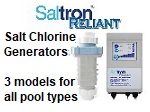 the dealer is having is that if you use a metal treatment,
it may compromise the copper electrode function. The only
way to treat the metals is to add a metal treatment. That
will negate the copper algaecidal function, unless a
suitable metal treatment is used. To provide algaecidal
activity, you could use a polymer based algaecide for a few
months, while the copper becomes re-established. This is one
of the limitations in dealing with ionization-oxidation
products or ionizers, that utilize copper, and having an
existing heavy metal problem. You could use a
MetalTrap
Filter to lower the copper level, without compromising the
ionization. A
salt chlorine generator complete sanitizer and a much
more affordable option.
the dealer is having is that if you use a metal treatment,
it may compromise the copper electrode function. The only
way to treat the metals is to add a metal treatment. That
will negate the copper algaecidal function, unless a
suitable metal treatment is used. To provide algaecidal
activity, you could use a polymer based algaecide for a few
months, while the copper becomes re-established. This is one
of the limitations in dealing with ionization-oxidation
products or ionizers, that utilize copper, and having an
existing heavy metal problem. You could use a
MetalTrap
Filter to lower the copper level, without compromising the
ionization. A
salt chlorine generator complete sanitizer and a much
more affordable option.
Sincerely. Alan Schuster, 5/3/2014
The algaecide treatment and shock
treatment, combined with chlorine tabs on each spot,
successfully removed the pool stains. I also pressure washed
to clear the top of the screen enclosure of debris. The
problem is, after the pool looked great, when I went to bed.
However, this morning new spots appeared, about 50 of them,
in the same areas, but not the same spots. I have no idea
what's going on, but I'm frustrated as hell. Any thoughts or
suggestions? Thanks.
Mike, 5/5/2014
The pool stains are not copper or another metal or else the
chlorine would not have removed them. The plaster spot
problem that has been widely reported does not respond to
chlorine. That only leaves algae or some organic type of
pool stain. Have you ever added a metal treatment? Is your
pool overhung by a tree, such as a live oak or black olive? If chlorine was the solution, it seems that the oxidation
function is inadequate, on a 24-hour basis. Perhaps, you
should simply maintain the pool on a very low level of
chlorine, so that there is always some present, for those
times with active oxygen is not being produced. Using
bromine would be even better, as it seems more effective
against certain problem types of algae. It would be safe to
assume that the copper is not able to control the problem,
possibly due to the addition of metal treatments. Add a
polymer algaecide and continue for a few months. I suggest
that you shock the pool, raising the free chlorine level to
5-10 PPM. Use the brush and improvement should be
forthcoming, in a day or so. Good luck.
Alan, 5/7/2014
Yes! There is a live oak above that
area of the pool. Has that been known to cause this or
similar problems? No, I have not used a metal treatment
because the manufacturer of the copper system said not to. I
agree it must be something organic, but damned if I know
what it is, particularly since the stains show up so
quickly.
Mike, 5/8/2014
Blame it all on the tree. As far as I am concerned the best
live oak tree is a dead one. The same for black olive trees.
I have a live
oak
in front of my house. It makes a mess of the lawn and stains
the driveway. The state of Florida makes it difficult to
take this native tree down. Certain times of the
year the problems are worse. If you can legally take it
down, I would do it. Your problem is this. The oxidation
function produces forms of active oxygen that last only for
a short time, after the unit is shut off. Leaves, seeds and
bits of debris from that tree will leach tannins. Without an
oxidizer or chlorine present, the tannins appear as rust
colored stains. It has nothing to do with "iron rust" and it
is not a metal pool stain. Tannins can be destroyed by
chlorine and other oxidizers. You have several options. Get
rid of the tree. Use a very low level chlorine as a backup
sanitizer/oxidizer. This does explain why the
stains keep reappearing!
Alan, 5/9/2014
Alan, hi! This is great because at
least now I know what I'm dealing with. Before, it was a
crap shoot. The tree is a neighbor's tree but branches hang
over my pool and (with some difficulty I fear) I'm going to
find a way to cut them back. I do use an automatic pool
cleaner already and the tannin stains did only seem to
appear in the six hours the motor was off at night. I'm
grateful that at least we were able to diagnose the cause.
Now for a solution! Thanks again!
Mike, 5/9/2014
Hi Alan, I followed your advice and
had the tree cut back away from the screen enclosure.
Shocked the pool, and the stains disappeared permanently! I
plan on keeping a little chlorine present, just as a backup.
Thanks so much for your patience and help. You have a great
website!
Mike, 6/4/2014
Editors Note. In the final analysis it was simply a
matter of there being no chlorine or oxidizer present during
the overnight period. The problem was not attributable to
copper staining. It was simply a matter of fine particles of
live oak tree debris falling into the pool and leaching
tannins, after the pool was shut off at night. The solution:
maintain a low level of chlorine, with the copper-oxidation
unit. 5/10/2014
► Seeing
Yellow?
I have a marcite pool that has been in
for 8 months and it has gotten yellow-colored blotches on
the bottom and the steps. The pH, chlorine, alkalinity
levels are ok. I brush the pool each week. I was told the
calcium would cause this. I have shocked it and I have put
in a gallon of chlorine every two weeks.
Kendell W., Sarasota, FL, 3/12/2005
The yellow color of the spots could be attributed to several
causes: iron pool stains, algae growth and discoloration
caused by fertilizer granules. An Iron Test can measure the
presence in the water. Try the following to help narrow the
choices and point to a solution. Put 1/2 pound of pH
decreaser in a white sock, shut off the filter and drop onto
a stained area. Check after 1/2 hour. If there is a
noticeable improvement, the likely cause was iron, in the
water, or possibly fertilizer granules. Repeat this
elsewhere, as needed to remove all of the pool stains. If
the area is extensive, it may be necessary to drop the pH of
the water to 6.5 or less. After the pool stains are removed,
add a phosphate-free, metal chelating treatment such as
Liquid MetalTrap, to help prevent a recurrence. Thereafter,
add more of the product, prior to the addition of any makeup
water. Restore the pH to 7.2-7.6. If the "sock treatment"
did not work, the likelihood is that the problem is algae or
even pool stains from leaves. Place a 3" chlorine tablet on
a stain (NOT FOR VINYL POOLS), shut off the filter and allow
to remain in place for a few hours (the tablets can affect
some masonry finishes, so either test it on an inconspicuous
spot or verify suitability with the finish contractor). If
improvement is seen algae or discoloration caused the pool
stain. You can use Polymer Algaecides, shock treatment and
well-placed trichlor tablets (NOT WITH VINYL POOLS). Broader
areas can be treated with a granular trichlor (NOT WITH
VINYL POOLS). Calcium is usually associated with scaling or
cloudiness. Yellow discoloration is not a characteristic of
calcium. The discoloration is probably not related to any
defect in the marcite finish. I hope that I have been
helpful.
Sincerely. Alan Schuster, 3/12/2005
► Staining
Caused By A Black Olive Tree?
My neighbor has a black olive tree
near our property line and a couple of times a years, it
"drops" a lot of debris. Leaves and seeds get into the water
and not all of them end up in the skimmers. The ones that
fall to the bottom cause a brownish stain. Shocking will get
rid of the pool stains, after I have removed all the junk.
Is there anything else I can do. I hate that tree. Thanks.
Larry A., Boca Raton, FL, 7/17/2010
I have had the same problem myself. You are correct to shock
after removing the "junk". The stains are the result of
Tannic Acid leaching
from the leaves. The pool stains occur after the leaves have
remained in contact for a period of time. You might consider
an automatic pool cleaner. It will help remove the leaves
before staining can develop. It will help, but is not an
absolute solution. There is no magic chemical. Another way
to deal with troublesome leaves is to remove them, before
they get a chance to sink to the bottom. Sorry that I couldn't be more helpful.
Sincerely. Alan Schuster, 7/17/2010
► Major
League Mineral Problems?
Hi there Alan. First off, very
informative site. I really wish I had found the site sooner
in my endeavors, as it has become a real pool water
problem-solver. This email is going to be fairly long,
mainly because I don't know what is important and what is
not. There are several questions/problems that I am having
that will be interspersed throughout this narrative email. I
will summarize them at the end of the email. If there is any
information missing let me know and I will provide it.
BACKGROUND: We purchased a house that has an inground pool.
It is a vinyl lined pool, 20x40'. Depth ranging from 3.5' to
8.0' (I'm guessing on the deep end, we haven't been in that
side yet). We live in Londonderry New Hampshire . The pool
water is currently 60 degrees and was 54 degrees when we
opened it on May 3rd. The pool was covered with a winter
cover that did get 2 rips which let in a little of the water
that was on the top. The pool was professionally closed by
the previous owners at the end of September. The pool has a
DE filter. The pool has a main drain and one wall skimmer.
There are 2 returns, one in the deep end and one in the
shallow end. The home we live in is on well water and even
after the softener still has higher than the preferred range
levels of magnesium and iron (I can't find the closing
papers so I don't know the exact after softener numbers.)
The water going into the pool is before the softener. As
such, I am sure the iron and manganese levels are in the
0.1-0.2 PPM range. I mostly use a solar cover and do not
have a heater.
HISTORY: The pool was opened on May 3rd. I drained all water
off of the cover, took off the cover, added approx 1.5 feet
of well water. At this point I took the measurements with
both the test kits with the little bottles and with the
strips. Both tests were in agreement. The chlorine levels
were in the range of 2.0 to 3.0 PPM. The PH level was much
lighter than the lowest level on the scale. TA was 0. At
this point in time I was misled by several websites (hence
my statement earlier of "I really wish I had found your site
sooner") and by a local pool supply store that the most
important first thing to adjust is the pH. I have since
learned the hard way that fixing the high minerals is the
most important. I ended up putting in 30 pounds of pH
Increase and this did nothing at all to the measurements. I
went to several websites and found out from them that the
single most important first item is to make sure TA is
accurate. I am not sure of the total TA increaser I added,
but I believe it was in the range of 30 pounds. I remeasured
the levels and TA was at approx 40, ph did not move, and
chlorine dropped a little. I then added another 20 pounds
and TA did not really move. I then found 2 websites and a
salesperson that said when this occurs shock the pool. I
added 2 gallons of liquid shock. I don't remember the
chemical name but it was the concentrated yellow liquid. The
suggested rate is 1/2 gallon per 10,000 gallons. According
to the directions I put in 1/4 gallon too much. At this
point in time all was well, it was close to nightfall. The
next morning I woke up and to my dismay the pool water was a
green/orange/blackish color, all the fiberglass material
(steps, returns) were a burnt brown color, and the walls
were greenish in color. I tried scrubbing and power washing
nothing took off the mess. 3 days later I ended up calling
the local pool supply store and they asked if I had well
water and when I responded yes they stated it was due to the
minerals. I took my water measurements and the chlorine
levels were still greater than 10 (not sure of the real
level this was the highest level that the strips would go
to). I went to the store and bought 4 quarts of mineral
treatment. I asked about the high chlorine levels and was
told not to worry about it. I did not agree with this
believing that there was some reaction going on between the
chlorine and the metals (again, I wish I found your site
sooner). I then went to another pool store and they stated
to be certain to lower the chlorine first. I bought 4 lbs of
chlorine reducer and added approx 3 lbs of it. Within 10
minutes or so almost all stains on the walls and fiberglass
were gone (one of the happiest moments in my short pool
owning life). After the chlorine levels were down to approx
0.2, I then added the 4 quarts of mineral out at dusk, as
the directions stated, left the filter running off of the
main drain all night. When I woke up in the morning the pool
was the sparkling blue color of before the super shock
fiasco and no stains were present. I left the pump running,
went to work and came home around 5. By this point in time
the pool was back to green/black water color with green
stains on the vinyl liner. The fiberglass was still clear. I
figured that this was due to the merged metals and metal
remover being captured by the DE filter and since I didn't
backwash this bond ended up breaking down re-releasing the
metals back into the water.
QUESTION -- QUESTION. Why did the water go back to
green/black? I then added an additional 20 lbs of TA
Increaser thinking that this might be the cause. The TA
levels were brought up to 120. I went out and had one of the
pool stores test my water. This particular place used test
kits and not computer testing. The tests showed that my pH
was lower than 6.0 and needed 20 drops to bring it up to
7.0, which was estimated to be 20 lbs of pH Increase. The
CYA level was measured to be 50. Phosphates were 200 or so.
I bought 4 more quarts of metal treatment and added it at
dusk. Almost immediately after adding it the green/black
water cleared up or so it appeared. I could almost see the
where the metal out was moving through the water. I left the
filter running again all night, this time vacuuming and
backwashing in the morning. The pool water and walls had
darkened a little overnight. By the time I had returned from
work the water was a little darker. Not bad, but not the
crisp blue that had been there before the shock and after
the initial 4 quarts of metal treatment were added. At this
point I figured the metals and discoloration were there to
stay so I focused back on the pH.
ONGOING PROBLEMS: (2 days ago) I added approx 25 lbs of pH
Increase and this brought the pH level to 7.3. (last night)
I retested the TA and it was now close to 300. I figured
since the pH was okay, that a high TA was not a point of
concern. I then added chlorine to the automatic chlorine
feeder. We are using the 3" trichlor hockey pucks. I
intentionally set the level of feed low. I just wanted to
get some chlorine in the pool to prevent algae from growing.
(Today) I took a water sample to another store that does
computer based testing and had them also run metal tests,
including copper, manganese, and iron. What they found was
that the iron and manganese were both around 0.1 and 0.2.
Copper was non existent. pH was at 7.3. Free Chlorine was at
0.2. Total Chlorine was at 0.8. The disturbing part though
is that both CYA and TA were off their measuring scales. I'm
not sure what the upper level of their scales are. The sales
guy told me that any CYA level above 100 is a point of
concern and their testing platform stops testing at this
point. QUESTION - QUESTION. Is there any concern with the
CYA levels being high?
QUESTION - QUESTION. Why would the TA and CYA jump
dramatically like that?
QUESTION RECAP: When the water was treated with metal
treatment and appeared to be resolved, why did the water go
back to green/black the next day? Is there any concern with
the CYA levels being high? Why would the TA and CYA jump
dramatically like that? Nothing was added, as far as I can
tell nor any of the people at the pool store, that would
have/could have affected the CYA levels. It is possible that
the original readings that I got were wrong with regards to
the CYA. I'm guessing this because after 4 or 5 days after
super shocking the levels were still measuring greater than
10. From what I was told, high CYA levels tend to lock in
the chlorine levels. When I need to add well water next time
what is the best approach? I see on your website a
description of adding the metal out when adding the water.
Should I go this route? Or should I just not use liquid
shock? Is there any harm in adding too much metal treatment.
Thanks in advance for your time and (hopefully) feedback. I
did not intend to be so wordy but as stated earlier, I'm not
sure what is important and what is not so I'd rather give
too much information and have it be ignored than leave out
the one piece of information that could provide the "ah-hah"
answer.
Chris, New Londonderry, N.H., 5/16/2004
Not that I'm counting characters, but this may be the
longest letter I have ever received. The first mistake was
not adding a mineral treatment, as the pool was being topped
off. Adding the label dose to your pool will never be
adequate. The dosage recommendations are based on reasonably
good or potable water quality: everything that your water
supply is not! These mineral treatments will react with the
iron and manganese. Hopefully you have added enough, but I
would still add a dose or two every month or whenever new
water is added. Try and add the new water by placing the
garden hose in the skimmer - give the filter a chance to
remove some of the particles. D.E. filters are really good
in this respect. An even better solution would been to use a
pre-filter to help remove some of the sediments & metals and
helps avoid problems. The acidic conditions helped to keep
the minerals in solution. Raising the chlorine level
oxidized the metals and decreased their solubility and
increased their color value. The pool now has a good pH and
high TA and CYA. So long as the pH is good and the water is
clear and there is no sign of scaling, you may not have to
lower the TA to 80-120 PPM. It depends on the calcium
hardness reading and that was not provided. A high TA could
result in scaling and cloudy water problems, if the calcium
hardness is above 200 PPM. The high CYA level is due to the
prolonged use of stabilized chlorine (tablets in your case).
The tablets add cyanuric acid to the water as they dissolve.
Levels above 150 PPM are thought to cause a decrease in the
efficiency of chlorine. That means you need to keep somewhat
higher Free Chlorine levels, if the CYA level is high. Given
your water quality, I would not rush out to replace water at
this point. In your area, water is normally pumped out to
winterize the pool and this will put a cap on how high the
CYA level can rise. I hope that I have addressed your
questions. One of the CYA readings must be in error. The
level could not change that quickly. Chemicals added to
raise the pH, will increase the TA as well. After dealing
with a mineral problem, it is a good idea to clean or
backwash the filter: this avoids the possibility of the
minerals being dissolved and producing a recurring problem.
There is no problem adding more mineral treatment than
needed. It remains in solution and available. In your case,
more is better! Not all chemicals are the same, especially
those without an ingredients statement. Some mineral
treatments are more concentrated than others. Some degrade
to ortho phosphate and are ineffective, if the pH rises to
above 7.8. Good luck and enjoy the season.
Sincerely. Alan Schuster, 5/16/2004
Editors Note: it took a few days longer and a few
more e-mails, but the pool finally cleared up. The problem
was the manganese. Such a large volume of mineral treatment
was required, because other minerals were present and were
competing for the chelating agent.
5/20/2004
Editors Note: Years have gone by and treatment
options have changed as well. The following is how that pool
should be treated, today. Inasmuch you are on well water,
using the METALTRAP Filter, to treat all new water, helps
keep new additions of iron and other metals out and
minimizes the possibility of pool staining. You could, also,
use The MetalTrap Filter to recirculate the pool water and
lower the heavy metal content, already present in the pool
water. Even better would be the use of the
Dual-Cartridge
MetalTrap Filter, which will remove metals, sediments and
contamination. The use of phosphate-free,
Liquid MetalTrap
would have been a far better choice, than the product used,
back then. It is a true chelating agent, is phosphate-free and is unaffected by
pH. Why exchange a metals problem, for a phosphates problem?
11/19/2011
|
Visit The Website Stores . . . for
better informed shopping!!! |
|
|
Shipping is FREE* . . . within
the Continental U.S.
A $9.99
handling charge will apply
to Continental U.S. Orders,
under $75.00. Orders
outside of the Continental
U.S. may require some
additional charge, based on
quantity and destination.
Most products can be
shipped World-Wide. International
and orders outside of
Continental U.S. - see
comments on the ordering
pages. |
|
|
Major
Credit Cards and PayPal are accepted. |
|
▲
Return To Top Of Page
▲
Aqualab Systems, LLC does not
make any warranty or
representation, either expressed
or implied, regarding the
accuracy or completeness of the
information provided by this
website; nor does Aqualab
Systems., LLC. assume any
liability of any kind whatsoever
related to, or resulting from,
any use or reliance on this
information. The content of this
website should not be used, if
it is conflict with any
applicable federal, state or
local regulations or guidelines.
© Aqualab Systems, LLC. All
rights reserved
|
|