|
 |
Shipping is FREE* . . . within
the Continental U.S.
A $9.99
handling charge will apply
to Continental U.S. Orders,
under $75.00. Orders
outside of the Continental
U.S. may require some
additional charge, based on
quantity and destination.
Most products can be
shipped World-Wide. International
and orders outside of
Continental U.S. - see
comments on the ordering
pages. |
|
 |

Major
Credit Cards and PayPal are accepted. |
|
On-line
shopping since 2002 - Safe and Secure!!! |
|
Managing the Chlorine level, of Spa,
Swim-Spa or Hot Tub
water!!! |
|
Sanitizing is a must, for proper spa
water management.
Salt Chlorine generators are a
better way to utilize chlorine, producing
more controllable results. They
eliminate the need to handle, measure or
store chlorine products, while reducing
buildup problems. An
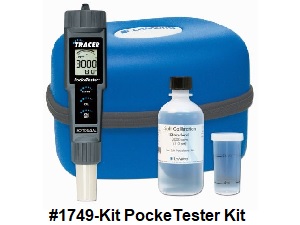
Electronic
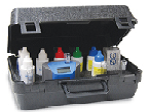
PockeTester Kit is a convenient
way to monitor the salt level. |
|
|
|
How to use chlorine, as a spa sanitizer? |
Chlorine is
used as a spa or hot tub sanitizer, typically in
the form of granular sodium dichlor. The other
forms of chlorine, popular in pools, are not
used in spas and hot tubs for a variety of
seasons: solubility, build-up considerations and
effect on the pH. Over the past few years, the
industry has come to recognize some of the negative aspects
of cyanuric acid build-up. Yes, cyanuric acid can help
protect chlorine, from being destroyed, by the Sun's UV
rays. However, that is not a major consideration, for
spas that are covered most of the time or are indoors.
Cyanuric acid levels, over 50 PPM, have been shown to lessen
the effectiveness of chlorine and increase the likelihood of
negative consequences. Given the small volume of
water, in a typical spa, the use of stabilized chlorine will
result in a relatively rapid build-up of cyanuric acid,
resulting in a decrease in sanitizer effectiveness and
overall water quality. If you want to use chlorine and avoid
the negative effects of a rising cyanuric acid level, chlorine can used in another
entirely different and better way: a
salt
chlorine generator uses ordinary salt and
converts it into chlorine. This eliminates the
build-up problems, associated with rising levels of cyanuric
acid, and the
need to handle, store or measure chlorine
products. Salt chlorine generators can used as a backup
sanitizer or oxidizer, in conjunction with
Ozonation, Mineral Sanitizers, UV Sanitizing or
Ionization. If problems arise, refer to the
Spa Problems Page, as a
source of problem-solving information, broken down into
various categories. Scroll down the page and click on the linked
keywords,
catch phrases
or images, in the archived answers below, to access additional information, on that topic or product.
 |
Join our E-Letter Mailing List.
You'll receive 1-3 E-Letters a
month, featuring helpful pool
and spa advice, new product
information and sale
announcements. All we
require is your e-mail address
and you can opt out anytime you
wish.
Your information
will never be shared or sold. |
|
▼
Helpful,
Problem-Solving Information, in a question and
answer format.
▼ |
►
Cyanuric Acid Build Up Has A Major Downside?
I've been
reading, in trade publications, about changing views on the
use of stabilized chlorine, in spas and hot tubs, as well as
pools. It used to be that a cyanuric acid level of
100-150 PPM was considered to be the point, at which water
replacement was recommended. Now that upper level
seems to have been reduced to 50 PPM, as higher levels have
been associated with a decrease the effectiveness of
chlorine and the need to maintain higher levels of free
chlorine, as the cyanuric acid levels, rise over time.
It seems to be a real problem, in spas and hot tubs, because
of the smaller water volumes and the increased sanitizing
demands, due to the higher water temperatures. This
doesn't really seem to make a strong case, for the use of
sodium dichlor, as the primary spa sanitizer. What are
your thoughts?
Joe B., NJ,
12/1/2019
I have
probably read the same articles, in Pool and Spa News and
Service Industry News, and I can't find fault, with your
reasoning. High cyanuric acid levels can explain a
whole host of spa and pool problems. It probably
cannot explain all the problems, but it is most likely a
significant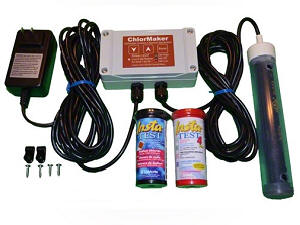 contributing factor, in a wide range of sanitizing and water
quality issues. A spa with less than 50 PPM should be
able to get by with a 2-4 PPM, of free chlorine. At
100 PPM, it might required 5-8 PPM. At 150 PPM, it
might require 8-12 PPM. The levels suggested, by the
last two examples are not really practical, from a user
point of view. Most testers only read up to 10 PPM.
Cyanuric acid testing can become less reliable, as the
levels rise to 100-150 PPM. This can leave, those
tasked with water maintenance, at a disadvantage, when
relying on stabilized chlorine, as the primary sanitizer.
Chlorine has a long, proven history of use and there are
better ways of utilizing chlorine, without compromising
sanitizer effectiveness, due to high levels of cyanuric
acid. A
Salt
Chlorine Generator is a better way to use chlorine:
one that eliminates the buildup of cyanuric acid and can
provide better results and more control. If you want
to use chlorine, this would seem to be the way to go. I hope
that this has been enlightening.
contributing factor, in a wide range of sanitizing and water
quality issues. A spa with less than 50 PPM should be
able to get by with a 2-4 PPM, of free chlorine. At
100 PPM, it might required 5-8 PPM. At 150 PPM, it
might require 8-12 PPM. The levels suggested, by the
last two examples are not really practical, from a user
point of view. Most testers only read up to 10 PPM.
Cyanuric acid testing can become less reliable, as the
levels rise to 100-150 PPM. This can leave, those
tasked with water maintenance, at a disadvantage, when
relying on stabilized chlorine, as the primary sanitizer.
Chlorine has a long, proven history of use and there are
better ways of utilizing chlorine, without compromising
sanitizer effectiveness, due to high levels of cyanuric
acid. A
Salt
Chlorine Generator is a better way to use chlorine:
one that eliminates the buildup of cyanuric acid and can
provide better results and more control. If you want
to use chlorine, this would seem to be the way to go. I hope
that this has been enlightening.
Sincerely.
Alan Schuster, 12/1/2019
►
Chlorine Reading Gets Too High?
Hi, I have
switched to a floating dispenser and 20g chlorine tablets in
our spa recently but notice that within 2 days the chlorine
reading is way over 10ppm - even with the opening set to its
lowest setting. So I end up taking the dispenser out for a
couple of days - day which can't be right. The tablets say
they are ok for spa, but Is there a specific type of tablet
I should be using? Thanks.
Chris, 1/3/2020
You're looking for something to add, that will last several
days to a week. Chlorine tablets are simply to quick to
dissolve, at the temperature of a
spa, which is why you end up with high chlorine readings.
Not a good spa sanitizer choice - it's better suited for
pool use. Bromine tablets are much slower to dissolve and
are better suited, for spa use. Even better is a salt
chlorine generator, that is smart enough to only produce
chlorine, when it is actually needed. You'll never
over-chlorinate again, with a
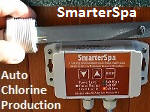
SmarterSpa Salt
Chlorine Generator. It requires no installation and
works independently of the pump. It is Plug-n-Play ready,
providing better control and results. It eliminates storage,
handling and measuring of chlorine products. I hope that
this information will be helpful.
Sincerely. Alan Schuster, 1/3/2020
►
I Can Smell Chlorine, But The Test Is Zero?
My husband has added a lot of chlorine to our hot tub. I am
able to smell the chlorine in the water. However, when the
water is tested using test strips the reading is no chlorine
(FCl). There is no color change at all. All the other
parameters: TA, pH, CH are in spec. He has added chlorine
several times with no change to the chlorine levels. Do you
have any ideas what the issue may be?
Thanks - Julie V., 12/29/2016
Your really can't smell chlorine in a spa. The active,
germicidal form is measured as Free Chlorine and can't be
detected below 300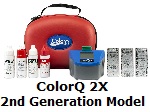 PPM, by smell. What you cam smell and associate with
chlorine is combined chlorine. It shows up on the total
chlorine test, along with the free
chlorine. The difference between the two readings is
combined chlorine and that can be smelled, down to 0.1 PPM.
It is odorous, irritating and ineffective as a
sanitizer. This may sound
counter-intuitive, but in order to destroy the combined
chlorine, you have to add free chlorine. For each 1 PPM of
combined chlorine, you
need to add 10 PPM of Free chlorine. Start adding multiple
doses every hour, until you get a free chlorine level in the
1-3 PPM range. The ideal range for combined chlorine
is 0.3 PPM maximum. Than means the Total Chlorine
reading should not read more than 0.3 PPM, higher than the
Free Chlorine level. You should use a
tester, that measures both Free and Total chlorine, for best
results. A
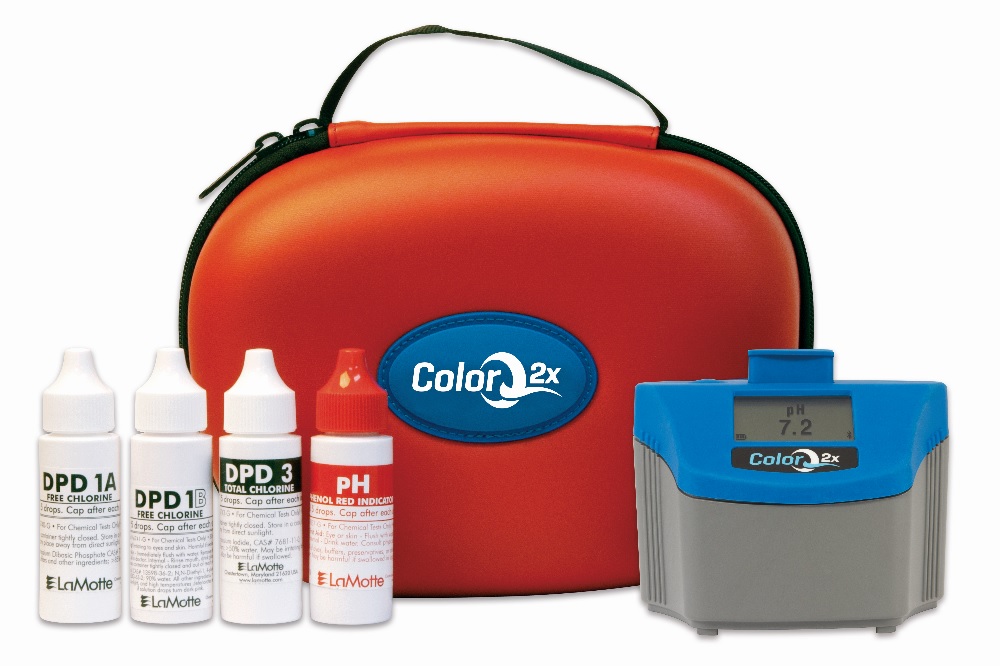
ColorQ 2X Tester,
which is all-digital and eliminates all color-matching,
would be an ideal choice. As long as you are using chlorine,
why not use it in a better and more controllable manner? A
salt chlorine
generator is the better way to do chlorine. Our website
offers several, affordably-priced models and many require no
installation. I hope that the information provided was
helpful. Best wishes for the New Year.
PPM, by smell. What you cam smell and associate with
chlorine is combined chlorine. It shows up on the total
chlorine test, along with the free
chlorine. The difference between the two readings is
combined chlorine and that can be smelled, down to 0.1 PPM.
It is odorous, irritating and ineffective as a
sanitizer. This may sound
counter-intuitive, but in order to destroy the combined
chlorine, you have to add free chlorine. For each 1 PPM of
combined chlorine, you
need to add 10 PPM of Free chlorine. Start adding multiple
doses every hour, until you get a free chlorine level in the
1-3 PPM range. The ideal range for combined chlorine
is 0.3 PPM maximum. Than means the Total Chlorine
reading should not read more than 0.3 PPM, higher than the
Free Chlorine level. You should use a
tester, that measures both Free and Total chlorine, for best
results. A
ColorQ 2X Tester,
which is all-digital and eliminates all color-matching,
would be an ideal choice. As long as you are using chlorine,
why not use it in a better and more controllable manner? A
salt chlorine
generator is the better way to do chlorine. Our website
offers several, affordably-priced models and many require no
installation. I hope that the information provided was
helpful. Best wishes for the New Year.
Sincerely. Alan Schuster, 12/29/2016
►
How Much Dichlor To Add?
Hi Alan. I have a 342 gallon hot
tub. Where is a good place to start as far as how much
Dichlor to use in this amount of water to get it into the
range where it should be? Thanks.
Don M., 3/18/2015
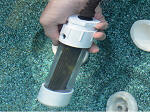
How much you will need will depend on the content and
quality of the water. Start by using the dosage recommended
on the label. Give it a few
hours and retest. Add more and repeat, as necessary, until
you get a free chlorine level in the 1-3 PPM. Thereafter,
add enough to keep it in that range. Adding some after each
spa use will help. Test before using the spa and add, as
needed. Every spa is different, so there is no set amount to
add. A salt chlorine
generator is an easier way to use chlorine. It
eliminates the handling, measuring and storing of chlorine
products and provides better control, over the chlorine
level. Choose from several very affordable, no-installation
required models. I hope that this recommendation works out
for you.
Sincerely. Alan Schuster, 3/18/2015
►
Salt Chlorine Generators With Chlorine Detection Technology?
I have a tub and a swim spa.
Have you tested these new units and can you confirm that
they work well, in setting and controlling the Chlorine
level?
Can you also enplane what is the difference in MegaChlor and
MegaChlor CD. Regards
Pierce M., Ireland, 7/19/2016
In both
cases you are dealing with small volumes of water, as
compared to typical pools. A hundred grams has a big impact
on a spa or swim spa, but
little in a typical pool. Two people in a spa is more like a
hundred people in a pool, in terms of the waste being added,
per volume of water. That's why spas and swim-spas have
chlorine levels that deplete quickly, during use.
The SmarterSpa
has been sold for more that a year and I have heard no
complaints. It used have a slightly different name, but they
changed the name to make it spa specific. Without the
chlorine detection technology, it is the same as the
ChlorMaker
unit, which is controlled by power settings and timer.
SmarterSpa turns itself on and off, according to the actual
chlorine content, using chlorine detection technology, so you'll never over-chlorinate again.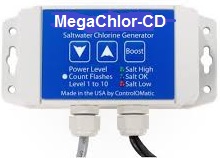
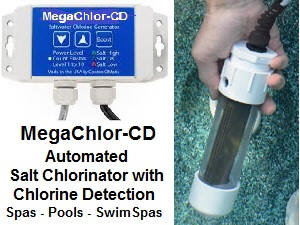
The MegaChlor
units have a larger output, as they have 4 larger sets of
plates, instead of 3 smaller ones, compared to ChlorMaker or
SmarterSpa. That allows
it to treat larger units, even pools. The MegaChlor and
MegaChlor CD
are identical, except that the CD model has chlorine
detection technology. The inclusion of chlorine detection
technology is reflected in the higher price. The CD version
operates independently of the pool or spa pump and turns
itself on and off, based on actual chlorine content. I
hope that this will be helpful.
Sincerely. Alan Schuster, 7/19/2016
► Heavy Handed With
Chlorine?
My husband and I just got a new hot
tub. We are not very educated in balancing the chemicals. We
were told to use Chlorinating Granules, and then later add
Stabilizer/Conditioner after the chlorine level was
satisfactory. Are these the only two products we will need
to use? Are there products that are more highly recommended?
Also, my husband misread the directions and added way too
much chlorinating granules (about 5 Tablespoons instead of a
teaspoon!). Is there a way to reestablish the balance in the
water, or do we need to drain the hot tub and start all
over? Thank you.
Derek and Laura, 5/6/2018
In addition to maintaining the sanitizer level, it is
important to maintain the pH in the proper range. To help
facilitate this, it is important to maintain the total
alkalinity as well. There may be other issues such as
calcium hardness and heavy metals: usually a water analysis
is used to determine any appropriate treatment. Unless your
hot tub is left uncovered and in the Sun, there is no need
to add chlorine stabilizer. The covering of the hot tub
eliminates any such need. If your hot tub has been
overdosed, there is a chemical (Chlorine Neutralizer) that
can be added to quickly lower the chlorine level. A level of
1.5-3 PPM of Free Chlorine is recommended. Partial replacement
of the water, especially in a freshly filled hot tub, is a
wasteful means of control. Remember this! You can always add
more - you can't take out! Granular Chlorine is a hot tub
and spa popular sanitizer. However, bromine can be used with
a feeder or floater and has less odor.
Salt Chlorine
Generators, Ozone Generators,
Mineral Sanitizers and
Ultraviolet Sanitizers are other sanitizing possibilities.
Browse through the archives for more on these topics. I hope
that I have been helpful Enjoy the hot tub.
Sincerely. Alan Schuster, 5/6/2018
► Too Much
Stabilizer?
I just had my spa water tested. My
cyanuric acid was over 300. The people I bought the spa from
gave me chlorine granules. I notice now that they have
stabilizer in them. Is this a common chemical to use in my
spa? I drained the spa to get rid of the cyanuric acid. What
is your opinion and what chlorine should I use and how much
and how often. My water was getting cloudy when it was
covered but would clear up when it was shocked and left open
for the sun to hit. Please help me my wife and I are new to
this spa thing. We have no problem with our pool.
Joe and Diana B., Jackson, NJ, 9/18/2013
Stabilizer serves no real purpose in a spa that is covered
most of the time. The granular chlorine is a stabilized
product and is the most common type used in spas: not
because it is stabilized, but because it is completely
soluble and essentially pH neutral. High levels of cyanuric
acid, over 50 PPM, should be avoided because it can reduce chlorine
effectiveness. If you are going to use chlorine, follow the
directions on the package. Add enough product to maintain a
Free Chlorine level of 2-4 PPM. Adding some after each use
of the spa, will help decompose bather wastes. Shocking
weekly will help maintain water quality and avoid the
formation of resistant organisms. Shocking the pool cleared
the water up, by re-establishing the chlorine level and
destroying contamination. Exposure to the Sun was just
coincidental. When chlorine stabilizer levels are above 50
PPM, it reduces chlorine's effectiveness, forcing you to
maintain a higher free chlorine level. Spa water should be replaced
every three months and that will lower the cyanuric acid
level to zero. There are other means of spa sanitizing that
you might want to consider: bromine,
salt chlorine
generators, ozone generators,
UV sanitizers and
mineral
sanitizers.
I hope that I have been helpful.
Sincerely. Alan
Schuster, 9/18/2013
► Chlorine
Won't Dissolve?
Hi Alan, I have an eight hundred
gallon hot tub. Recently, I could not find any SPA chlorine,
so I bought chlorine powder for a pool. It does not dissolve
in my hot tub! WHY?
Alice, 1/16/2009
The only type of Granular Chlorine that is recommend for use
in a spa is sodium dichlor. This product is completely
soluble and is essentially pH neutral. These properties make
it ideal for use as a spa chlorine. However, it use does
cause the cyanuric acid the keep rising. Cyanuric acid
is not needed in a spa that remains covered, most of the
time. As the CYA level rises above 50 PPM, the
effectiveness of chlorine will decrease and could compromise
sanitation. Other types are either
too high in terms of the pH, are not completely soluble or
are too slow to dissolve. You didn't supply the label
information, so there is no way for me to be more specific.
A guess would be that you bought calcium hypochlorite: a
chlorine that is not completely soluble and is not
recommended for spas. You might want to browse through the
archives: there is information on other types of sanitizers
that you might find more to your liking. If you want to stay
with chlorine, a salt
chlorine generator is the better way to do chlorine. I hope that I have
helped clear up the mystery.
Sincerely. Alan Schuster, 1/16/2009
► Trouble
Viewing The Colors?
I seem to have a problem determining
the best match on a spa water tester. Is there an easier
way?
Matt S., 8/02/2007
Lots of people have color matching problems and sometimes it
is due to color blindness. The
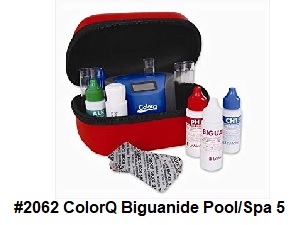
ColorQ 2X PRO 7 Water Analyzer
can easily solve your problem. It performs 7 different
tests: pH, free and total chlorine, bromine, total
alkalinity, cyanuric acid and calcium hardness. These are
all of the common spa tests and the ColorQ is all digital.
No colors to match and no charts to look up. Is very simple
to used and is very affordable. It will build your
confidence and keep you in control. You did not mention how
the spa is being sanitizer. There are other ColorQ models
and I am sure that one will be perfect for your needs. I
hope that I have been helpful.
Sincerely. Alan Schuster, 8/3/2007
► Chlorine
And Bromine?
Alan, tonight is (unfortunately) the
first time I've looked at your website. Until today, I've
relied on the hot tub sales-guy to answer my questions about
chemicals. Here's where I'm at. I have a (600 gallon) hot
tub. I've used dichlor as a sanitizer since I bought it last
summer. I was leaving for a 9 day vacation a couple weeks
ago so called the hot tub sales guy and asked him what to do
about chemicals while I'm gone. He said to come in and get
some bromine tablets and drop one in the little basket thing
before leaving town. I said, "But I've heard that you can't
just switch from bromine to chlorine and back again." He
said, "Nah. You can switch back and forth without any
problems. It's no big problem. Look at the ingredients in
the bromine products. They're all 80% chlorine anyway. Don't
worry about it." So I bought bromine tablets (from him),
dropped one in the basket, and left town. When I came back
(a couple days early because of sickness), I checked the
tablet, saw that there was still a little bit in the basket,
so I pulled it out. Then I did my normal non-chlorine shock
and thought I was good to go with my normal dichlor routine.
When I checked the tub for chlorine this afternoon, the
strip came up white (when it should have some purple color
in it). I added a couple cap-fulls of dichlor (an amount
that would have normally -- before the bromine tablets -
brought it up to an appropriate chlorine level [1-5 to 2
ppm), and called it good. I went out an hour or two later,
used another test strip, and it came up white. I tossed in a
couple more cap-fulls of dichlor, and tested it again.
White. You see where I'm going. So I called the sales guy
and asked him if maybe these test strips don't work in the
cold (I'm in North Dakota; today's high was something like
-3°F. He said they should work fine in the cold but that
maybe I had gotten water in the container and that I should
buy a new bottle of test strips. I did (from him). I came
back home, tested it again, nothing. Added more dichlor.
Tested again. You see where I'm going. At this point, I've
probably thrown in 4 or 5 times more chlorine than it would
normally require to bring from 0 to 1.5 or 2. Then I came
inside and did what I should have done first; some online
research. I see on your site and a couple others that you
can't switch back and forth from chlorine to bromine and
back. Based on my limited knowledge in the area, I am
guessing what's happening is that all the chlorine I'm
dumping in is converting to bromine. That's why the
test-strips never show any chlorine. (Right?) So. Enough
with the problem. Let's talk about solutions. Keeping in
mind that the high temperatures here are supposed to be
below zero for the next week or so, and I want to use the
tub again, what should I do. Draining it would do little
more than create a regulation sized hockey rink in my back
yard. That seems unworkable. I am guessing the tub has a
huge amount of bromine in it right now. What can I do to get
the bromine levels under control and get the tub useable (or
is it useable right now)? I'm assuming the best course of
action is for me to just switch to bromine until spring (and
maybe longer, if I've figured bromine out by then). What
would you do? Any suggestions you have would be appreciated.
Thanks.
Chad N., Bismarck, ND, 1/3/2009
P.S. Sorry I got so long winded.
You may be long winded, but you aren't close to the longest
letter. You have some misinformation that needs to be
addressed. Yes, if you have bromides present from bromine
tablet use or from the addition of sodium bromide, chlorine
will convert to bromine. No, you can't have a large amount
of bromine present, if all you added were a few bromine
tablets. The amount of bromine is commensurate with the
amount of bromides present: converted to bromine by chlorine
or non-chlorine shock. You can convert from chlorine to
bromine at will. To completely convert to chlorine, after
having used the product for a while, you must replace the
water. Here's what doesn't make sense. The test methods for
chlorine and bromine are the same: only the color comparison
charts are different. If you really had bromine present, it
would register on the chlorine test. There are several
possibilities: your chlorine level could actually be low,
the test strips may be bad or the test strips do not work
properly in the presence of high levels of chlorine or
bromine. Inasmuch as I don't know the specific of your test
strips, I can't speculate as to their suitability at high
levels of chlorine or bromine. Test strips, such as
Insta-Test Strips utilize a chemical called Syringaldazine,
which is the best one to use in the presence of high levels
of chlorine or bromine. You need to verify the test results
with another product and/or test method. The limited use of
the bromine tablets is not a part of this problem. It is far
more likely that your spa has a high biological demand. Are
the walls slimy? It could be possible that the problem was
building over a few weeks, as a result of the sporadic and,
possibly inadequate, addition of the dichlor. One way to
avoid the ups and downs of sanitizer levels is to add an
ozonator. This will allow you to reduce the amount of
chemicals needed and help maintain proper sanitary
conditions. I hope that I have been helpful.
bromine. No, you can't have a large amount
of bromine present, if all you added were a few bromine
tablets. The amount of bromine is commensurate with the
amount of bromides present: converted to bromine by chlorine
or non-chlorine shock. You can convert from chlorine to
bromine at will. To completely convert to chlorine, after
having used the product for a while, you must replace the
water. Here's what doesn't make sense. The test methods for
chlorine and bromine are the same: only the color comparison
charts are different. If you really had bromine present, it
would register on the chlorine test. There are several
possibilities: your chlorine level could actually be low,
the test strips may be bad or the test strips do not work
properly in the presence of high levels of chlorine or
bromine. Inasmuch as I don't know the specific of your test
strips, I can't speculate as to their suitability at high
levels of chlorine or bromine. Test strips, such as
Insta-Test Strips utilize a chemical called Syringaldazine,
which is the best one to use in the presence of high levels
of chlorine or bromine. You need to verify the test results
with another product and/or test method. The limited use of
the bromine tablets is not a part of this problem. It is far
more likely that your spa has a high biological demand. Are
the walls slimy? It could be possible that the problem was
building over a few weeks, as a result of the sporadic and,
possibly inadequate, addition of the dichlor. One way to
avoid the ups and downs of sanitizer levels is to add an
ozonator. This will allow you to reduce the amount of
chemicals needed and help maintain proper sanitary
conditions. I hope that I have been helpful.
Sincerely. Alan Schuster, 1/4/2009
►
Traditional Chlorine Products Are
Not Necessarily The Best Choice?
Just tested out the
ColorQ PRO 7, I
have been fighting accuracy issues for some time now with
test strips and trips to the local tub dealer. My most
recent issue is with the delta being greater than 0.5 FCL
just tested my 375 gallon hot tub at 102 degrees here are
the results: FCL=2.88, TCL=7.32, pH=7.6, TA=108, CH=223,
CYA=63. I'm not sure what to do to get the TCL down. I think
that FCL is ok? Any suggestions? Thanks in advance.
Dennis D., Woodstock CT, 11/7/2008
Chlorine would not be my choice as a spa sanitizer, unless
it was in the form of a
salt chlorine generator. At
least, not as you are using it. The difference between the
total and free chlorine readings is combined chlorine: it
can be odorous, irritating and ineffective as a sanitizer.
To get the free chlorine and total chlorine reading closer,
you will have to add about 40 PPM of free chlorine. Adding
potassium monopersulfate is another solution, but I think
there are better options. You could add a dose of sodium
bromide solution (used in the bromine 2-part system) and
continue with adding chlorine. The various forms of chlorine
will convert the bromides into bromine. It will make the
water smell better and simplify testing. You could also use
bromine tablets in a feeder or floater. To further assure
proper water quality, you could add a mineral
sanitizer. This will allow you to get suitable results,
while maintaining lower chlorine or bromine readings. Adding
an ozone generator would further improve water quality,
while greatly reducing the chemical presence. I hope that this
information is helpful and thank your purchase of a
ColorQ
Water Analyzer. It definitely is a step up!
Sincerely. Alan Schuster, 11/8/2008
► Where Does
the Spa Chlorine Go?
Good day, Alan, We are new to the
world of spas here in Florida. We use chlorine as our
sanitizing agent. I don't understand why when you enter a
spa and the chlorine and pH levels are where should be, and
30 min. later when you get out, the levels are much lower.
Is this normal? As I said, we are new in this arena. I
didn't realize that you had to add chemicals after, or
before, each use. Guess we can learn something new every
day.
Joyce & Jim, Florida, 9/15/2007
The typical pool in your neighborhood has about 60 times
more water than your spa. Add to this the fact that the spa
is at a much higher temperature and this will produce more
bather wastes. This means that the typical spa gets more
demands put on its sanitizing system than the typical; pool.
Sanitizer levels can be depleted very quickly and it just
makes sense to test the water and add more chlorine before
and after each use. However, if the spa is equipped with an
ozonator or
UV sanitizing unit, less chlorine will be used.
Ozone and UV units have controllable effects on the
sanitation, while chlorine effectiveness rises and falls
with its concentration. A
salt chlorine generator
is a very affordable way to maintain a spa's chlorine level
and eliminates many other chlorine issues: measuring,
handling, storage and odor. These alternative means of
sanitizing spa water are more flexible and provide a higher
degree of effectiveness through use of a backup system. I hope that I cleared up the mystery.
Sincerely. Alan Schuster, 9/15/2007
► Favoring
The Higher End?
Hello Allan. I'm on your site often
and find it to be most informative. We maintain an 812
gallon, in ground, indoor spa, which uses chlorine for
sanitation. The information left by the professional pool
company indicates the chlorine should be maintained at 3 ppm
minimum. I thought I noticed you suggested 1-3 ppm for a
spa, which is what they suggested for the 18,000 gallon pool
and 783 gallon kiddie pool. Does 3 ppm minimum seem high to
you, or is this necessary for proper sanitation? What would
be the safe, high-end of that range - 5 ppm? It gets very,
very, very little use. Thank you kindly.
Tracy, 1/13/2009
Having one or two people in an 18,000 gallon pool has little
short term effect on the chlorine level, given the volume of
water. Putting the same two people in an 800 gallon has a
much greater effect, given the smaller volume and higher
temperatures. For this reason, favoring the high end or
slightly higher is preferred, so that sanitizer is present,
when needed. A salt chlorine generator makes a for a better
way to do chlorine, as it is controllable and eliminates the
odorous forms, as well. I hope that this information is
helpful.
Sincerely. Alan Schuster, 1/13/2009
► Tablets In
A Spa?
Sorry this might be wordy with a lot
of different questions. I am currently using a natural
product, with a granular chlorine. I should mention that I
have The Magnetizer attached to the tub and have an ozonator
that runs 24 hours a day. The granular chlorine I use is
Sodium Dichloro-s-Triazinetrione 100%, with an available
chlorine content of 62%. My question is, I find it hard to
keep a Chlorine level of 1 -2 PPM with the granular dichlor
and was looking at adding the Chlorine tablets that the
dealer carries and wants me to use, which are composed of
Trichloro-s-Triazinetrione 100%, with an available chlorine
of 90%. Everywhere I look on your website you say not to use
Trichlor in a spa. I am just trying to keep a minimal
Chlorine reading to be safe, even though this natural
product is said to kill bacteria. I have Bromine tablets at
home and was wondering if I can use those in the floater and
still use my Dichlor Chlorine with it when needed. My whole
goal is to keep the Chlorine level as low as possible, when
we are soaking because of skin sensitivities. I also would
prefer Chlorine to Bromine and if I'm not confused, if I use
Bromine tablets, any Chlorine I use will turn to Bromine! Is
it safe to use the Chlorine tablets, if the floater will
only be set to 1, just to keep a minimal reading or what do
you recommend? Also the natural product locks my pH at
around 7.8, which works well with my tub. Will Bromine
tablets or Chlorine tablets cause my pH to lower. It's been
three months now and my pH has not changed. All other water
parameters are perfect. Thanks for your help
Chris, 2/22/2007
Trichlor tablets will dissolve too quickly at the
temperature of a spa! I suggest that you use bromine tablets
and keep the level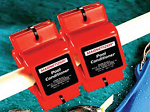 at 3-5 PPM. Add a
Mineral
Sanitizer and you can keep the level at 1-3 PPM. Try running
the ozonator for more hours a day. I suggest 4 periods of
2-hours. Make sure that it is working! Chlorine and bromine
tablets are acidic and will tend to lower the pH. You can
still use the dichlor as a shock. In hot water applications,
bromine seems to perform better and is less odorous and
irritating. Claiming a product will kill microorganisms
requires and EPA registration. Unless your natural product
has such a number, it may be wishful thinking. The ozonator
will help you use less chlorine or bromine, in order to
maintain this lower, but satisfactory level. Otherwise, you
seem to doing things correctly and it may be just a matter
of getting the bromine additions to better match your spa
usage. You are not complaining about scale or hardness
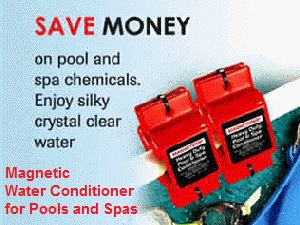
problems, so I will assume that The Magnetizer
(shown on the right) is doing its thing! I hope that this information is helpful.
at 3-5 PPM. Add a
Mineral
Sanitizer and you can keep the level at 1-3 PPM. Try running
the ozonator for more hours a day. I suggest 4 periods of
2-hours. Make sure that it is working! Chlorine and bromine
tablets are acidic and will tend to lower the pH. You can
still use the dichlor as a shock. In hot water applications,
bromine seems to perform better and is less odorous and
irritating. Claiming a product will kill microorganisms
requires and EPA registration. Unless your natural product
has such a number, it may be wishful thinking. The ozonator
will help you use less chlorine or bromine, in order to
maintain this lower, but satisfactory level. Otherwise, you
seem to doing things correctly and it may be just a matter
of getting the bromine additions to better match your spa
usage. You are not complaining about scale or hardness
problems, so I will assume that The Magnetizer
(shown on the right) is doing its thing! I hope that this information is helpful.
Sincerely. Alan Schuster, 2/22/2007
► Liquid
Chlorine And Dichlor?
I am treating a hot tub w/ about 300
gallons. Is there anything fundamentally problematic with
liquid sodium hypochlorite 10% solution, aside from the pH,
to for in hot tubs. I am interested in using it occasionally
to add chlorine AND to raise the pH. I normally use dichlor
but it slowly lowers the pH, even when buffered with Na
bicarbonate and Na carbonate. I'm currently having trouble
keeping the pH up to 7.5 with all the dichlor I use. I
sometimes shock with dichlor too as I have a big bather load
with kids etc. I'm very careful with testing and I think I
can handle the balancing act with these two forms of
chlorine, if there is no other issue with sodium
hypochlorite. Thanks.
John Brady, 4/27/2010
The reason that liquid chlorine is not recommended is solely
because of the high pH and the small volume of water in the
typical spa. So long as you are aware of this and are
judicious with the amount that you add, I see no reason that
you can't use the product, as you have proposed! Testing the
water for Free Chlorine and pH before and after each use of
the spa, might be a good idea to assure that all of the Free
Chlorine has not been depleted by the bathers and that the
pH is within range. Using liquid chlorine by itself is not
something that I would recommend. For sheer convenience and
performance, a salt chlorine generator
makes for a better
way to do chlorine, as it is controllable and eliminates the
odorous forms, as well. No more build-up problems. I hope
that I have been helpful. Enjoy the spa.
Sincerely. Alan Schuster, 4/28/2010
► Trichlor In
A Spa?
I use trichlor tablets in my pool. Can
I use them in a spa (completely separate from the pool)?
Hank C., 4/17/2010
Trichlor is not used in spas. It may be slow-dissolving in a
pool, but the hot water of a spa will dissolve them much
quicker. If you put the tablets in the skimmer, you will
risk damage to the heater. Trichlor is very acidic and is
not well suited for spa use. Bromine tablets, in a floating
feeder, can provide the type of spa performance, that you
associate with trichlor in the pool application. I hope that
I have been helpful.
Sincerely. Alan Schuster,
4/17/2010
►
Chlorine Tablets And Shock?
What should I use for shock for an
inground spa that is maintained with chlorine tablets?
Doug, 3/20/2007
Trichlor tablets are not usually recommended for spa use.
The high temperatures make them dissolve too quickly. They
should never be added to the
skimmer, as corrosion of the heater could result. As a
shock, dichlor works well. Potassium monopersulfate is
another popular choice. Bromine tablets are better suited
for spa use. I would add a mineral sanitizer to reduce the
bromine usage and chemical presence. Adding an Ozone
Generator will cut the chlorine and shock usage dramatically
and produce better water quality. A
salt chlorine generator is another, better way to add
chlorine and it a better performing chlorine option. I
hope that I have been helpful.
Sincerely. Alan Schuster, 3/21/2007
► Using An
Inline Chlorine Feeder?
We have a hot tub with a 2 speed
motor. We find it difficult to use the chlorinator because
of a too high chlorine reading. The chlorinator is an
in-line type. When the 'jets' are turned on, the motor speed
doubles, therefore doubling the amount of chlorinated water
through the lines. We are currently just putting pucks in
the skimmer basket and draining water then adding fresh
water to dilute the too high reading. Any suggestions?
David M., Niagara Falls, Ontario, 1/14/2007
This type of chlorine will dissolve too quickly at hot tub
temperatures. It should not be used, in a residential hot
tub or spa, for exactly the problems that you are
encountering. This type of feeder is really meant for a
pool. Using trichlor tablets adds cyanuric acid, which
will reduce chlorine effectiveness, as the CYA level rises
above 50 PPM. A CYA level above 50 PPM will happen quickly,
forcing water replacement or reduced sanitizer
effectiveness. I suggest that you consider using a
Mineral Sanitizer and maintain a free chlorine level at
1.5-3.0 PPM or
bromine level of 3-5 PPM. Adding an ozonator will make it
even easier and allow you to use less chlorine or bromine.
If you want to stay with chlorine, a
salt chlorine generator
would be the better method. I
hope that this information will prove helpful.
Sincerely. Alan Schuster, 1/15/2007
► Why Use
Stabilized Chlorine?
I am relatively new to the industry
and I have a question that doesn't seem to make sense to me.
Here goes! Why is stabilized chlorine seem to be the
standard sanitizer for spas (when the customer wants to use
chlorine). It seems to me that the amount of time a spa
(residential) is exposed to the sun is minimal so it would
make sense to me to not be adding all that cyanuric acid
into the spa. Could you help me with this one. Thanks.
Michael G, 11/25/2009
A good question. It actually has nothing to do with the fact
that it is stabilized. Sodium dichlor is completely soluble
and close to neutral. Other granular materials, such as
calcium hypochlorite and lithium hypochlorite, have a very
high pH and that would require constant adjustment in a spa.
In addition, calcium hypochlorite is not completely soluble.
So if you want a completely soluble and pH neutral granule,
dichlor is it! However, you probably will find a
salt chlorine
generator to be an even more convenient way to do
chlorine, providing better results and no buildup problems. Welcome to the industry.
Sincerely. Alan Schuster, 11/26/2009
► Mixing
Chlorine And Bromine?
Alan, I was told not to ever mix
Chlorine tablets and Bromine tablets in the spa, what are
the possible reactions, if done so in a spa? You said there
is a little Chlorine added to the Bromine tablets already.
Rob, Hawaii, 4/14/2010
Yes, it is true that the bromine tablet do contain a
chlorine product. However, when used as directed all of the
chlorine will be converted to bromine. Chlorine tablets
contain a different chlorine compound and are not
recommended for spa use. These tablets are slow dissolving
in a pool, but at the temperatures of a spa will dissolve
too quickly. This quick dissolution could result in a
adverse reaction with the bromine tablets and, in the
interest of safety, it is never recommended that different
chlorine and bromine products be mixed together in a feeder
or other device. I hope that I have been of assistance.
Enjoy the spa.
Sincerely. Alan Schuster, 4/14/2010
► Chlorine
Converting To Bromine?
I’ve read a lot of the material on
your site and there’s one thing that keeps cropping up that
I just don’t understand. You state that if there are bromine
salts in the water when chlorine is added, that the chlorine
will be “converted” to bromine. Could you explain this in
detail? What is the process by which the chlorine is
converted? Thanks in advance.
Gina A., 1/10/2007
When bromide ions are present and chlorine (hypochlorous
acid) is added, the bromide ions convert to bromine
(hypobromous acid) and the chlorine converts to chloride
ions. This is a simple oxidation-reduction chemical reaction
and not the literal physical conversion of chlorine to
bromine, which would be a fusion reaction. I hope this
explanation will suffice.
Sincerely. Alan Schuster, 1/10/2007
► Using
Liquid Chlorine?
We use liquid chlorine and acid in our
inground pool. We have had no problems with the pool water
and are able to maintain the water chemistry. Why can't we
use the same chemicals in our spa? Thanks.
Kathy G., Wellington, FL, 5/22/2009
While you did not provide the size of either the pool or
spa, I am going to guess that the size of the pool is 12,000
gallons and the spa is 275 gallons. This makes the pool 44
times larger, in terms of the water volume. This does not
mean that you will only have to add 1/44th as much chlorine
and acid. The higher temperature of spa water increases the
amount of wastes being introduced into the water and this
will require much more chlorine than that indicated, by a
comparison of water volumes. Liquid chlorine has a very high
pH and the acid a very low pH. It will be a difficult
balancing act, trying to keep the pH in range. Keeping the
chlorine level in range, can be even more difficult and
you'll find that frequently there will be too much chlorine
for bather comfort. It just makes more sense to use an
appropriate sanitizer product, in a residential spa. The
only chlorine recommended for use in a spa is sodium dichlor
because this product is essentially neutral and, therefore,
has little effect on the pH. There are other convenient
means of spa sanitizing with chlorine, such as a
salt chlorine generator. I hope that I have been helpful.
Sincerely. Alan Schuster, 5/22/2009
|
Visit The Website Stores . . . for
better informed shopping!!! |
|
|
Shipping is FREE* . . . within
the Continental U.S.
A $9.99
handling charge will apply
to Continental U.S. Orders,
under $75.00. Orders
outside of the Continental
U.S. may require some
additional charge, based on
quantity and destination.
Most products can be
shipped World-Wide. International
and orders outside of
Continental U.S. - see
comments on the ordering
pages. |
|
|
Major
Credit Cards and PayPal are accepted. |
|
▲
Return To Top Of Page
▲
Aqualab Systems, LLC does not
make any warranty or
representation, either expressed
or implied, regarding the
accuracy or completeness of the
information provided by this
website; nor does Aqualab
Systems., LLC. assume any
liability of any kind whatsoever
related to, or resulting from,
any use or reliance on this
information. The content of this
website should not be used, if
it is conflict with any
applicable federal, state or
local regulations or guidelines.
© Aqualab Systems, LLC. All
rights reserved