|
 |
Shipping is FREE* . . . within
the Continental U.S.
A $9.99
handling charge will apply
to Continental U.S. Orders,
under $75.00. Orders
outside of the Continental
U.S. may require some
additional charge, based on
quantity and destination.
Most products can be
shipped World-Wide. International
and orders outside of
Continental U.S. - see
comments on the ordering
pages. |
|
 |

Major
Credit Cards and PayPal are accepted. |
|
On-line
shopping since 2002 - Safe and Secure!!! |
|
Many pool water problems require a
different chemical approach. |
|
The water
used to fill or top off a pool or spa
can have dissolved metals and unwanted
contaminants present. Usually,
after chlorine and pH control chemicals
are added, discoloration and staining
can follow, if the water contains iron,
copper or manganese. Testing the
water, before it is added, will alert
you to the presence of a potential
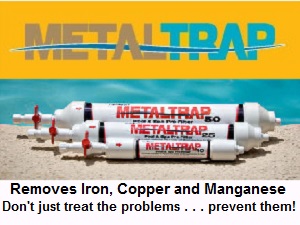
problem. A
MetalTrap Filter or
MetalTrap Dual-Cartridge Filter can help
you remove any dissolved metals and
sediments, avoiding staining and
discoloration problems. If the underwater
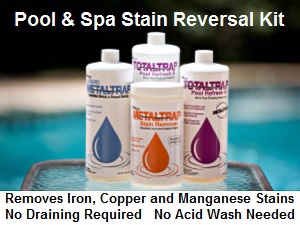
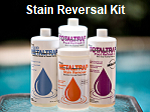
surfaces have stains, a
MetalTrap Stain
Reversal Kit contains everything to
dissolve the stains, eliminate the
stain-causing metals from the water and
help prevent a recurrence.
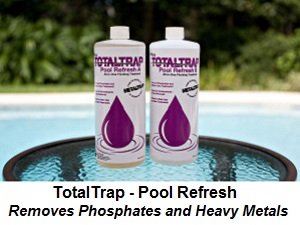
TotalTrap - Pool
Refresh can be used to remove
dissolved heavy metals and phosphates,
by vacuuming to waste or filtration. |
|
Removing Heavy Metal, at the
source |
Stain Reversal Kit, for Pools
and Spas |
Removing Heavy Metals and
Phosphates |
 |
 |
 |
|
Product
and Ordering Information |
Product
and Ordering Information |
Product and Ordering Information |
If you have a pool or spa water
testing need, we should have the
product.
►
Scroll down to read through some
Question & Answer information.
◄
|
|
A
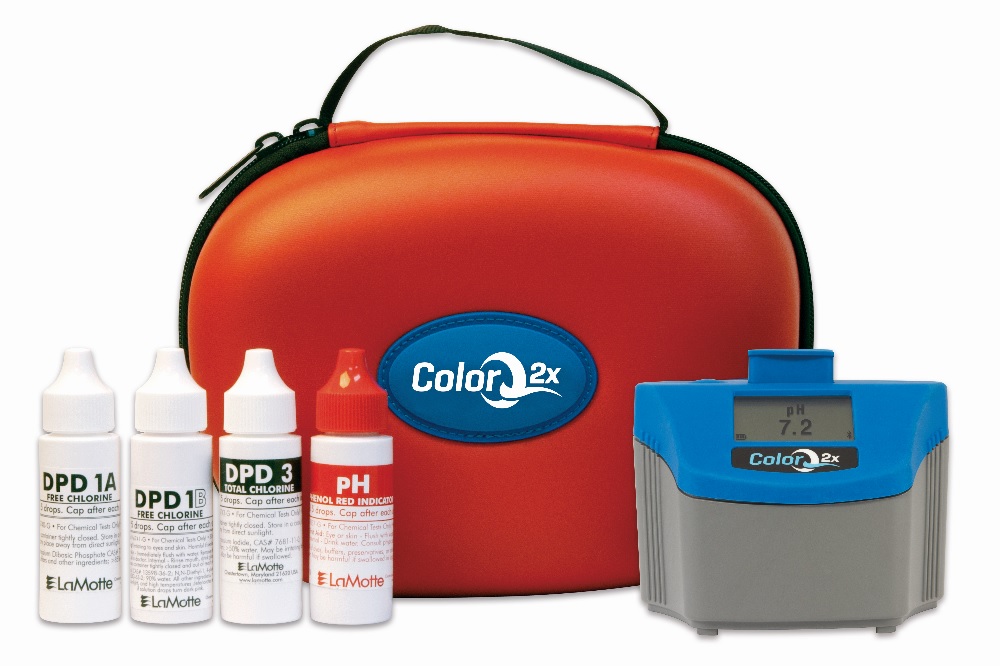
ColorQ 2X is a 2nd generation,
Bluetooth, Waterproof, all-digital tester,
that can
measure all the common test factors. There is a model, for every sanitizing
need.
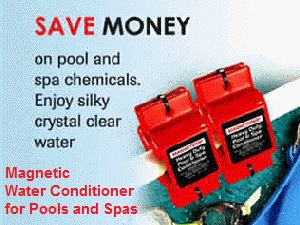
Magnetic Water Conditioners
help solve scaling problems, due
to high levels of calcium
hardness and are available in 4
models.
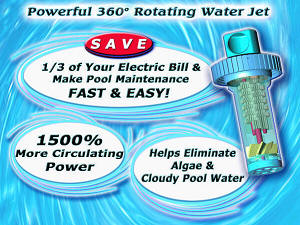
The Circulator is a
replacement return jet fitting,
that dramatically improves
circulation, by creating a
spiraling return flow, that
eliminates dead zones. Better
circulation helps sanitizers
work more effectively. |
|
ColorQ All-Digital Water Testers |
Magnetic Water Conditioners |
Circulation Boosting Return Jet
Fittings |
 |
 |
 |
|
Product and Ordering Information |
Product and Ordering Information |
Product and Ordering Information |
|
If you have a pool or spa water
testing need, we should have the
product.
►
Scroll down to read through some
Question & Answer information.
◄
|
|
How to use
some of the less common pool chemicals? |
As the swimming
pool industry has matured, specialty chemical
products have evolved. There are specific
products - for specific problems! Various
products to make pool maintenance easier or more
effective and choosing the right product for the
task can help assure a better prospect of
success, save time and money. Borates have
come into widespread pool use, as a means of
helping to control algae growth. It is not
a stand-alone cure for algae, but it does reduce
the carbon dioxide content, which, in turn,
helps retard algae growth. Borates do not
replace conventional pool sanitizers, but can
help reduce their overall usage. If problems
arise, refer to the
Pool Problems
Page, as a source of problem-solving
information, broken down into various
categories. Scroll down the page and click on the linked
keywords,
catch phrases
or images, in the archived answers below, to access additional information, on that topic or product.
Do you know what's in
your water? If you're having problems, with
sanitation or water clarity, testing allows you to better
understand the chemistry and determine the cause of the
problem. Once understood, you can select the best
treatment option. Understanding the nature of the
problem, should be step one. For information about
our full selection of testing options, visit our
Test Equipment Store.
 |
Join our E-Letter Mailing List.
You'll receive 1-3 E-Letters a
month, featuring helpful pool
and spa advice, new product
information and sale
announcements. All we
require is your e-mail address
and you can opt out anytime you
wish.
Your information
will never be shared or sold. |
|
▼
Helpful,
Problem-Solving Information, in a question and
answer format.
▼ |
►
Chelated Copper or Sodium Borate
Advantages or Disadvantages?
Alan, my
husband spent a good bit of money yesterday to convert
our pool from a chelated Copper (copper citrate) system
to a Borax system. I need to know the advantages and
disadvantages of each system. Also, which do you
recommend?? Thank you,
Paula J.,
Brandon, MS, 4/6/2018
Neither product is a stand alone
system, for maintaining swimming
pool and are usually used to
compliment another sanitizer or
oxidizer. Regardless of how
they might assist, in the sanitizing
role, they provide no oxidizing
benefit and must be used with an
oxidizer such as, chlorine, bromine,
hydrogen peroxide, potassium monopersulfate
or ozone. They can be used
with a single oxidizer or with a
combination of products. While they can
help reduce the amount of oxidizer
required, they cannot eliminate it. Chelated copper products are
generally recognized as algaecides
and can help reduce the amount of
oxidizer, chlorine for example,
required. Sodium borate, as
used in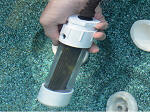 swimming pools, helps deplete the
amount of dissolved carbon dioxide
and, in the course of doing so,
denies algae an abundant and ready
source of this vital plant nutrient.
What you have are two examples of
products, that can help you use less
chlorine, which is the most popular
pool oxidizer and sanitizer.
Some individuals gloss over the need
for chlorine, as a sales ploy.
In my opinion, these products are of
greatest benefit, when used with a
traditional sanitizer/oxidizer.
Their presence will allow you use
less chlorine or bromine, to
maintain any given PPM level.
Having made this transition, you
have no other option, but to
maintain an adequate
sanitizer/oxidizer level and that
translates into using chlorine or
bromine. I am sure that your
intent was to use no chlorine, but
that is an elusive goal.
Better that you try to maintain the
pool using chlorine or bromine and
settle for being able to reduce the
amount of product required.
For this reason, I find that
salt chlorine generators are
complete sanitizers. They
perform both the sanitizing and
oxidizing function and eliminate the
negative aspects of traditionally chlorinated
pools. You will have more
control and consistency, using a
salt chlorine generator, along with
these supplemental products.
They just need some help. I
hope that this information is
helpful.
swimming pools, helps deplete the
amount of dissolved carbon dioxide
and, in the course of doing so,
denies algae an abundant and ready
source of this vital plant nutrient.
What you have are two examples of
products, that can help you use less
chlorine, which is the most popular
pool oxidizer and sanitizer.
Some individuals gloss over the need
for chlorine, as a sales ploy.
In my opinion, these products are of
greatest benefit, when used with a
traditional sanitizer/oxidizer.
Their presence will allow you use
less chlorine or bromine, to
maintain any given PPM level.
Having made this transition, you
have no other option, but to
maintain an adequate
sanitizer/oxidizer level and that
translates into using chlorine or
bromine. I am sure that your
intent was to use no chlorine, but
that is an elusive goal.
Better that you try to maintain the
pool using chlorine or bromine and
settle for being able to reduce the
amount of product required.
For this reason, I find that
salt chlorine generators are
complete sanitizers. They
perform both the sanitizing and
oxidizing function and eliminate the
negative aspects of traditionally chlorinated
pools. You will have more
control and consistency, using a
salt chlorine generator, along with
these supplemental products.
They just need some help. I
hope that this information is
helpful.
Sincerely. Alan Schuster,
4/6/2018
► Huge Black
Pool Stains?
Alan, I just decided to open my pool
for the summer. Unfortunately I do not have a lot of time to
care for it myself so it sat all winter without a cover. I
live in Ft Worth TX so temperatures stay pretty warm most of
the year. I have huge oak and maple trees in my back yard
and their leaves fell in the pool and decomposed. I had a
service empty the pool and acid washed it but they are TONS
of huge black stains at the bottom of my pool. I have a
30,000 gallon gunite and plaster pool and the plaster is
wearing off. The pool is at least 15 years old, and I have
lived here for 3 years. Is there something that can remove
these stains or should I just re-plaster the pool? I think I
am getting a fair deal on the replastering, so I am
considering it. Thanks.
Randall, Ft. Worth, TX, 6/5/2020
It does appear that you will be refinishing the pool sooner
rather than later. There's little sense investing a lot of
time and money, but it still might be a good idea to clean
up the pool. It might make for a better plastering job? Most
likely the pool discoloration and stains are the results of
tannins from all of the leaves, especially the oak leaves.
Boost the Free Chlorine level to 5-10 PPM and keep it there
for a day
 or so or until the stains disappear. Adjust the
water chemistry as necessary and keep the filter operating.
This should do the trick and you'll be in a better position
to determine when to resurface the pool. If pool stains
resist the chlorine treatment, they are most likely caused
by metals. Just adding Liquid
METALTRAP and METALTRAP Stain
Remover may remove the stains, but it might not be
permanent. If you use the MetalTrap Stain Reversal regimen,
you'll remove the pool stain and remove the metals, as well.
You start by adding the METALTRAP Stain Remover, as
directed. This helps dissolve the stain. Next Liquid
METALTRAP is added, to complex or chelate the metals, in
order to keep them in solution. Next. you recirculate the
pool water through a METALTRAP Filter and those heavy metals
will be permanently removed. In you plan on refinishing the
pool, ask the contractor to add water to the plaster, after
it has been run through the
METALTRAP Filter. If might help prevent the
pool finish from slight discolorations. By all means, when
the pool is refilled, pass all the water through the
METALTRAP Filter. Removing metals, as the pool fills, is the best
insurance against future problems. Remember, always use the
METALTRAP Filter to treat all new water. The new pool
finishes today can be quite different from the one used in
your pool. It is not just plain old plaster any more. There
are all types of finishes, with different looks and
properties to consider. Good luck and I hope that I've been
helpful.
or so or until the stains disappear. Adjust the
water chemistry as necessary and keep the filter operating.
This should do the trick and you'll be in a better position
to determine when to resurface the pool. If pool stains
resist the chlorine treatment, they are most likely caused
by metals. Just adding Liquid
METALTRAP and METALTRAP Stain
Remover may remove the stains, but it might not be
permanent. If you use the MetalTrap Stain Reversal regimen,
you'll remove the pool stain and remove the metals, as well.
You start by adding the METALTRAP Stain Remover, as
directed. This helps dissolve the stain. Next Liquid
METALTRAP is added, to complex or chelate the metals, in
order to keep them in solution. Next. you recirculate the
pool water through a METALTRAP Filter and those heavy metals
will be permanently removed. In you plan on refinishing the
pool, ask the contractor to add water to the plaster, after
it has been run through the
METALTRAP Filter. If might help prevent the
pool finish from slight discolorations. By all means, when
the pool is refilled, pass all the water through the
METALTRAP Filter. Removing metals, as the pool fills, is the best
insurance against future problems. Remember, always use the
METALTRAP Filter to treat all new water. The new pool
finishes today can be quite different from the one used in
your pool. It is not just plain old plaster any more. There
are all types of finishes, with different looks and
properties to consider. Good luck and I hope that I've been
helpful.
Sincerely. Alan Schuster, 6/5/2020
► Borate
Levels?
I am using test strips to test the
borate level in my 24k gal pool and it is difficult for me
to get an accurate color reading from the strips. I think my
borate level is somewhere in the 60-80 level. My pH is about
7.1 and my TA is about 110 which I think is within reason.
The borate seems to be on the high side and my question is
can I have a high borate level without having the pH and TA
levels also being high? Also, what problems would the high
borate level cause? Thanks for any and all help/comments.
Harry L., 7/10/2019
Borates help lower the amount of dissolved carbon dioxide,
depriving algae of a vital nutrient. The suggested level is
30-50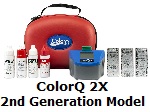 PPM. Borates do not prevent the pH and or TA from
being higher or lower than normal.
Insta-Test Borate Test
strips are available to test the borates level. Your final
pH will depend on the nature of the water and the type and
quantities of pool chemicals being added: chlorine having
the most pronounced effect. Higher borate levels can present
some toxicity issues, especially with pets that drinking
from the pool. A recommended range is used, so that a
reasonable amount of chemicals can be suggested, as being
required to help achieve the desired benefit of using less
chlorine. Your best assurance of good water quality is
proper maintenance and frequent water testing. If you want
to avoid the color-matching and guesswork, I suggest an
all-digital ColorQ
2X Water Analyzer. There's a model for every
type of pool or sanitizing method. I hope that this
information is helpful.
PPM. Borates do not prevent the pH and or TA from
being higher or lower than normal.
Insta-Test Borate Test
strips are available to test the borates level. Your final
pH will depend on the nature of the water and the type and
quantities of pool chemicals being added: chlorine having
the most pronounced effect. Higher borate levels can present
some toxicity issues, especially with pets that drinking
from the pool. A recommended range is used, so that a
reasonable amount of chemicals can be suggested, as being
required to help achieve the desired benefit of using less
chlorine. Your best assurance of good water quality is
proper maintenance and frequent water testing. If you want
to avoid the color-matching and guesswork, I suggest an
all-digital ColorQ
2X Water Analyzer. There's a model for every
type of pool or sanitizing method. I hope that this
information is helpful.
Sincerely. Alan Schuster, 7/11/2019
► Safe Borate
Level?
Someone suggested that I use borax in
my pool to help as an algaecide and said it would also
decrease the chlorine usage. Is this a safe chemical? If it
is safe how much should I put in the water? How much is
safe? Is this a commonly practiced procedure? I live in a
western suburb of the Phoenix area and my pool capacity is
12000 gallons. Thanks.
John B., Arizona, 3/12/2017

Borates will decrease the amount of carbon dioxide in the
pool water, helping to slow down any potential algae growth.
The recommended level is 30-50 PPM. Levels higher than 80
PPM could to be close to causing the onset of toxic
symptoms, in pets and people that ingest too much water. It
is used in a variety of pool chemicals, full strength or as
an additive. The commercial product contains a lot of water.
The pool grade usually contains less water. If using the
commercial product, you can add 8 pounds, to bring you to
about 30 PPM. Borates can be measured with
LaMotte
Insta-Test Borate strips, between 0 to 80 PPM. I hope that
this information is helpful.
Sincerely. Alan Schuster, 3/13/2017
► How Borates
Work?
I've had a hard time finding objective
info on a chemical used to fight algae: 100% sodium
tetraborate pentahydrate. People selling it say it works
great, but I've not been able to find any customer feedback
on the web. Does this stuff work on algae and bacteria, and
would you recommend it for a pool that recently had a
stubborn pink bacteria and black algae bloom simultaneously?
Brad H., 6/18/2008
Sodium borate is not an algaecide. Its use is based on
something known in analytical chemistry: that borate
solutions do not absorb atmospheric carbon dioxide. Someone
made the connection and got a patent, some 20+ years ago. It
has expired and others are marketin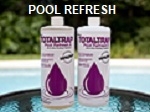 g it. It is a product
what will help you use less chlorine, by retarding algae
growth. Less available carbon dioxide deprives algae of a
vital building block of life. But, it is not an algaecide.
You still need chlorine to kill and destroy algae and
bacteria. In your case, lots of it. Lower the pH to 7.2, as
that will make the chlorine more effective. Test the
stabilizer and get it under 100 PPM. Have the water tested
for phosphates and nitrates, as these can be playing a role.
If nitrates are present, there is no
practical way to remove them.
However, you can remove phosphates,
which is another vital plant
nutrient and that is the next best
thing.
Pool Refresh Total Trap will
remove the phosphates and any
dissolved metals, such as iron and
copper. Pink Algae is actually a bacterial problem and chlorine may
not be as effective as bromine. Switching could solve the
problem, but costs will rise. Adding a 60% polymer algaecide
could help, as well. I hope that this will help solve the
problem.
g it. It is a product
what will help you use less chlorine, by retarding algae
growth. Less available carbon dioxide deprives algae of a
vital building block of life. But, it is not an algaecide.
You still need chlorine to kill and destroy algae and
bacteria. In your case, lots of it. Lower the pH to 7.2, as
that will make the chlorine more effective. Test the
stabilizer and get it under 100 PPM. Have the water tested
for phosphates and nitrates, as these can be playing a role.
If nitrates are present, there is no
practical way to remove them.
However, you can remove phosphates,
which is another vital plant
nutrient and that is the next best
thing.
Pool Refresh Total Trap will
remove the phosphates and any
dissolved metals, such as iron and
copper. Pink Algae is actually a bacterial problem and chlorine may
not be as effective as bromine. Switching could solve the
problem, but costs will rise. Adding a 60% polymer algaecide
could help, as well. I hope that this will help solve the
problem.
Sincerely. Alan Schuster, 6/19/2008
► Where To Start?
I recently purchased a home in
Woodland, CA with a inground pool. The vinyl liner was
replaced by the previous owner in 1999. My concern is
cleaning and water chemistry but I am totally overwhelmed by
the number of products on the market. Can you narrow down
the list of essentials I should keep on hand for proper
maintenance of a vinyl lined pool. Thank you.
Colleem T., Woodland, CA., 4/25/2020
The question is reasonable with a big BUT! The chemicals
that a pool will require are based upon the water chemistry
and the sanitizer being used. These are unknowns in your
case. Assuming that you are using chlorine, I would suggest
a salt Chlorine generator.
It will provide convenience and will
be less likely to cause a liner
problem. You will need chemicals to
lower the pH. You may or may not
need to adjust the total alkalinity,
chlorine stabilizer or calcium
hardness: it depends upon how the
water tests. Adding algaecide is a
good idea. Your water may or may not
contain metals that will need to be
treated. Which brings us back to the
first sentence. The best way to
determine the chemical needs is a
water analysis. Most pool
professionals offer a complimentary
analysis. That's where you should
start. You will have to perform a
free chlorine and pH test on a
frequent or daily basis. A
ColorQ 2X All-Digital Water Analyzer
will perform all the common tests,
while eliminating the color-matching
and guesswork.. Become better informed and
you'll have fewer problems. You can fill in a lot of the
blanks by browsing through the various topics of this
website. I hope that I have been helpful. Enjoy the pool.
Sincerely. Alan Schuster, 4/25/2020
► Helping The
Solar Heater?
Can you use a liquid solar product
with a solar pool heater? It is a chemical filled ball that
is placed in the skimmer, slowly releasing its contents.
Does it clog the tubes?
Yolande K., Tampa, FL, 3/13/2012
The major reason that pool water cools off is due to
evaporation. There are products that help to reduce
evaporation by forming a mono-molecular layer on top of the
pool surface. This ultra-thin film is biodegradable, so as
not to cause buildup problems. This film will help retain
the heat during the overnight period and help reduce the
overnight drop in temperature. Is it worth the expense? I
hope that this information helps to keep you in warm water.
Sincerely. Alan Schuster, 3/13/2012
► How Long To
Wait, After Adding Chemicals?
Hello. How are you doing? We just
recently purchased a 15ft x 4ft above ground pool. It has
been nice, but now we are having to add pH, soda ash and
chlorine chemicals, etc. I don't like chemicals, but I know
they need to be added to keep it safe. I did not find
anything on the pH bottle about when it is safe to swim,
after using the chemicals. I have a 4 year child and I like
to be safe about the chemicals. If you get a chance, please
let me know more about chemicals and pool safety. Thanks so
much!
K. H., 6/11/2011
How long to wait? This question really does not have one
answer! You don't want people jumping into a "cloud" of
chemicals. Follow the label directions and add each chemical
to dissolve in turn. Never directly combine different chemicals. Make sure that the filter
is operating while chemicals are
being added. Liquid chemicals can
disperse more quickly, than some
granular chemicals. Some chemicals
are more hazardous that others. In
the final analysis, it is a matter
of allowing a reasonably amount of
time for the chemicals do be diluted
by dispersion. Depending upon the
amount of chemical, type of chemical
and strength of the circulation, an
elapsed time of 30 minutes to one hour might
be reasonable. It is always best to be able to re-test the
water after some chemical additions, in order to make sure
that proper pool water chemistry is being maintained. Let
the label instructions and common sense be your guide.
A
ColorQ All-Digital Water Analyzer
will help you perform all the
common tests, while eliminating the
color-matching and guesswork. Better circulation helps to assure quicker dispersion of the
chemicals and eliminates the dead zones that promote algae
growth. The Pool Circulator is an easy-to-install circulation
booster, that will make the water come alive and provide
savings in electricity and chemicals. There is a page for
Pool Chemical Safety, available on the website. Be safe and
enjoy.
chemicals. Make sure that the filter
is operating while chemicals are
being added. Liquid chemicals can
disperse more quickly, than some
granular chemicals. Some chemicals
are more hazardous that others. In
the final analysis, it is a matter
of allowing a reasonably amount of
time for the chemicals do be diluted
by dispersion. Depending upon the
amount of chemical, type of chemical
and strength of the circulation, an
elapsed time of 30 minutes to one hour might
be reasonable. It is always best to be able to re-test the
water after some chemical additions, in order to make sure
that proper pool water chemistry is being maintained. Let
the label instructions and common sense be your guide.
A
ColorQ All-Digital Water Analyzer
will help you perform all the
common tests, while eliminating the
color-matching and guesswork. Better circulation helps to assure quicker dispersion of the
chemicals and eliminates the dead zones that promote algae
growth. The Pool Circulator is an easy-to-install circulation
booster, that will make the water come alive and provide
savings in electricity and chemicals. There is a page for
Pool Chemical Safety, available on the website. Be safe and
enjoy.
Sincerely. Alan Schuster, 6/12/2011
► Clean Up
Time?
What is the best way to neutralize the
chemicals used in pool servicing that have been spilled in
the backs of trucks? What are the neutralizing chemicals or
compounds you would use?
Matt., 10/9/2012
Trying to neutralize a possible mixture of chemicals is
probably too risky. You are better off using copious amounts
of water to dilute and flush out all of the chemicals. The
water will reduce the risk of chemical reactions. Chemical
spills should always to handled in accordance with the
instructions provided on the packaging.
Sincerely. Alan Schuster, 10/9/2012
► Enzyme Use?
Although I have never used such a
product, I am curious about enzymes. How are they used in
swimming pools? Are there advantages, limitations and
disadvantages? My pool is a vinyl inground, 16 by 32 and I
use a stabilized chlorine in an automatic chlorinator. I am
not having any particular problems.
Fayetteville, NC, 8/24/2009
Enzymes can help digest or biodegrade oily residues, bather
wastes, cosmetic residues and organic byproducts. The
removal of these undesired materials can help improve water
clarity, reduce any tendency towards foaming, improve the
appearance of the water line area and help eliminate oily
films that can interfere with sanitizing or filtration.
Those are the advantages. There are no disadvantages or
limitations that come to mind, inasmuch as enzymes are used
in all types of pools, residential and commercial. Just
follow the directions on the label. I hope that I have been
helpful.
Sincerely. Alan Schuster, 8/24/2009
► Urine
Detection?
I've been told that there is a tablet
that can detect urine in pool water. What can you tell me
about it? Thanks a lot.
Jo G., Merrick, NY, 8/2/2010
The joke's on you! I can tell you that no such product
exists. Once upon a time there was a product like that, but
it was intended as a joke! It was not intended to be
anything else! Urine in a swimming pool is no joke: it can
quickly deplete the chlorine level, especially in smaller
pools, and will lead to the formation of odorous
chloramines. If there is urine in the pool, the odorous
combined chlorine level will rise and the free chlorine
level will bottom out. Large amounts of shock will probably
be required to restore the proper chlorine levels. Toilet
training is better! I hope that I have debunked the myth and
let's have no peepee in the pool. Enjoy the pool.
Sincerely. Alan Schuster, 8/2/2010
► Lots Of
Questions?
Hi, I find your web site most
interesting. Thanks. My husband and I have a small pool
business--retail as well as service. I have a few questions
for which I have been unable to find the answers--maybe you
can help. Regarding "mustard algae"--is it possible some of
this is either dirt or dead algae circulating through the
sand filter and back to the pool? It seems as if most people
who think they have the mustard algae also have a sand
filter. This is coupled with the fact that many pool dealers
in our area think "bigger is better" when they sell a pump
and motor. I spoke with a woman today who has an effective
2.2 HP (1.5 HP with a 1.47 SF) on a 24" sand filter! Others
will say they were sold a 1.5 HP pump and motor for only a
few dollars more than a 1 HP. Hasn't anyone checked out the
flow rate charts? So much for may soap box, but I was
wondering if that could be causing ineffective filtration
rather than an actual algae problem? Also, I have had
limited experience with the sodium bromine products. I
carried a product containing sodium bromide which seemed to
work well, but another (containing ammonium sulfate) I have
tried more recently creates a major chlorine demand
requiring cases and cases of sodium hypochlorite to achieve
a residual free chlorine. I do use the sodium bromide salts
with a non-chlorine activator in our spa with good results.
I have limited knowledge of this phosphate problem, but we
have maintained clear, clean, safe pools for years without
treating for it. Maybe it's because more people are having
their lawns treated that phosphates have become a problem.
At what point should phosphates be treated, and do you know
of a good, reliable test kit we as a dealer can use? I
appreciate any light you can shed on these topics. Keep up
the good work.
Carol K., Cincinnati, OH, 8/25/2013
Dead algae can go right through some sand filters. Many
people make the mistake of backwashing too often. It should
be done when the pressure readings indicate a need. Almost
all of the people writing about cloudy water have sand
filters. An oversized pump can be part of the problem, but
usually it is poor water chemistry and maintenance
practices. There are things that you do that can help
improve the situation,
in other than a chemical sense.
Replace the sand with a zeolite sand
filter media replacement: it is far
better, than sand, at removing dead
algae and fine particles. Replacing
existing return jet eyeball
fittings, with
The
Circulator, will create a
spiraling return flow, that reaches
throughout the pool. Sodium bromide products do seem to
work well in problem situations. The other type of product,
being based on ammonium sulfate will boost the chloramine
content and will require massive shock treatments to restore
proper conditions. Regarding the phosphate levels: I believe
that you mean 500 PPB (B for billion) and not 500 PPM (M for
Million). In order to be effective, the phosphate level must
be reduced to near zero. 500 PPM is a very high level. If
the phosphate level is reduced, there is less tendency for
algae growth, but keeping it low is another matter. If a
pool has a recurring algae problem, the use of
POOL REFRESH
phosphate eliminator can make sense. Nitrates is another
possible cause of recurring algae problems. For the majority
of pools, clear water that is algae-free can be achieved
with modest phosphates present, provided that the pool water
chemistry, filtration and cleanliness are properly
maintained. There are
phosphate and nitrate test kits
suitable for your needs. I hope that I have been helpful.
Sincerely. Alan Schuster, 8/26/2013
► Keeping The
Water Warm?
I heard that there is a product that
you can add to the water that will help keep the temperature
from dropping at night. It that true.
Brenda, R., Michigan, 6/25/2009
Strange, but true. The product works by forming a
mono-molecular layer on the pool surface and is used, at
night, after the filter is turned off. Does it work? In
theory, if you reduce evaporation, you will reduce heat
loss. A better and reasonably inexpensive method of warming
the pool water is the use of a
solar pool heater. There are
solar pool heating kits that are easy to install and
reasonable in cost. To get the most efficiency out of a
heater in an area, such as yours, a solar blanket can be
used, in conjunction with any type of heater, to reduce
night time heat loss. These are plastic sheets (sized to
completely cover the water) filled with air bubbles, that
are used as a cover on the pool surface. Solar blankets are
not safety covers! Put it on after the pool is finished for
the day and take it off when you are about to resume
swimming. If left on during sunny periods, it will cause the
pool temperature to rise significantly. Reels are available
to remove and store the solar blanket, until it is used
again. Safety pool covers are available that are either
manual or automatic and can help reduce heating costs or
help keep unheated pool warmer. Enjoy the summer.
Sincerely. Alan Schuster, 6/25/2009
► Vinegar and
Baking Soda?
I have been told that white vinegar
and baking soda are alternatives to pH balance. If this is
so are they as good as the commercial chemicals? Which one
is used for raising and lowering?
Jim H., Minnesota, 6/13/2016
Although people have written about vinegar before, I have no
idea how the notion got started. Vinegar is not a good means
of lowering the pH of the pool and it is certainly not cost
effective. While, I doubt that the bathers will smell like a
pickle, there is really no point in such usage. Baking soda
is used to control the total alkalinity of the pool water.
It should be used on an as needed basis, in order to adjust
the total alkalinity upwards into the 80-120 PPM range. One
and one-half pounds will raise the TA of 10,000 gallons by
approximately 10 PPM. I hope that I have been helpful.
Sincerely. Alan Schuster, 6/13/2016
► Exercise
Physical Therapy Pool?
IS THERE ANY REASON A BURN PATIENT
SHOULD NOT USE AN EXERCISE POOL THAT WE USE BROMINE IN?
Physical Therapy, 3/13/2010
I really am not qualified to answer this question. It should
be directed to a medical doctor. I am sure that the main
concern is that the water be properly sanitized, so that
infection possibilities are at a minimum. I know of no
reason why bromine would be objectionable, but it is the
medical opinion that matters most! Sorry that I couldn't be of
more help.
Sincerely. Alan Schuster, 3/13/2010
► Potassium
Permanganate?
Can you tell me some of the possible
uses of potassium permanganate in a swimming pool? Also, is
there a history of using this product in the pool/spa
industry? Thanks.
Scott M., 2/1/2007
I have never heard of its use in the swimming pool industry
and probably for good reasons. It would introduce manganese
compounds and that would bring the risk of severe staining
and discoloration problems. While it is a powerful oxidizer,
the use of chlorine or monopersulfate makes more sense in
treating a swimming pool. I hope that I have been helpful.
Sincerely. Alan Schuster, 2/2/2007
|
Visit The Website Stores . . . for
better informed shopping!!! |
|
|
Shipping is FREE* . . . within
the Continental U.S.
A $9.99
handling charge will apply
to Continental U.S. Orders,
under $75.00. Orders
outside of the Continental
U.S. may require some
additional charge, based on
quantity and destination.
Most products can be
shipped World-Wide. International
and orders outside of
Continental U.S. - see
comments on the ordering
pages. |
|
|
Major
Credit Cards and PayPal are accepted. |
|
▲
Return To Top Of Page
▲
Aqualab Systems, LLC does not
make any warranty or
representation, either expressed
or implied, regarding the
accuracy or completeness of the
information provided by this
website; nor does Aqualab
Systems., LLC. assume any
liability of any kind whatsoever
related to, or resulting from,
any use or reliance on this
information. The content of this
website should not be used, if
it is conflict with any
applicable federal, state or
local regulations or guidelines.
© Aqualab Systems, LLC. All
rights reserved