|
 |
Shipping is FREE* . . . within
the Continental U.S.
A $9.99
handling charge will apply
to Continental U.S. Orders,
under $75.00. Orders
outside of the Continental
U.S. may require some
additional charge, based on
quantity and destination.
Most products can be
shipped World-Wide. International
and orders outside of
Continental U.S. - see
comments on the ordering
pages. |
|
 |

Major
Credit Cards and PayPal are accepted. |
|
On-line
shopping since 2002 - Safe and Secure!!! |
|
Testing Pool and Spa Water Chemistry!!! |
|
Testing
water is an integral part of pool and
spa water management. Reliable and
accurate results are important, in order
to maintain proper water chemistry. The
water balancing or chemistry affects
every aspect of pool and spa management.
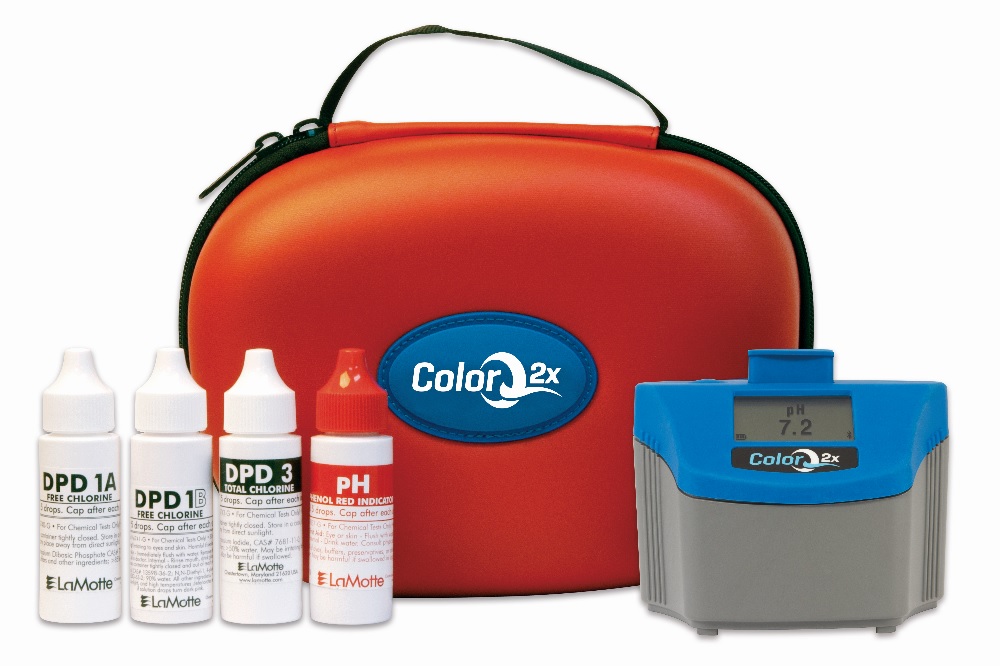
A
ColorQ,
All-Digital Water Tester
can perform all of the common pool water
tests, while eliminating the
color-matching and guesswork. There is a
model, for every pool testing need. The
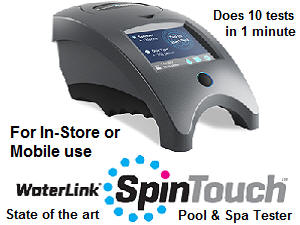
WaterLink
SpinTouch Labs are the
ultimate pool and spa testers, performing
up to 10 different water test factors,
in just 1 minute. They were voted
product of the year. An
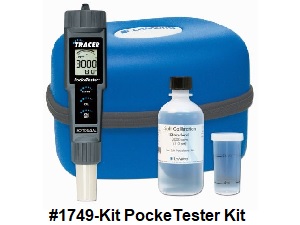
Electronic
PockeTester Kit tests for
salt and TDS, as well as other test
factors. Simply Dip and Read. |
|
|
If you have a pool or spa water
testing need, we should have the
product.
►
Scroll down to read through some
Question & Answer information.
◄
|
|
How to
properly and reliably test pool water? |
Proper pool
water management starts with the analysis of the
pool water. Tests such as pH and chlorine need
to be performed by the pool owner, on a frequent
or daily basis, depending upon the usage
conditions. The Chlorine test should be
performed by a method that tests for Free
Chlorine, as it is the most important form.
Tests such as chlorine stabilizer, total
alkalinity and calcium hardness are performed
occasionally during the season and can be
performed by a pool owner or dealer. Tests for
heavy metals such as iron, manganese or copper
should be performed at the beginning of the
season or at the first indications of pool water
discoloration or a pool surface staining
problem. These pool water tests are usually
performed by local dealers. Tests for nitrates,
phosphates or Total Dissolved Solids (TDS) are
performed by some dealers, on a occasional
basis, if a more obvious explanation is lacking.
Maintaining or balancing proper pool water
chemistry or pool water balancing is important
to help to minimize problems, assure optimum
water quality and to maximize the ownership
experience. Water testing has never been
simpler: the new
ColorQ digital, water analyzers
eliminate all color-matching and guesswork.
If problems arise, refer to the
Pool Problems
Page, as a source of problem-solving
information, broken down into various
categories. Scroll down the page and click on the linked
keywords,
catch phrases
or images, in the archived answers below, to access additional information, on that topic or product.
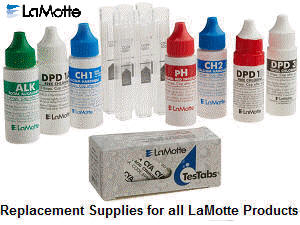
Fresh testing reagents
are important, to help assure reliable results.
Most reagents have expiration dates. We sell
replacement reagents and supplies, for every LaMotte Pool
and Spa Tester, for homeowner, professional or facility use.
If you have any model of ColorQ Tester, WaterLink SPIN LAB,
WaterLink Express Lab, Tracer PockeTester, LaMotte Specialty
Test Kit and more, we have factory-fresh replacement
reagents and supplies. Simply use this link,
LaMotte Test Kit
Replacement Reagents and Supplies, and scroll down the
page, until you see the tester, that you are looking for.
If you are looking to purchase a new tester, use this link,
Water Testing Supplies,
to find the product, that best suits your needs. If
you are unsure or undecided, please feel free to contact us.
We are a factory-authorized seller, that understands
water testing, and specializes in Pool and Spa Testers.
 |
Join our E-Letter Mailing List.
You'll receive 1-3 E-Letters a
month, featuring helpful pool
and spa advice, new product
information and sale
announcements. All we
require is your e-mail address
and you can opt out anytime you
wish.
Your information
will never be shared or sold. |
|
▼
Helpful,
Problem-Solving Information, in a question and
answer format.
▼ |
►
This Is What Very High Chlorine Levels Do To Test Results?
We just recently opened our pool and
began testing chlorine levels with our
ColorQ
test kit purchased a few years ago, from your company. I have
since noticed that the test drops DPD-1A and DPD-1B,
purchased this year, appear to be defective. When
testing the water the DPD 1-B drops turn a red color for only a
short moment (3 to 4 sec) then they go nearly clear
indicating a need to add chlorine. I know I have a more than
adequate level of chlorinator in the water from a test strip
test. I do not see any issues with the pH drops, the
total alkalinity drops and calcium drops however I have
nothing to compare them against as I already disposed of our
remaining test drops from last year. Could these drops be
bad also? Please let me know what the problem might be
and when you can rectify it.
Glenn J., Novi, MI, 5/28/2019
It would appear that the free chlorine level is so high,
that it is destroying the test chemicals. Take a sample of
pool water and mix it with 2 parts of
tap water. Test the mixture. If you get a test reading,
multiply it by 3. It won't necessarily be an accurate
answer, but could confirm the presence of a very high level.
Most testers only read chlorine, to 10 PPM. You don't
need to add more chlorine, as you probably have far too
much. The reagents are not defective. It is a
very high level of chlorine, probably over 20 PPM, that is
caused the quick fading. Let me know what happens.
Sincerely. Alan
Schuster, 5/28/2019
Thanks so much
for the quick reply! You called it. That was it. 2 parts tap
water to one part pool water and I’m at 7.51 free and 7.99
to on the LaMotte tester. Good balance, if it just was not
so high. I guess it shows about 25 PPM of chlorine,
after multiplying by 3, which means that I was too heavy
handed. I guess the HOT 95 degree sun here in Michigan will
burn it off in no time at all. Thanks again for the
response and continued great knowledge and service.
Glenn J., 5/28/2019
Using a Water
Treatment App, with Test Strips?
Which LaMotte App can be used with the Insta-Test 6 Strips?
Thank you.

Ric, 9/17/2020
There are several LaMotte
Water Testing Apps, but only one can be used with the
Insta-Test
6 Test Strips: WaterLink Solutions Home App.
If you ever want to upgrade to a
ColorQ 2X
tester, the same App can be used. I hope that this
information is helpful.
Sincerely. Alan
Schuster, 9/17/2020
►
Testing Water With A Salt Chlorine Generator In Use?
I just
equipped my inground pool with a salt chlorine generator and
want to make sure that I continue to get the right testing
information. I use a #2056 ColorQ PRO 7 photometer kit
and it makes provided reliable results and I like its ease
of use. Can I continue to use this tester or do I need
something else? The salt chlorine generator has salt
level indicator lights. Can I benefit from a separate
salt tester? I am really looking forward to using the
salt chlorine generator and now longer having to deal with
cyanuric acid buildups and water replacements. I
appreciate any information, that you can provide.
Adam M., Wake
Forest, NC, 6/4/2017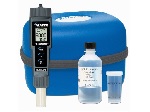
All
ColorQ Water
Analyzers are ideally suited, for use with pools
equipped with salt
chlorine generators. All of the tests, performed
on traditionally sanitized chlorine pools, should continued
to be run. As always, Free and Total Chlorine and pH
should be tested daily or at least
several times weekly,
depending on the actual circumstances. Salt levels
need to be maintained at the level, suggested by the
equipment's manufacturer. A proper salt level helps
assure proper performance and extends the life of the salt
cell. A digital salt tester is the best and easiest
way to monitor the salt level, over time. We offer a
choice several models of
digital electronic salt testers. I hope that
this information will be helpful.
Sincerely. Alan
Schuster, 6/4/2017
► Test Strip Reader
Or A Digital ColorQ?
Hi Alan. You have an excellent website
and I appreciate the willingness to answer questions. So
here goes. I am a new pool owner. I have been testing
with test strips that require me to evaluate the colors. I
have strips that measure Chlorine, Bromine, pH, Alkalinity
and Hardness. I have trusted the results. Lately with all
of the reading I have done I have become very fearful of my
pH being out of range and thus I purchased an automatic test
strip reader. This reader has strips that measure
Chlorine/Bromine as well as pH and Alkalinity. The strips
are dipped and placed face down on the reader and the reader
determines the values. The problem is that I can not get the
old method and this new reader to agree ever. I have no
idea what my pH level is because one reads 7.2 and the
standard strips measure 6.0. The strips and the strip reader
are made by the same company, so there is no compatibility
issue. I realize that I could be judging the colors
incorrectly, but I don't think that I am. Which one should I
trust? I have checked your website Test Equipment Store, for
the ColorQ testers, and I am wondering, if I should be
returning my automatic reader and purchasing one of these.
My reader cost about $70 but I don't mind spending more if
it will read more accurately. I also found that there seems
many types of ColorQ models. Which one I should be
considering. Thanks.
Dave W., 7/13/2016
Test strips are reasonably accurate, but were never intended
or expected
to be a precision test method. Some people have difficulty
picking up on subtle color differences. Using a test strip
reader sounds like a good idea and for some people and it might
be, if you have color vision impairment. However, from a chemist's point of view, it is adding
another layer of complexity and cannot add to the accuracy
of the test results. Your own experience bears this out. I
have no way of telling you which answers might be more
reliable and you should not have to guess. If you can return
the tester, I certainly would do so. The
ColorQ family of
digital water analyzers are a much better choice. There is
no color-matching or guesswork involved. You get a digital readout,
with the answers for as many different test factors, as that
model can perform: The 12 models of ColorQ testers
measure from 4 to 11 different test factors and there will
be one of more that suit your needs. The ColorQ testers are
simple-to-use and, yet, use the same technology as more sophisticated pool
water testing labs. I think it sets the standard, for the
industry, with a selection of models that will suit every
pool or spa owner. For your purposes the #2056 ColorQ PRO 7
or the #2072 ColorQ PRO 6 would be the best choice. I hope
that this is helpful.
differences. Using a test strip
reader sounds like a good idea and for some people and it might
be, if you have color vision impairment. However, from a chemist's point of view, it is adding
another layer of complexity and cannot add to the accuracy
of the test results. Your own experience bears this out. I
have no way of telling you which answers might be more
reliable and you should not have to guess. If you can return
the tester, I certainly would do so. The
ColorQ family of
digital water analyzers are a much better choice. There is
no color-matching or guesswork involved. You get a digital readout,
with the answers for as many different test factors, as that
model can perform: The 12 models of ColorQ testers
measure from 4 to 11 different test factors and there will
be one of more that suit your needs. The ColorQ testers are
simple-to-use and, yet, use the same technology as more sophisticated pool
water testing labs. I think it sets the standard, for the
industry, with a selection of models that will suit every
pool or spa owner. For your purposes the #2056 ColorQ PRO 7
or the #2072 ColorQ PRO 6 would be the best choice. I hope
that this is helpful.
Sincerely. Alan Schuster, 7/13/2016
►
ColorQ Replacement Chemicals?
I have a ColorQ PRO 7 Digital
Tester, which I purchases last year, on your website.
I really love this tester. It completely eliminates
the guesswork, in trying to match colors. I was never
good at that and with the ColorQ, I don't Have to do any
color-matching. What is the best way to order
replacements? Thank you.
Bonnie T, Concord, NC
5/13/2012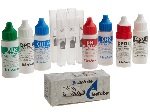
I am glad to hear that the
ColorQ PRO 7 is serving you well. All of the individual
items for the ColorQ PRO 7 and all other ColorQ models, as
well, can be found on this page:
Test Kit Replacements.
In addition, there is a money-saving refill pack, that
contains all replacement items and some free test tubes.
There is one available for the ColorQ PRO 7 and several other
models, as well. I hope this information will help
keep you testing and enjoying the season.
Sincerely. Alan
Schuster. 5/13/2012
►
Testing Errors Due To Very High Chlorine Levels?
Hi, was
wondering there is any evidence that when testing pool water
for chlorine, CYN, TA, TH etc, a high chlorine level, in the
test water, will cause these measurements to be incorrect?
Regards.
Alan K. Queensland,
Australia. 1/13/2014
With the
single exception of the cyanuric acid tests,
all of the colorimetric tests can be
adversely affected by high levels of
chlorine or bromine. While some of these
solutions, such as pH and TA may contain
chlorine neutralizing compounds, high
chlorine or bromine levels can overwhelm
them and allow some of the testing chemicals
to be degraded. Cyanuric acid is done by a
turbimetric method and should be
unaffected. All of the other tests use
organic chemicals, which can be destroyed,
by high chlorine levels. Even the chemicals
used to measure chlorine can be degraded, by
very high levels. You can lower the
chlorine level in the test sample by adding
a drop or two of a chlorine neutralizing
test solution. Not suitable for the
chlorine test, for obvious reasons. I
hope that this information will prove
helpful.
Sincerely. Alan Schuster, 1/13/2014
► Test Strip
Reliability?
What is the accuracy of swimming pool
test strips? I can't seem to get any of the manufacturers
to send me lab data on the accuracy of the strips.
Richard K., California, 4/23/2011
Good question! Test strips are not a precision laboratory
means to test pool water. They are intended to provide
satisfactory and reasonably accurate test results, with
convenience and ease of use. If the test strip reads a pH
of 7.4, that should indicate that the pH is 7.3-7.5. For
swimming pool or spa use, this is not a problem and is more
than adequate. If the Free Chlorine reads 1.0, that should
indicate a concentration close to that value. Does it matter
if the true reading is 0.9 PPM or 1.1 PPM? No! It does
matter, if the reading is 0.2 or 2.2 PPM. The testing of
swimming pool water does not require the precision and
accuracy that one would expect of a blood or urine test. Do
test strips provide reasonably accurate and useful results?
Yes! How you take the water sample or store the test strips
can affect the test results. I have a feeling that the
manufacturers were reluctant to provide the information
because they have no control over how the test is performed,
the water is sampled, the directions are followed or how the
test strips were stored. However, not all brands are the
same in terms of their formulation, manufacture or test
chemistry. My own personal experience with the
LaMotte
Insta-Test product is very favorable. I hope that I have
been helpful.
the pH is 7.3-7.5. For
swimming pool or spa use, this is not a problem and is more
than adequate. If the Free Chlorine reads 1.0, that should
indicate a concentration close to that value. Does it matter
if the true reading is 0.9 PPM or 1.1 PPM? No! It does
matter, if the reading is 0.2 or 2.2 PPM. The testing of
swimming pool water does not require the precision and
accuracy that one would expect of a blood or urine test. Do
test strips provide reasonably accurate and useful results?
Yes! How you take the water sample or store the test strips
can affect the test results. I have a feeling that the
manufacturers were reluctant to provide the information
because they have no control over how the test is performed,
the water is sampled, the directions are followed or how the
test strips were stored. However, not all brands are the
same in terms of their formulation, manufacture or test
chemistry. My own personal experience with the
LaMotte
Insta-Test product is very favorable. I hope that I have
been helpful.
Sincerely. Alan Schuster, 4/23/2011
► High
Chlorine Reading?
I just put up a vinyl pool that is 15
ft round x 3 ft high. Since I just filled it I put a packet
of Vinyl pool shock (1 lb) with the pool filter running.
After a day I did the water test and the OTO level on the
tester still shows above 3 ppm and the pH shows above 7.8. I
know I can add pH minus to reduce this, but how do I lower
the latter to 3 ppm? Thanks.
L. M., Deltona, FL, 6/9/2017
You may not have to anything about the chlorine reading.
While OTO is popular, it is far from the most meaningful
test. I suggest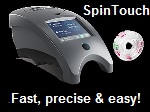 that you try using
a ColorQ
all-digital water analyzer, as they provide the right kind of
information - easily and reliably. There are 12 models and
one or more will suit your needs. Occasionally, to better assure
proper overall pool water chemistry, visit a pool store that
has a very reliable, professional lab such as a
WaterLink SpinTouch Lab, rather than a less accurate test kit or
strip reader. The
recommended level for Free Chlorine is 1-3 PPM and the Total
Chlorine level should not be more than 1 PPM higher. Using
the pool with very high chlorine levels can be irritating.
The chlorine level will drop over time as the pool shock
reacts with algae and debris. I hope that this information
will prove helpful.
that you try using
a ColorQ
all-digital water analyzer, as they provide the right kind of
information - easily and reliably. There are 12 models and
one or more will suit your needs. Occasionally, to better assure
proper overall pool water chemistry, visit a pool store that
has a very reliable, professional lab such as a
WaterLink SpinTouch Lab, rather than a less accurate test kit or
strip reader. The
recommended level for Free Chlorine is 1-3 PPM and the Total
Chlorine level should not be more than 1 PPM higher. Using
the pool with very high chlorine levels can be irritating.
The chlorine level will drop over time as the pool shock
reacts with algae and debris. I hope that this information
will prove helpful.
Sincerely. Alan Schuster, 6/9/2017
►
Professional Pool Water Testing?
I OWN A RENTAL STORE AND JUST GOT
STARTED SELLING POOLS, CHEMICALS AND SUPPLIES THIS SPRING.
IT HAS BEEN GOING GREAT EXCEPT THAT I AM USING LIQUID
REAGENTS TO TEST EVERYONE'S WATER. I DON'T HAVE THE
SOPHISTICATED SYSTEM THAT THE ONES IN THE BIG CITY OF KANSAS
CITY HAS. MY STORE IS 50 MILES FROM THE CITY AND I'M TRYING
TO GET ALL POOL CUSTOMERS, HERE IN RICHMOND AND LOCALLY, TO
COME AND LET ME TEST THEIR WATER. SO MY QUESTION IS ARE THE
ONES UP IN THE CITY USING A WATER TEST SYSTEM THAT YOU POUR
THE POOR WATER IN IT AND YOU GET A PRINTED READ OUT AND WHAT
IS IT CALLED? THANK YOU AND LOOK FORWARD TO HEARING FROM
YOU.
JULIE R., RICHMOND, MO, 4/18/2016
It could be as simple as injecting a sample of water into a
disk, that contains the testing chemicals! They are
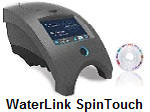
probably using a WaterLink SpinTouch Lab. It is the ultimate
pool and spa test. Simply add a single, 3-ml sample of
water to a Spin Disk, insert the disk in the tester and
press a button. In just a minute, you will have the
tests results, for up to 10 different testing parameters,
and be able to print a complete report. And did I
mention that you don't have to be a chemist? Confidence in
the testing procedure is a two-way street between the dealer
and the consumer. In addition, The LaMotte Co. has a
locator, on their website, that will direct pool and spa
owners to your location. I hope that you'll find a product
that suits the needs of your business and your customers.
Good luck.
Sincerely. Alan Schuster, 4/18/2016
Editors Note: The
latest breakthrough in water testing is the
WaterLink SpinTouch
Lab. It was designed for professional, in-store testing and
uses a completely new technology. Absolutely simple to
use, it can perform 10 different pool or spa tests and
provide a computer printout in only one minute. The era of
"just add water" has arrived. Evidently, pool and
spa owners are finding the product a game changer, if it
fits their budget. 4/26/2016
► Automatic
Water Analysis?
I have recently opened a Pool and Spa
Chemical Supply Shop near Charlotte, NC and require
information and relative costs etc to test our customer's
pool water samples as quickly and efficiently as possible. I hope you will
be able to assist. Regards.
Brad S,, Concord, NC, 1/21/2017
There are several factors for you to consider as a pool
professional dealer. Speed: during peak season, you want to
move things along as much as possible. Thoroughness and
Accuracy: you need to do all the important tests, when
required, with suitable accuracy, from even a relatively new
operator. Cost: speed and cost can go hand in hand, to a
degree. Simplicity: keeping it uncomplicated by using dosed
testing chemicals, disposable components and a minimum items
that require rinsing and cleaning for each test.
Professionalism: you need to use equipment that will instill
confidence in the consumer as well as the water tester. I
suggest that you go our Test Equipment Store There you will
find information on an extensive line of professional pool
water testing equipment, as well as costs and availability.
Automated is easily achieved - automatic is more difficult.
Your choice will be influenced by budget and needs. You
should be able to pick a water testing setup that meets your
requirements. So far as technology and speed are
concerned, the new
WaterLink SpinTouch Lab is as good as it gets.
Ten different pool water tests and a printout, in only one
minute. Good luck on the venture.
Sincerely. Alan Schuster, 1/21/2017
► Being
Better Informed?
I just had to write to say I LOVE your
website. It's keeping me sane in my world of three competing
pool dealers, with conflicting advice on pool chemistry.
Now, if only their measurements would stop conflicting, I'd
be home free.
C.P., 9/11/2011
Being better informed helps avoid falling victim to a dealer
with the wrong information or test results. Water chemistry
is where it starts! Some new testers are just available. It
is the LaMotte ColorQ Water Analyzer. There are 12 different
models to choose from: one should be just what you need! It
includes everything that is needed. All are simple to use,
hand-held, all-digital, accurate and reliable, do all of the
important tests, require no color matching or look up charts
and are reasonably priced. In the long run, being better
informed will save you money, time and should minimize
problems. I'm glad to hear that this website has been
helpful, as that is our goal.
Sincerely. Alan Schuster, 9/12/2011
► Trouble
Dealing With The Colors?
My son has always tested our pool
water, as I have trouble trying to distinguish some of the
colors. Is there a simple way to test pool water without
having to check colors? Something affordably priced would be
perfect. This fall, he will be off to college and I'll be on
my own. Thanks for the help that your website provides.
Herb K., Sarasota, FL 2/16/2008
Pool dealers have been using colorimeters to electronically
test water for years. The problem is that this type of
equipment is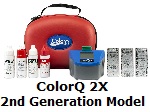 relatively expensive and is really only
intended for high volume, in-store testing of pool or spa
owner's water. A new, reasonably priced product is available
that utilizes a hand-held colorimeter. The
ColorQ PRO 7 Water Analyzer measures Free
and Total Chlorine, Bromine, pH and Alkalinity, Calcium
Hardness and Cyanuric Acid. It is done with a colorimeter
and all you have to do is read the answers on the large, LCD
display. No colors to distinguish and no more guesswork.
Perfect for pool owners, pool servicemen, especially, those
with color vision impairments.
Other models do additional tests, such as iron, copper,
biguanide and biguanide shock. The proper testing of pool water enhances the ownership
experience, by helping to assure better water quality and
sanitation. I hope that I have been helpful and that this
is a solution.
relatively expensive and is really only
intended for high volume, in-store testing of pool or spa
owner's water. A new, reasonably priced product is available
that utilizes a hand-held colorimeter. The
ColorQ PRO 7 Water Analyzer measures Free
and Total Chlorine, Bromine, pH and Alkalinity, Calcium
Hardness and Cyanuric Acid. It is done with a colorimeter
and all you have to do is read the answers on the large, LCD
display. No colors to distinguish and no more guesswork.
Perfect for pool owners, pool servicemen, especially, those
with color vision impairments.
Other models do additional tests, such as iron, copper,
biguanide and biguanide shock. The proper testing of pool water enhances the ownership
experience, by helping to assure better water quality and
sanitation. I hope that I have been helpful and that this
is a solution.
Sincerely. Alan Schuster, 2/17/2008
► TDS And
Salt Relationship?
We have a 44241 gallon salt water
pool. We own a meter that tells us our salt and total TDS
reading.. we have heard that our TDS reading may be a bit
higher since it is salt water... did not know if you could
give us an equation that would give us a TDS only reading.
We have been told that we do not want that number to be
above 1500. Some of our swimmers are complaining of rashes
and we just want to make sure everything is ok. We do not
want to have to drain the pool if it could be avoided. Thank
you.
E.M., 4/15/2010
First, you have to understand what
TDS Testing comprises.
It is the total of all the salt added to the pool, plus all
the chemicals used to balance the pool chemistry and all of
the mineral that naturally occur in your source water. The
recommended levels of salt will vary from salt chlorinator
manufacturer to manufacturer and even by model. Assuming
that the salt level is 3000 PPM and the TDS is 4500 PPM,
that means that the TDS would have been around 1500 PPM,
even if no salt was added. These values are but a fraction
of the levels in ocean water, which can be 15 timers higher
than the salt level in your pool. 1500 PPM of non-salt TDS
is high and is not ideal, as it can interfere with clarity,
water quality and sanitizer effectiveness. You need to test
the tap water. In places, like Arizona, it can be 1000 PPM
or more, right out of the faucet. In that case, water
replacement is not a realistic option. If the TDS is low,
partial replacement is an option. Your question refers to
bathers getting rashes. The cause of rashes is more likely
to be inadequate sanitation, too high a level of combined
chlorine, too high a free chlorine level and pH readings
that are too far removed from the ideal of 7.2-7.8, as
opposed to high TDS. Salt chlorine generators tend to cause
the pH to rise, unless regular additions of acid are made.
This can lead to a loss of sanitizer effectiveness and
increase the possibility of irritation. That is where I
would look. See if there is a correlation, between the pH
and chlorine levels and the complaints. I hope that this
information will be helpful.
Sincerely. Alan Schuster, 4/15/2010
► How Often
To Test Pool Water?
I try and test the pH and chlorine at
least every other day. Is that often enough? How often
should I test for total alkalinity and chlorine stabilizer.
Thank you.
Austin H., Augusta, GA, 8/12/2004
Testing the pH and chlorine every other day is quite
reasonable. In addition, I would test at the first sign of a
change in water
quality or during periods of high bather
demand. Test more often, if problems crop up or bather usage
is very high. The more important chlorine test is the Free
Chlorine Test: free chlorine is the active germicidal form.
The total alkalinity should be tested at the start of the
season, whenever there are fluctuations in the pH and
monthly during the season. The chlorine stabilizer should be
tested at the start of the season. Unless the stabilizer
level is approaching too high a value, once or twice a
season is sufficient. The balancing of the pool water
chemistry will, in the long run, solve or avoid many
problems. If you're looking for an easy-to-use tester, that
eliminates all the color-matching and guesswork, a
ColorQ
all-digital water analyzer will be an excellent choice. I hope that I have been of assistance. Enjoy the
season.
Sincerely. Alan Schuster, 8/12/2004
► Bleaching
Effect On Test Strips?
I recently had the strong chlorine
odor problem followed by a cool weather streak which lead me
to leave me pool cover and neglect my normal maintenance for
about two weeks. When I opened the cover, I found the pool
to be cloudy and green. I used algaecide and shock to
resolve this and put chlorine tabs in the dispenser. It
took three days of shocking to clear up the water. The
chlorine reading is still so low it is not registering on
the test strip. I read that if there is too much chlorine in
the water it will have a bleaching effect on the test strip,
so I took a sample of the water and diluted it to see if I
could obtain a reading. The reading was still low. Should I
shock the pool again?
Suzanne B., 9/15/2006
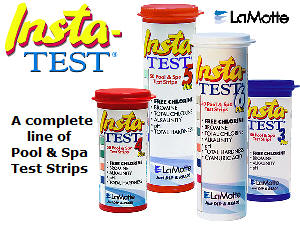
Test strips, such as the
LaMotte Insta Test
Strips are one
of the best ways to measure high levels of chlorine. The
bleaching effect, that you are mentioning, is more likely to
happen with OTO or DPD testers. I suggest that you add the
liquid chlorine or quick dissolving shock, about a
pound/gallon per 5,000 gallons, until the free chlorine
level is over 5 PPM. Don't drag it out! The longer it takes,
the more product will be required. Keep it there until the
problem is under control. You have green water because the
sanitizer level was inadequate and algae took hold. Check
the overall water chemistry as well. Make sure that you are
testing for FREE CHLORINE. I hope that I have been helpful.
If so, please tell your friends about the website.
Sincerely. Alan Schuster, 9/15/2006
► High
Chlorine Levels "Bleaching" Test Chemicals?
Sorry to bother you again Alan but
just a quick email to see if you can give me some info.
I did a pool course a while back and I was reading through
the notes and it said if pool chlorine reaches over 10ppm,
'bleach out' could occur. It did not however explain what
this meant, nor could I find it on the net. Could you help
with this. Many thanks, as always.
Gareth J., UK, 11/18/2009
When the chlorine level get too high, it can destroy the
testing chemicals and provide a false result. If you suspect
that the chlorine is over 10 PPM, try this. Mix 1 part of
pool water with 2 parts of bottled drinking water. Test
immediately! Multiply by 3, to get a reasonable
approximation of the true reading. This technique is not
valid, with the other tests. For the other tests you would
have to use distilled water. pH cannot be done, using
anything but the actual water sample, but a few drops of
chlorine neutralizer can be added, before testing. I hope
this clears up the problem.
Sincerely. Alan Schuster, 11/18/2009
► How Long Do
Test Strips Last?
I have some test strips from last
year. Are they still good?
Mel. T., Rochester Hills, MI, 5/28/2008
Maybe and maybe not! Most
test strips have an expiration
date on them. If there is no expiration date on them, don't
buy them again! In addition to paying attention to the
expiration date, you must make 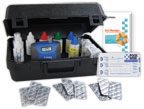 sure that the test strips
have been stored away from heat, moisture and light. Always
reseal the container immediately after removing a test strip
and NEVER REMOVE A TEST STRIP WITH WET FINGERS! Moisture is
the enemy of test strips and can destroy their reliability
and reduce their shelf life, regardless of the expiration
date. Closing the container can help minimize the moisture
problem. Most strips come with a silica gel packet inside
and this helps absorb some of the moisture. Even better are
the Test Strips packaged with a desiccant liner, as a means
of moisture removal. You know how the test strips have been
stored, so use this information as a guide. In the future,
follow the recommendations, as to handling and storage
between uses. If you want to eliminate all the color
matching and guesswork, you should consider a
ColorQ
all-digital water analyzer. Simple to use, with
photo-diagrammatic instructions. I hope that I was helpful.
Enjoy the summer
sure that the test strips
have been stored away from heat, moisture and light. Always
reseal the container immediately after removing a test strip
and NEVER REMOVE A TEST STRIP WITH WET FINGERS! Moisture is
the enemy of test strips and can destroy their reliability
and reduce their shelf life, regardless of the expiration
date. Closing the container can help minimize the moisture
problem. Most strips come with a silica gel packet inside
and this helps absorb some of the moisture. Even better are
the Test Strips packaged with a desiccant liner, as a means
of moisture removal. You know how the test strips have been
stored, so use this information as a guide. In the future,
follow the recommendations, as to handling and storage
between uses. If you want to eliminate all the color
matching and guesswork, you should consider a
ColorQ
all-digital water analyzer. Simple to use, with
photo-diagrammatic instructions. I hope that I was helpful.
Enjoy the summer
Sincerely. Alan Schuster, 5/28/2008
► Saturation
Or Langelier Index?
Saturation index for pools? Do you
have any, where you can put the pool test results and gives
you the answer? Could you let me know? That would be great.
Thanks.
Tony, 1/27/2011
There is a page on the website devoted to the calculation of
the Langelier or Saturation Index, as well as information on
the Ryznar Stability Index. I hope that the information will
prove useful.
Sincerely. Alan Schuster, 1/27/2011
► New Pool
Owners?
Hi Alan. We recently bought a house
with an inground gunite pool. We are having a problem with
what I believe is mustard algae. After reading the questions
on your website I am confused about free chlorine tests. We
bought a test kit to test chlorine levels, but I do not know
how to test for free chlorine. Please help!
No Name, 6/13/2007
I suspect that you are using a test kit with a color block
for pH and Chlorine. This would be an OTO test kit and it
does not measure for Free
Chlorine: the active germicidal form of chlorine. For pool owners that
prefer to avoiding having to differentiate slight color
differences, the new
ColorQ Water Analyzers are just what
you need. With a variety of models, there's one or more that
will best suit your needs. Easy to use, with
diagrammatic instructions. This is a step above most
testers. I hope that I have been helpful. Enjoy the pool.
Sincerely. Alan Schuster, 6/13/2007
► Time To
Take Charge?
I have a new pool that was completed
six weeks ago. The pool is a 16,000 gallon in-ground gunite
pool with an aggregate finish and a salt system in south
Florida. I had hired a pool professional to start up my pool
and maintain it, since I was told that optimizing a new pool
would be difficult. However, after five weeks I noticed that
the pool did not register any chlorine level and the pH was
always above 8.2. My pool professional indicated that my
test strips were not accurate and that the pool was fine. I
then proceeded to have a sample analyzed by my local pool
supply store and they concurred with my readings. At the
time of testing, the chlorine and free chlorine level was 0
ppm, chlorine stabilizer was 0 ppm, total alkalinity was
200, pH was 8.2, TDS was 0 and calcium hardness at 40. They
indicated that I needed to get the pH down or risk scaling.
Following their instructions, I added chlorine stabilizer,
put my chlorine generator on boost mode for 24 hours and
have added several gallons of muriatic acid (and fired my
pool professional). After 1 week, I have chorine levels
around 3 ppm, pH has been ranging between 7.4 and 8.0, total
alkalinity at 80. In order to get the pH level down, I have
been adding about a gallon of acid every other day (not sure
if adding this level of acid is recommended or not). My
problem is my pool finish. The bottom looks good; however,
the walls seem to still have a lot of “paste” that has not
wore off from daily brushing to expose the aggregate.
Additionally, when I run my hand along the walls they seem
slimy. The water has always appeared to be clear. Any
insights on what’s happening?
Mike T., Florida, 4/6/2017
Your "pool professional" was not very professional. and I
have some doubts about the pool dealer. New gunite pools
tend to have pH readings on the high side and the use of a
salt chlorine generator only adds to the problem. Once the
walls cure and the chemistry is optimized, it will level
off. Your "pro" did not add stabilizer and that is why your
reading is zero. Or is it? The pool store has your TDS at
zero and that is impossible. It should be around 3000 PPM,
in your case. A calcium hardness of 40 PPM is doubtful, as
it is higher right out of your tap. The slimy feeling on the
walls is an algal or bacterial slime and is the result of
inadequate sanitation and/or circulation. It is time to take
charge here and do some testing of your own! I suggest using
a ColorQ
all-digital water analyzer. They are easy to use and provide
the right kind of information, for all of the common pool
water test factors. There are some "questionable"
strips out there, just like there are some questionable "
professionals." You need to test for free chlorine and
maintain a level of 1-3 PPM. With slime on the walls, boost
the level to 5-10 PPM, in order to help destroy these
deposits. Your pH should be maintained at 7.2-7.8 and adding
acid is how it should be done. A low hardness can contribute
to etching, which in turn will drive the pH up. Get the
hardness to about 200 PPM. Because you have a
salt chlorine
generator, I would concentrate on the pH and not worry about
the total alkalinity, unless the hardness is over 400 PPM.
Make sure the salt level conforms to the manufacturer's
recommendations. To help improve circulation you might
consider adding The Pool Circulator: circulation boosting device
Get the chemistry right and don't rely completely on the
action of others. Be better informed. Things will improve.
store has your TDS at
zero and that is impossible. It should be around 3000 PPM,
in your case. A calcium hardness of 40 PPM is doubtful, as
it is higher right out of your tap. The slimy feeling on the
walls is an algal or bacterial slime and is the result of
inadequate sanitation and/or circulation. It is time to take
charge here and do some testing of your own! I suggest using
a ColorQ
all-digital water analyzer. They are easy to use and provide
the right kind of information, for all of the common pool
water test factors. There are some "questionable"
strips out there, just like there are some questionable "
professionals." You need to test for free chlorine and
maintain a level of 1-3 PPM. With slime on the walls, boost
the level to 5-10 PPM, in order to help destroy these
deposits. Your pH should be maintained at 7.2-7.8 and adding
acid is how it should be done. A low hardness can contribute
to etching, which in turn will drive the pH up. Get the
hardness to about 200 PPM. Because you have a
salt chlorine
generator, I would concentrate on the pH and not worry about
the total alkalinity, unless the hardness is over 400 PPM.
Make sure the salt level conforms to the manufacturer's
recommendations. To help improve circulation you might
consider adding The Pool Circulator: circulation boosting device
Get the chemistry right and don't rely completely on the
action of others. Be better informed. Things will improve.
Sincerely. Alan Schuster, 4/6/2017
► What Levels
Of Metals Are A Problem?
We are just finishing up a pool
installation and they are getting ready to do the plaster
coat. What are the acceptable levels or thresholds for
copper, iron and any other materials content in our well
water, in order to avoid staining? I want to buy the
appropriate test kits from you and would like to know what
levels of each would pose a concern for staining.
Joe G., 3/23/2010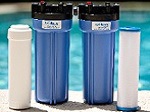
Almost any level, that you can measure, can be a problem,
with well water. Certainly, 0.1 PPM would be a problem with
iron and manganese. If you use a METALTRAP Filter, as the
water is being added, you might spare yourself some of the
problem. I always suggest use of a metal treatment, when
well water is involved. A metals, minerals and contamination
removing METALTRAP Dual-Cartridge Filter, with replaceable
or reusable cartridges, will remove metals and sediments, before they
get into the pool. I hope that this information will prove
helpful.
Sincerely. Alan Schuster, 3/23/2010
► Biguanide
Testing?
I have used a biguanide test kit with
the dropper bottles and test strips. I can't say that I like
or feel confident about having to match the colors. Is there
any other way to do the testing? Thanks for the help.
Brad M., Naples, FL, 2/6/2008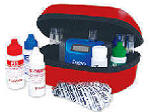
Good News! The ColorQ Biguanide PRO 5 Water Analyzer is an
all-digital, hand-held tester that performs tests for
biguanide, pH, total alkalinity, calcium hardness and
biguanide shock. There are no colors to match and no look-up
charts. It is an ideal tester for anyone with color matching
difficulties. And it is affordably priced and easy to use.
Seems to be just what you are looking for. I hope that this
information will prove helpful.
Sincerely. Alan Schuster, 2/7/2008
► OTO
Chlorine Test?
I have been using an OTO test for
years. It almost seemed to be the only test, when we first
got a pool. Today, I see more choices. Are they better than
OTO? If so, why? Appreciate your advice. Thanks.
Colton T., Austin, TX, 5/12/2009
OTO was probably the first test for chlorine and, in those
days, there was a lot less known about the chemistry of
chlorine in swimming pools. OTO measures Total Chlorine and
that is not as important as Free Chlorine. The newer DPD
Test Kits and various types of
Test Strips usually test for
both Free and Total Chlorine. This gives you a better
picture of the sanitizer level and the water quality. OTO
test kits have had their day in the Sun and their use is on
the decline. The other kits are better, plain and simple.
A ColorQ, all-digital tester would eliminate the
color-matching and guesswork and would be an even better
choice. I hope that I have been helpful.
Sincerely. Alan Schuster, 5/12/2009
► What's A
TDS Test?
My local pool dealer runs a TDS test
every now and then. Exactly, what is a TDS test? Thanks.
Josh S., Phoenix, AZ, 10/1/2010
Total Dissolved Solids (TDS) is a measurement of the total
concentration of dissolved materials in the water. It is
expressed as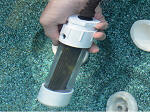 PPM of sodium chloride (salt). Soft water has a
low TDS. Hard water has a higher TDS. Salt water has a very
high TDS. High TDS in swimming pools can lead to water
quality problems. Most vinyl pools and pools, that are
winterized, never encounter a TDS problem. In certain areas
of the country, the source water is high in TDS and the pool
water may benefit from monitoring. TDS is usually measured
with a TDS meter and is relatively easy to perform. Many
test meters, such as the one pictured to the right, also
test for salt and other factors. Pools utilizing a
salt
chlorinator should use a meter that
tests for salt and not
just TDS. It is important to measure the salt content of the
water, to assure optimum performance and longer cell life.
I hope that I've explained the TDS test successfully.
PPM of sodium chloride (salt). Soft water has a
low TDS. Hard water has a higher TDS. Salt water has a very
high TDS. High TDS in swimming pools can lead to water
quality problems. Most vinyl pools and pools, that are
winterized, never encounter a TDS problem. In certain areas
of the country, the source water is high in TDS and the pool
water may benefit from monitoring. TDS is usually measured
with a TDS meter and is relatively easy to perform. Many
test meters, such as the one pictured to the right, also
test for salt and other factors. Pools utilizing a
salt
chlorinator should use a meter that
tests for salt and not
just TDS. It is important to measure the salt content of the
water, to assure optimum performance and longer cell life.
I hope that I've explained the TDS test successfully.
Sincerely. Alan Schuster, 10/1/2010
► TDS And
Salt Tests?
The subject is TDS. My pool is a
residential Fiberglass pool with a salt chlorinator system.
I have read so many opposite points of view on TDS testing
and on how to test that I am back to two basic questions. Do
I even have to test for TDS as part of my routine tests? I
have not had a TDS related problem in 3 years of pool
ownership in my salt water pool? Some say a TDS problem is
caused, 99% of the time by excessive CYA, so you treat the
excessive stabilizer problem and ignore TDS. Others state,
wait for TDS symptoms to appear and then test for TDS as
part of the problem solving process. Others state a TDS
problem in a salt water pool is so rare that there is no
need to test for TDS. If I should test, what method do I
use? Test for conductivity, test for TDS and subtract salt
content, test for TDS and subtract initial salt content?
Salt test reading is the TDS reading? Thanks for your help
(previous and future).
John G., 5/23/2008
Not all TDS readings have the same implications. Years ago,
a TDS over 1500 PPM was considered to be terrible. If you
live in parts of Arizona, that passes for tap water. Your
pool has about 3000 PPM of salt or whatever level the
manufacturer of your
salt chlorine generator recommends.
Some use more salt - others less. Assuming it is 3000 PPM
and you get a TDS reading of 4000 PPM. That means there are
1000 PPM of miscellaneous dissolved salts: some naturally
present in the tap water and others added to control the
pool water chemistry. The list includes bicarbonates,
carbonates, sulfates and cyanurates, as the major salts and
some lesser amounts of others. Unless you are having clarity
or scaling issues, I would not be concerned about testing
the TDS. If the cyanuric acid is over 100 PPM, you should
replace water. There is no way it accounts for 99% of the
difference between the TDS and salt readings. A normal pool
has hundreds of PPM of calcium hardness and total
alkalinity. Both test as TDS. If you use sodium bisulfate to
lower the pH, the water will contain large amounts of
sulfates. And this doesn't consider what occurs naturally. I
suggest that you use a meter to test for salt. Some of the
better testers do test for salt and TDS. Proper salt level
is important. Too little and not enough chlorine will be
produced. Too much could shorten the life of the salt cell.
Tracer PockeTesters are the easy way to test the salt
and TDS
levels. I hope that I have shed some light on the subject.
Sincerely. Alan Schuster, 5/23/2008
► What
Contributes To Rising TDS?
Does sodium bicarb raise TDS levels
with fresh water? I have gone from 320 TDS fresh water to
1300 TDS two months later. Thanks.
Dave, 2/16/2007
Everything that dissolves in the water can contribute to the
TDS: sodium bicarbonate, sodium carbonate, muriatic acid,
sodium bisulfate, cyanuric acid, chlorine, shock, metal
treatments, etc. It all gets measured as PPM of sodium
chloride, in spite of being a varied mixture of salts. One
pound of dissolved salts will raise the TDS by about 12 PPM,
in 10,000 gallons of water. I hope that this has helped
clear things up.
Sincerely. Alan Schuster, 2/16/2006
► When To
Replace A Test Kit?
How long can a pool test kit last?
Should it be replaced every year? Thank you.
Carolynne D., Alpharetta, GA. 6/2/2006
It really depends upon the type of test kit and how and
where it is stored between uses. Those generalized
recommendations to replace the test kits every year are
well-intentioned. Because so much depends upon the test
readings and there is no simple, foolproof means for
determining the accuracy of an older test kit, it is better
to err on the side of caution and replace the test kit on a
yearly basis. Some common sense must be applied. Test
solutions, that do not look right, should be replaced
regardless of their age! All test solutions should be
resealed after each use and stored away from moisture, heat
and light. Test strips usually have an expiration date.
However, if you remove the test strips with dripping wet
fingers, the moisture may destroy their reliability and/or
shorten their shelf life. Make sure that you remove all test
strips with dry fingers and that the container is resealed
and stored away from moisture, heat and light. Most test
strips are packaged in quantities that will last for about a
season and, usually, need to be purchased season to season.
If you would like a better type of pool water tester,
consider the ColorQ Water Analyzers. These Colorimeter based
testers are available in more than a dozen models and
require no color-matching or guesswork. I hope that I have
been helpful. Enjoy the pool season.
Sincerely. Alan Schuster, 6/2/2006
► Salt
Testing vs. TDS Testing?
Alan, excellent website! Learned more
in a few minutes on your page than in several weeks of
general web surfing. Couple questions for you. We have a
chlorine generator and love it. I use salt test strips to
keep tabs on the salt level. It doesn't change much over the
course of the (short ) swimming season. But, when I re open
the pool in the spring, I have to add back a lot of water
and, of course, salt. I have been adding the salt and using
the test strips. Today I took a water sample in for analysis
at a local pool store. My salt reading with the strips was
about 2800 PPM. The store did not use test strips, but
simply equated TDS to salt level and told me my salt level
was actually 3100 PPM. No real crisis here. But is TDS
really an accurate read on the salt level? I suspect this
really depends on what else is in the water. Comments?
Second question. With all water parameters in balance I
still seem to have to keep a close eye on pH and keep
pulling it down on a weekly basis. It tends to drift up a
lot. I have heard this is normal in a "salt water" pool. Why
would chlorine from a generator have more effect on pH than
chlorine pucks or other forms of pool chlorine? Are there pH
reducers in the chlorine products that reduce the pH rise
in "normal" chlorine pools?
Jim C., Canada, 4/28/2005
TDS measurements include the salt content plus naturally
occurring minerals, carbonates and bicarbonates, calcium
hardness minerals, chlorine stabilizer and other pool
chemicals. These can easily add up to a few hundred PPM or
more. A salt test reading is always the more meaningful
measurement, as it is what the operation of the salt
chlorinator depends on.
Salt chlorinators tend to cause the
pH to rise. The reason is that alkaline materials are
released, as the salt is converted into chlorine. By
comparison, trichlor tablets are acidic and tend to lower
the pH. I hope that I have been helpful. Enjoy the season.
Sincerely. Alan Schuster, 4/28/2005
► Choosing A
Salt Testing Meter?
Have an above ground swimming pool
with a salt water chlorinator. What salt water
test METER should I consider and why?
Keith, 10/24/2006
Salt content is important! Too little and not enough
chlorine is produced. Too much and the life of the cell can
be shortened. Your salt
chlorine generator should be used with the recommended PPM,
for that unit. There are two good
choices LaMotte No. 1749 or LaMotte No. 1766. The latter
tests for pH, as well, and costs a bit more. Either will
serve your needs. I hope that I have been helpful.
Sincerely. Alan Schuster, 10/24/2006
► Action
Based On Test Results?
Alan. First of all I would like to
commend you on your website and the information posted. The
information is thorough and direct. I was informed last year
by a pool professional friend of the family during the non
summer months all that was needed for the pool was cleaning
the filter and adding a bag of shock plus, once a week in
addition to brushing the floor and walls. However, I
recently noticed some staining in our in ground pool and
wanted to get your feedback prior to taking action. The
stains appear yellowish-brownish in a pattern formation on
the floor and steps area. The stains are very light but
noticeable. When I took sample water to the local pool
supply store for analysis, the rep told me that due to the
levels of the chemicals in the water, that the best thing to
do was to empty out the pool and start from scratch. The
water test results are as follows based on their tests:
Cyanuric Acid: 275, Chlorine: 10+, pH: 7.5, Copper: 0.08,
Alkalinity: 200, Calcium: 500, T.D.S.: 1200, Iron: 0. Your
advice is greatly appreciated. Best regards,
Sergio S., 5/23/2010
If your pool is gunite, which I suspect, draining is an
option. I never suggest draining a vinyl pool. because of
liner shrinkage and possible structural problems. The reason
that water replacement was recommended was because of the
high cyanuric acid level.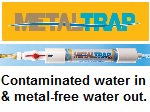 Water replacement is the only
means of lowering the level and 275 PPM is grossly high.
Very high levels can interfere with the effectiveness of
chlorine. While some of the other test values are high, I
cannot be sure of their relationship to the source water.
The stains could be the result of iron and other metals,
even though the test results are negative. If you drain the
pool, have the tap water tested for metals and add a dose or
two of phosphate-free Liquid MetalTrap, in any event. If the
tap water test is positive, you should use a
MetalTrap
Filter, to remove the metals, before they get into the pool.
The yellow-brown material could be early mustard algae and
it will benefit from a water replacement. If, by chance, the
pool is vinyl, replace the pool one-two feet at a time.
Evaluate you use of stabilized chlorine. If you are using
trichlor tablets, do not use dichlor as a shock, inasmuch as
it will speed up the rise in the cyanuric acid levels. I
hope that the information proves helpful.
Water replacement is the only
means of lowering the level and 275 PPM is grossly high.
Very high levels can interfere with the effectiveness of
chlorine. While some of the other test values are high, I
cannot be sure of their relationship to the source water.
The stains could be the result of iron and other metals,
even though the test results are negative. If you drain the
pool, have the tap water tested for metals and add a dose or
two of phosphate-free Liquid MetalTrap, in any event. If the
tap water test is positive, you should use a
MetalTrap
Filter, to remove the metals, before they get into the pool.
The yellow-brown material could be early mustard algae and
it will benefit from a water replacement. If, by chance, the
pool is vinyl, replace the pool one-two feet at a time.
Evaluate you use of stabilized chlorine. If you are using
trichlor tablets, do not use dichlor as a shock, inasmuch as
it will speed up the rise in the cyanuric acid levels. I
hope that the information proves helpful.
Sincerely. Alan Schuster, 5/24/2010
► The Color
Is Orange?
When I test my pool water for chlorine
level the color I get, after applying the solution to it, is
orange. It starts off a mild yellow but w/in 20 seconds
turns orange. I had been running my chlorine at twice the
normal dosage (5.0 vs. 2.5). Is this orange color because I
went heavy on the dosage. Any help is appreciated. Thank
you.
Robert D., 5/23/2009
The orange color indicates that the chlorine level is too
high to read, with that tester. That type of tester is
archaic and you should use one that tests for both free and
total chlorine. The label dose is only a guide - you must
add enough to maintain a proper level. For free chlorine
testing, I suggest using
LaMotte Insta-Test strips, as they
provide the right kind of information. To better assure
proper overall pool water chemistry, visit a pool store that
has a very reliable, professional lab such as a
WaterLink SpinTouch Lab,
rather than a less accurate test kit or strip reader.
LaMotte Professional Testing Center Locator I suggest that you start by having
the water tested for free and total chlorine. The total
chlorine reading should not be more than 1 PPM higher than
the free chlorine readings. If it is, add some non-chlorine
shock. I hope that this information is helpful.
Sincerely. Alan Schuster, 5/23/2009
► Low
Stabilizer Reading?
On our test strip it states that the
stabilizer is low. Our pH, CHLORINE and ALKALINITY all read
fine. Please advise what might need to be done. The water is
fresh- 1 week old. Thank you.
Jim M., 4/18/2007
Low levels of chlorine stabilizer will increase the loss of
chlorine, due to the Sun's UV rays. You need to add some
chlorine stabilizer (cyanuric acid). You did not provide the
reading or how big your pool is. In a 10,000 gallon pool,
one pound of cyanuric acid will raise the level about 12
PPM. That should help you figure out what needs to be added,
based on the test lit recommendations. If you are using
stabilized chlorine, this reading will rise over time. When
it reaches 150 PPM, you should replace some of the water.
Want to avoid future buildup problems? Have you ever
considered a salt chlorine generator. No chlorine to buy,
store or handle. No buildup of stabilizer! The
LaMotte
Insta-Test 6 does all of the important tests and would be a
better choice, that the 3-test strip that you are using. I
hope that this information is helpful.
Sincerely. Alan Schuster, 4/18/2007
► Can Type Of Lighting Affect Readings?
I find the my pool water test readings, when taken at night,
seem quite different. By then the lights are turned on. Is
this possible? Thanks.
Ronald L., 7/1/2007
Definitely could be the problem. Test strips and comparator
colors can be influenced by lighting: sodium vapor lights
are probably the most troublesome, by fluorescent or dim
lighting can be a factor. It is best to read under bright
natural light, without direct Sun exposure. One way to avoid
all of these problems is with the
LaMotte ColorQ Water
Analyzers. There are several models and one would be right
for your pool. I hope that this will help provide more
consistency in the testing.
Sincerely. Alan Schuster, 7/2/2007
► Manganese
Test Kit?
Hi, Alan, I have a pool service
business on the east end of Long Island. There is a
manganese problem in some areas of the south shore. Is there
a simple test kit that I could use, in the field, to test
for manganese. It just might help solve a lot of problems
for me. Thanks.
Tommy C. Quogue, NY, 3/19/2011

There are compact and portable field
manganese test kits
that are suitable for your needs. Your customers will
appreciate all the aggravation that you're are helping them
avoid. If you know manganese is present before the pool is
filled, you can use METALTRAP Filter to remove much of the
manganese and iron. It should remove it all and can make a
huge difference. Thereafter, it should be used to treat all
new water, as it is being added. It simply attaches to the
garden hose, being used to add the water. I hope that I have
been helpful. One more word of advise. Add 1 dose of a
quality mineral treatment product, such as
Liquid METALTRAP, for each 0.5 PPM of
manganese found. This should provide an excess to help deal
with other minerals that might, also, be present. Have a
good season.
Sincerely. Alan Schuster, 3/19/2011
► Using A
Chlorine Neutralizer?
I have 2 different pH test kits. One
recommends neutralizing chlorine prior to measuring pH while
the other does not. Obviously this results in very different
pH readings. Which method should be used in order to guide
pH manipulation. Thanks.
Tony, 11/22/2005
It would have been helpful to know whether you have a pool
or spa. Most phenol red solutions, but not necessarily all,
have a chlorine neutralizer formulated into the product.
This is important in order to help protect the phenol red
from being "bleached out" by high levels of chlorine or
bromine. Spas are more likely to be using bromine than are
pools and the lack of a chlorine neutralizer can result in
false high pH readings. You should be able to get comparable
readings, with either kit, by following the directions. If
there is an unreasonable difference, have the water tested
by a pool or spa professional, in order to better determine
the more accurate test kit. I hope that I have been helpful.
Sincerely. Alan Schuster, 11/22/2005
► A ColorQ
Digital Analyzer or a Test Strip Reader?
I am not good at matching colors and I
like the idea of the digital ColorQ water Analyzer. I saw a
test strip reader and that seems quite easy to use. How
would you compare them? Thanks in advance, for your valued
opinion.
Jerry G., Dallas, TX, 6/23/2008
Photometers, such as the
ColorQ Digital Water Analyzers are
capable of better reproducibility and accuracy than any test
strip. A quality test strip, such as the LaMotte Insta-Test
products, are able to provide test results that are
reasonably and suitably accurate. The problem comes about in
trying to match the colors to the color swatches. Using a
strip reader does not impart greater accuracy and actually
adds a few more variables. How long did you wait, before
inserting the strip in the reader? How wet was the strip?
Did water run, from one test pad to the another? What was
the temperature? All of these variables, and more, affect
the test results. An instrument, such as the ColorQ, is
based on the same technology used in laboratory instruments
and has a long history of successful use. Test strip readers
may be convenient and fast, but are not capable of matching
the performance of a quality photometer based tester. The
feedback about the ColorQ line of testers has been highly
favorable. The same cannot be said about dealer and consumer
experience with test strip readers. I hope that this
information will help you make the right choice.
Sincerely. Alan Schuster, 6/24/2008
►
Questionable CYA Test Results?
First of all, thank you for your
recent advice. Like many others that have come to rely on
you, I feel I have finally found someone who can give me a
credible answer to my questions/problems. On 4 Feb I used a
Stain remover to remove light brown stains in a portion of
my fiberglass pool. I followed the process and it worked as
advertised. However, I am concerned about some dramatic
changes in the chemical balance of my Pool. On 31 Jan, in
preparation of my stain removal process, I had my water
tested by a local Pool Company. This test showed a CYA level
@ 83 (OK for my area of the Country) and a TA reading of
114. On 11 Feb, 3 days after completion of the stain removal
process, I had my water tested at the same Pool Company.
This test showed my CYA level @ 35 and my TA level @ 152. My
question: Is it normal for a stain removal process to cause
such a dramatic change in CYA and TA?
John G., 2/12/2008
Unless you replaced more than 1/2 of the water, the cyanuric
acid results are questionable. There is no way that it
should drop from 83 to 35 PPM, without water replacement.
One of the numbers is wrong and I suspect the latter. If
that test result is wrong, the TA could be wrong, as well.
Some dealers use test strips, for testing, which are capable
of providing a suitably accurate, but not precise test
results. Using a computer to read the test strip, does not
necessarily provide greater accuracy. This could be a case
or dealer error or a bad water sample. I would encourage you
to become more self-sufficient, as it will save you money
and possibly help you avoid problems. The LaMotte
ColorQ PRO
7 Water Analyzer performs 7 important pool steps, while
eliminating color-matching, look up charts and guesswork.
And it is affordably priced! I am not sure what was done, in
the way of stain treatment, but the pH have increased and.
that would account for the higher TA, as it moves in the
same direction as the pH. To get a truer TA reading, subject
30% of the CYA reading, from the TA test result. pH and TA
are interrelated. Adjust the pH to 7.2-7.6, as needed. If
the TA is under 80-120 PPM, add some TA Increaser (baking
soda). If the TA is 80-120 PPM, you're perfect. If the TA is
higher, you may not have to do anything. There is no
compelling reason to have to lower the TA, if the pH is in
range and there is no sign of scaling or cloudy water. If
the calcium hardness is over 400 PPM, you might keep the pH
closer to 7.2-7.4. There's little point in trying to get
both parameters in range, when circumstances and nature are
conspiring against you. I hope that this information is
helpful.
Sincerely. Alan Schuster, 2/12/2008
► Sampling -
Testing Timeline?
My technicians are often ask by the
customer to bring a water sample to our retail store and
have it tested. The h/o will than call in for the results.
How long can a water sample taken from a pool sit before
having it tested?
Cheri D., 4/3/2007
Chlorine would be the most sensitive of the parameters. It
will always be dropping and could be affected in a short
time, depending on the quality of the water and the
cleanliness of the container. Keeping the sample in a hot
vehicle or in sunlight will only cause degradation to occur
more quickly. Anything more than a few hours could be
questionable. The other parameters are not as affected and
little difference should be seen, in a tightly sealed
container. Still, I suggest testing with a reasonably short
time frame: 3-4 hours. I hope this information helps you set
a reasonable guideline.
Sincerely. Alan Schuster, 4/2/2007
|
Visit The Website Stores . . . for
better informed shopping!!! |
|
|
Shipping is FREE* . . . within
the Continental U.S.
A $9.99
handling charge will apply
to Continental U.S. Orders,
under $75.00. Orders
outside of the Continental
U.S. may require some
additional charge, based on
quantity and destination.
Most products can be
shipped World-Wide. International
and orders outside of
Continental U.S. - see
comments on the ordering
pages. |
|
|
Major
Credit Cards and PayPal are accepted. |
|
▲
Return To Top Of Page
▲
Aqualab Systems, LLC does not
make any warranty or
representation, either expressed
or implied, regarding the
accuracy or completeness of the
information provided by this
website; nor does Aqualab
Systems., LLC. assume any
liability of any kind whatsoever
related to, or resulting from,
any use or reliance on this
information. The content of this
website should not be used, if
it is conflict with any
applicable federal, state or
local regulations or guidelines.
© Aqualab Systems, LLC. All
rights reserved